E-Paper



Number Theory: Congress right to be shocked, but can it still fight back?
The fact that Congress’s vote share was by and large intact between 2018 and 2023 means that at least at the macro level, its voters did not desert it for BJP.

 Prefer HTon Google


The Congress’s losses in the heartland states of Rajasthan, Madhya Pradesh and Chhattisgarh have not only overshadowed the party’s victory in Telangana but also been a huge sentiment and morale buster for the party before the 2024 Lok Sabha elections. In fact, such is the shock of the defeat that the party’s leadership in Madhya Pradesh has taken to peddling bogus conspiracy theories about Electronic Voting Machines (EVMs). An HT analysis of the results in these three states shows that the Congress has good reason to be surprised about its losses in the recently held elections. However, the question which the party needs to ask is whether it can devise a strategy to overcome the reason for its losses by reading the result -- or continue to shoot itself in the foot by living in denial. Here are four charts which explain this in detail.
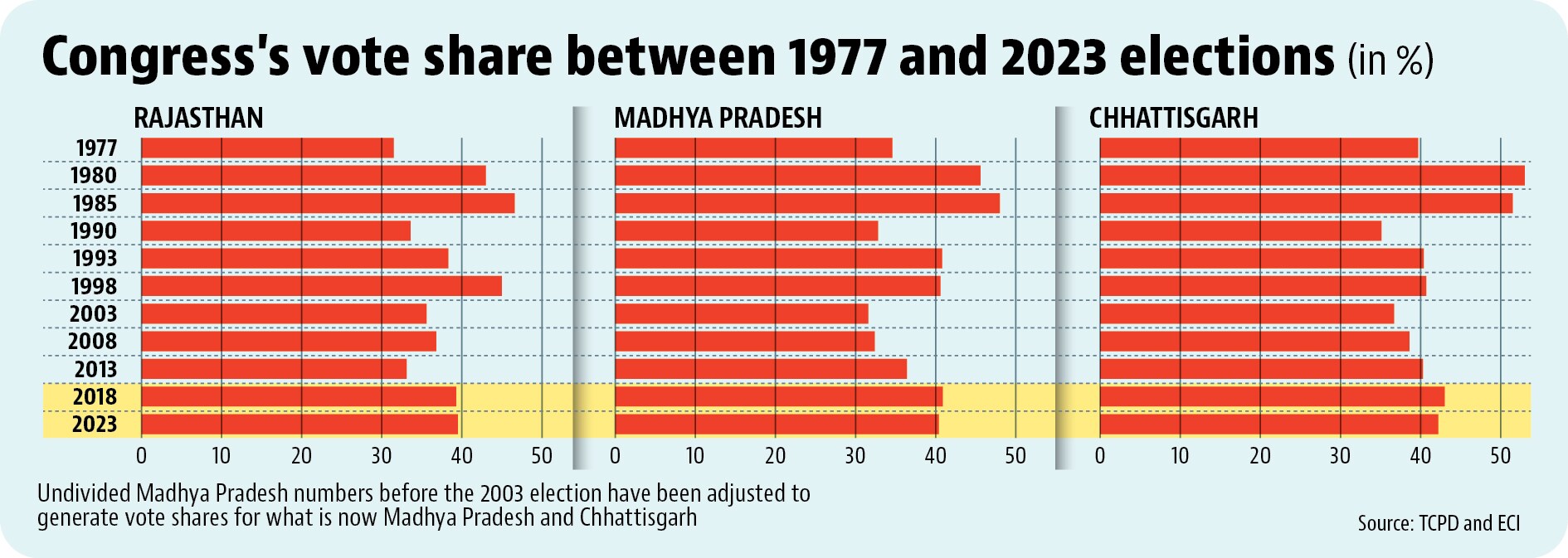
 Congress’s vote share was virtually unchanged between 2018 and 2023Vote share is the best measure of a popular support for a party in any elections. On this count, the Congress did not do badly in these elections, as far as its own experience is concerned. Data shows that its vote share was virtually unchanged in Rajasthan, Madhya Pradesh and Chhattisgarh. In Rajasthan, it actually increased by 0.3 percentage points and in Madhya Pradesh and Chhattisgarh the fall was just 0.5 and 0.8 percentage points. In all three states, these vote shares are not too far off the mark from the Congress’s best performance in a long time. To put the numbers in simple language, the party leadership could have been thinking that its support levels this time are similar to what it had in the 2018 elections, and reasoned that it therefore had a good chance of winning the polls, just like it did the last time.
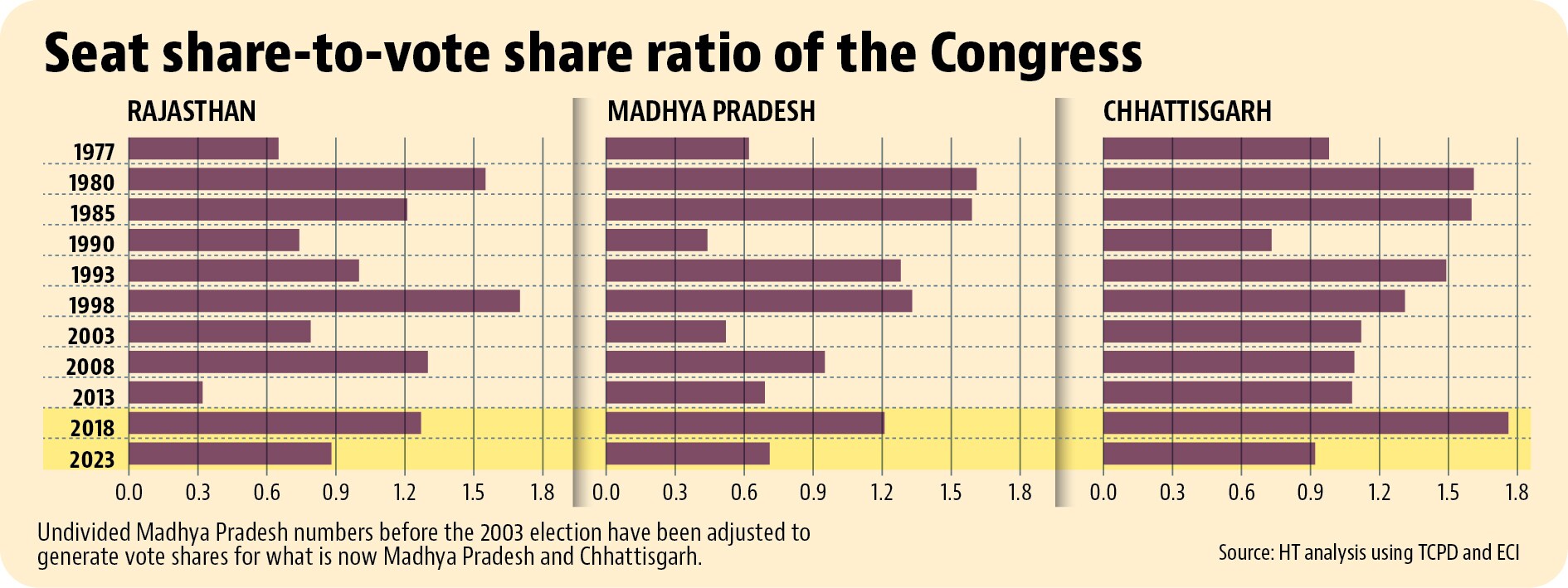
- Sharp fall in the party’s ability to convert votes into seatsThis is exactly where a first-past-the-post (FPTP) system is very difficult to predict. Whether or not a candidate actually wins an election depends on not just their own vote share but also that of the opponent. This means that hallmark of a good election strategy in an FPTP system is not just looking to increase or maintain popular support (vote share) but also ensuring that this actually converts to seats. This is where the 2023 elections in Rajasthan, Madhya Pradesh and Chhattisgarh are very different for the Congress than the ones in 2018. One of the simplest ways to measure a party’s ability to convert popular support into seats in an FPTP system is to look at the seat share to vote share ratio. The seat share to vote share ratio of the Congress fell sharply between the 2018 and the 2023 elections which completely nullified its hard work of keeping its popular support intact. What explains this sharp fall?
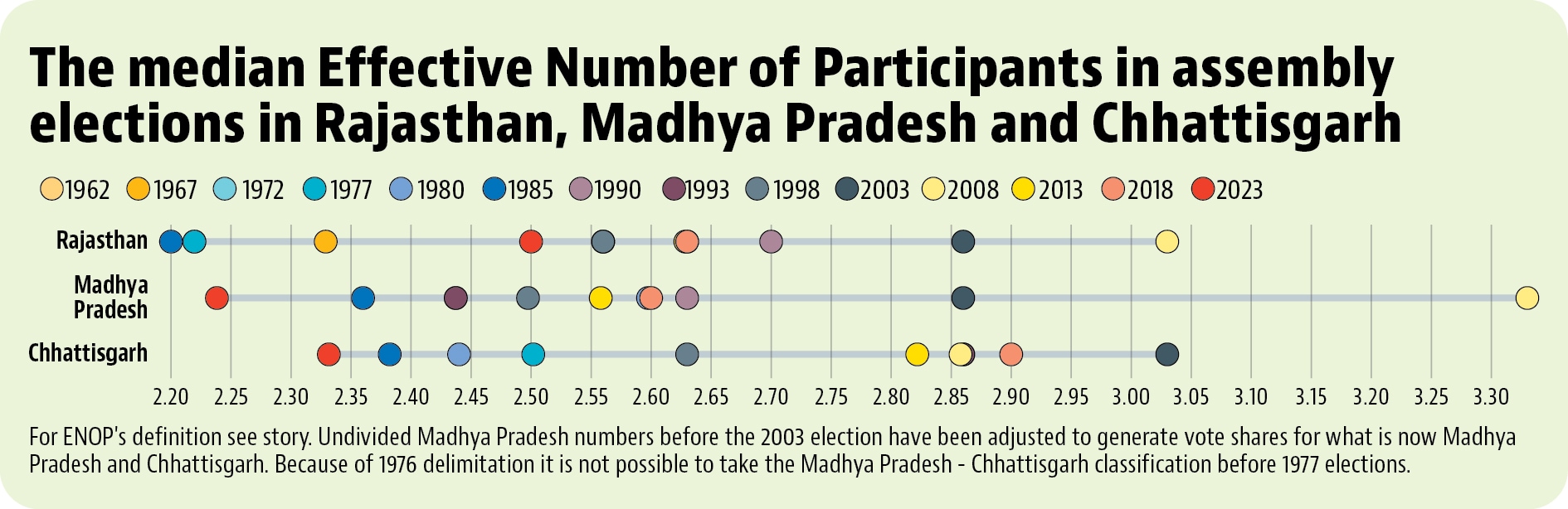
- The heartland polls were among the most polarised in the history of the 3 statesUnless a party has a vote share of 50% of more, it is always vulnerable to consolidation of opposition votes in an FPTP system. One of the best ways to measure the degree of polarisation in an election is to look at the median value of constituency level Effective Number of Participants (ENOP, which is the reciprocal of sum of squares of vote share of every candidate in a constituency. An example can make this clear. If a constituency has only three candidates and their vote shares change from 25%, 35% and 40% to 10%, 35% and 55%, the ENOP value will fall from 2.9 to 2.3. An HT analysis of the election results shows that the median ENOP in the 2023 Rajasthan elections is the lowest since 1985. For Madhya Pradesh and Chhattisgarh, this number is the lowest since 1977, which is the earliest period for which a backdated Madhya Pradesh-Chhattisgarh divisions of constituencies can be done.
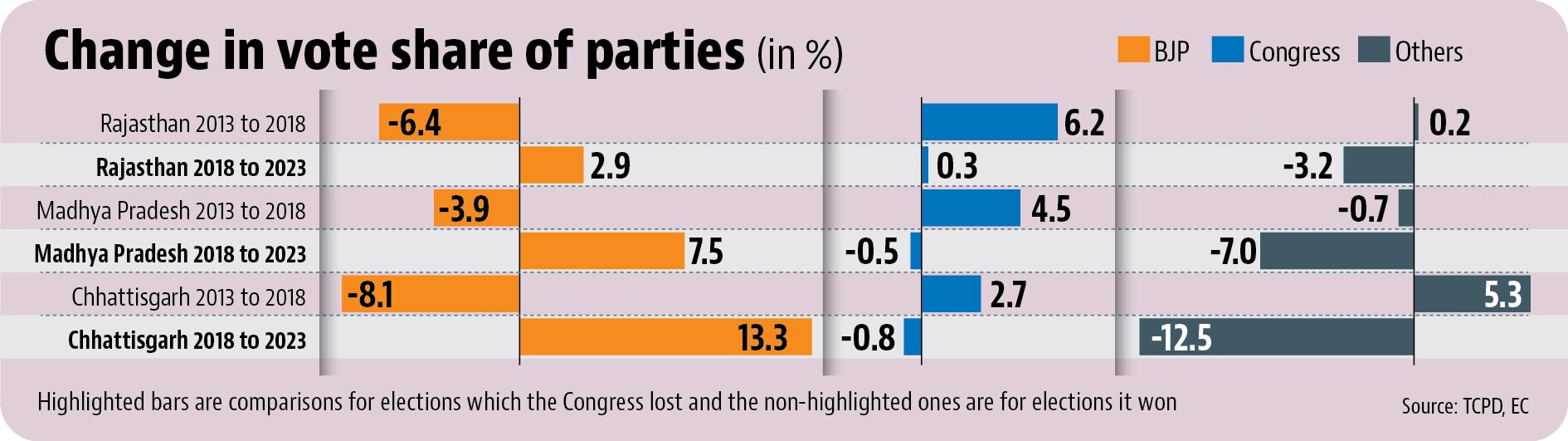
- The BJP aced the game of consolidating the anti-Congress votesThe fact that the Congress’s vote share was by and large intact between 2018 and 2023 means that, at least at the macro level, its voters did not desert it for the BJP in these elections. To be sure, this generalisation need not hold at the constituency level. Where the BJP seems to have excelled in this election cycle is in consolidating the voters who did not vote for either the BJP or the Congress in the 2018 elections. In other words, just guarding its own house was not good enough for the Congress to win, and it should have been more proactive in expanding its support base among voters who were not aligned to the BJP. This comparison looks even more interesting when compared with the change in vote share of the Congress, BJP and other parties between the 2013 and 2018 elections, when the Congress won all three states. The Congress’s 2018 victories came on the basis of a larger attrition of BJP voters than non-Congress non-BJP supporters. This raises an extremely important question for the Congress party. Is it missing the nuances of local politics in its zeal to create a polarisation against the BJP? This might have left it with a significant support base but one inadequate to win elections.