Number Theory: Understanding the rise of unpaid workers in India
This is the 3rd part of a four-part data journalism series on key trends in Periodic Labour Force Survey. The 4th will show changes in India’s rural job market.
India’s headline unemployment rate has decreased continuously in the Periodic Labour Force Survey (PLFS) that started in 2017-18. This was possible because more jobs than job-seekers were added to India’s labour market between 2017-18 and 2022-23. However, not all of these jobs were good. Unpaid family workers have contributed to 37% of the growth in India’s workforce since 2017-18. The share of such of unpaid workers in the workforce is now not very different from regular wage or salaried workers.
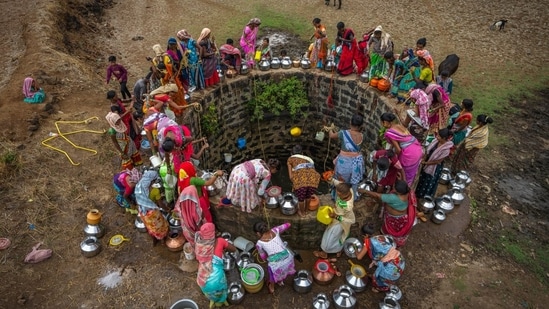
As expected, 82% of the growth in unpaid work since 2017-18 is from women (AP FILE)
Understanding the rise of unpaid workers in India
Unpaid workers are largely rural, but their proportion has increased even in urban areas
91.2% of unpaid family workers in 2022-23 were from rural areas. In comparison, just 75.7% of workers overall were from rural areas. This is in line with the fact that most unpaid workers are employed in agriculture (84% in 2022-23). Most of the growth in such unpaid work has, therefore, also come from rural areas. The number of such workers has increased from an estimated 62 million in 2017-18 to 104 million in 2022-23; 40 million of this growth of 42 million has come from rural areas. However, their share in the urban work force has also increased during this period: from 5.7% in 2017-18 to 6.6% in 2022-23.
81% of unpaid workers come from just 11 states
As expected, most of these states are rural and agricultural. These 11 states (in decreasing order of their contribution to India’s unpaid workforce in 2022-23) are Uttar Pradesh, Madhya Pradesh, Rajasthan, Maharashtra, Gujarat, Chhattisgarh, Bihar, West Bengal, Odisha, Karnataka, and Jharkhand. Part of the reason why these states are big contributors to India’s unpaid workforce is that they just have a large population and, therefore, a large workforce. However, that is not the sole reason. The combined share of India’s workers living in these states was 70% in 2022-23, 11 percentage points less than the share of unpaid workers in them. To be sure, individually, the share of unpaid workers in some of these 11 states has decreased compared to 2017-18. The states where this happened are Karnataka, Maharashtra, Madhya Pradesh, Chhattisgarh, and Rajasthan.
82% of the growth in unpaid work since 2017-18 is from women
This is somewhat expected. As HT has reported earlier, India’s labour force has grown since 2017-18 largely because rural women’s labour force participation has increased. Similarly, unpaid work in agriculture has contributed significantly (32%) to the growth in workers since 2017-18. The combination of these two trends is that women account for most of the growth in unpaid work; 34 million of the 42-million growth in unpaid workers has come from women. This also means that the growth in women workers is largely through the unpaid route -- 46% of the growth in women workers since 2017-18 is because of unpaid work compared to 20% for men.
Even graduates have added to the unpaid workforce since 2017-18
One would not expect a person with higher education to settle for an unpaid job in a family enterprise in India, but this is still true of the Indian workforce. The education level of 92% of the unpaid workers ranges from illiterate to higher secondary level. However, 7.2% of such unpaid workers were graduates in 2022-23, a proportion somewhat higher than the corresponding 6.5% figure in 2017-18. Those with a graduate or higher degree contributed 3 million or 8.3% to the overall growth of unpaid workers from 2017-18 to 2022-23.
The share of older people has also increased in unpaid work
As is expected from the numbers above, it is the relatively young who are doing unpaid work. Those younger than 25 years account for 26% of unpaid workers and those in the 25-40 years age bracket for 38% of unpaid workers. While the proportion of under-25 in unpaid work is the same as in 2017-18, that of the 25-40 age group has decreased. The 25-40 age group had a 43% share in unpaid work in 2017-18. Thisis made up by people aged 40 years or older, whose share in unpaid work is now 36%, compared to 30% in 2017-18.
Abhishek Jha is Assistant Editor-Data at Hindustan Times. He uses statistical programming to generate newsworthy insights from large datasets. He is part of the team that produces Number Theory, a daily data story feature of the paper’s print edition. Since March 2024, he has been writing Weather Bee, a weekly column for the Hindustan Times website. He is a chemical engineer by training, who specialises in stories related to weather, climate, and the environment. Jha has been at HT since 2018, where he offers data-driven perspective and analysis on politics, environment, weather, climate, economy and society. His work includes data coverage of elections in India and abroad, including the 2019 and 2024 Lok Sabha elections; the disasters and extreme weather resulting from changing climate, such as floods, droughts, heat waves, cold waves, and dwindling snow cap in the Himalayas; the factors that drive poor air quality in northern India; the changing patterns of land use; the Covid-19 pandemic and its impact on labour market conditions; the changing pattern of consumer spending seen in the new consumer spending surveys; and social norms seen in the surveys such as the National Family Health Survey.
Get Latest News, breaking headlines, and top India News, and today real-time updates from across the nation. Stay informed on politics, government policies, crime, Today Weather, and major developments on Hindustan Times
Get Latest News, breaking headlines, and top India News, and today real-time updates from across the nation. Stay informed on politics, government policies, crime, Today Weather, and major developments on Hindustan Times
Home/India News/Number Theory: Understanding the rise of unpaid workers in India
{{^htLoading}}
Advertisement
{{/htLoading}}
SHARE THIS ARTICLE ON
{{#usCountry}}{{/usCountry}}
Notifications
Get breaking alerts directly from the newsroom
Notifications are on!You'll be notified when news breaks