E-Paper



Number Theory: What explains India’s growing fiscal federalism fights-I
This is the first of a two-part data journalism series on fiscal federalism fights. The second part will look at the larger context of Centre-state transfers.

 Prefer HTon Google


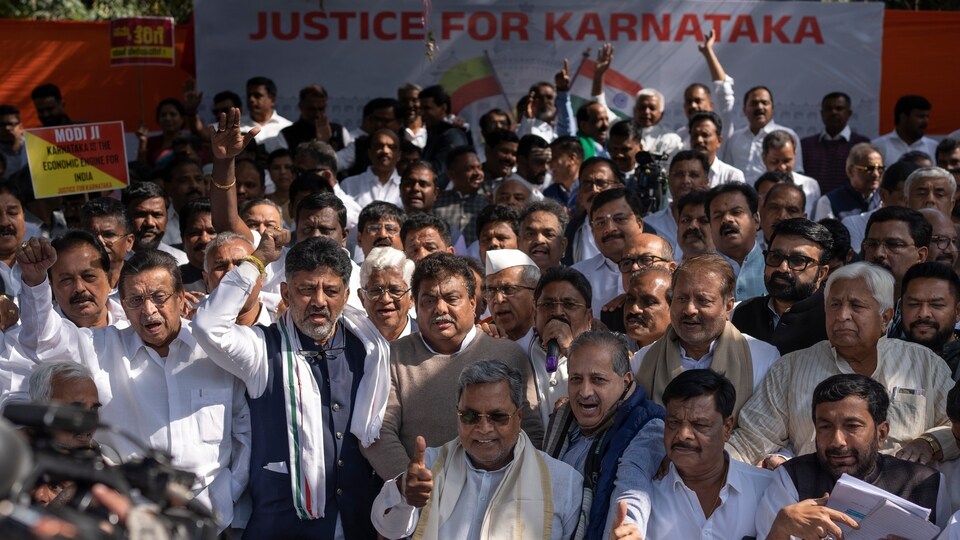
The Karnataka government on February 7 held a protest in Delhi, branded “My Tax My Right”, to “protest against the financial atrocities committed by the Central government on Kannadigas and Karnataka”. The Kerala and Tamil Nadu governments are holding a protest on similar lines on February 8.
Is India’s fiscal federalism framework really in a crisis? Is the Centre garnering more fiscal resources instead of sharing it with the states? Are southern states being short-changed when it comes to resource transfers from the Centre? Are these fights likely to worsen going forward?
There are no easy answers to these questions. But a holistic look at the data can help put things in perspective. The first part of this data journalism series will look at the North-South debate, and the second part will look at India’s fiscal federalism tensions against a larger backdrop.
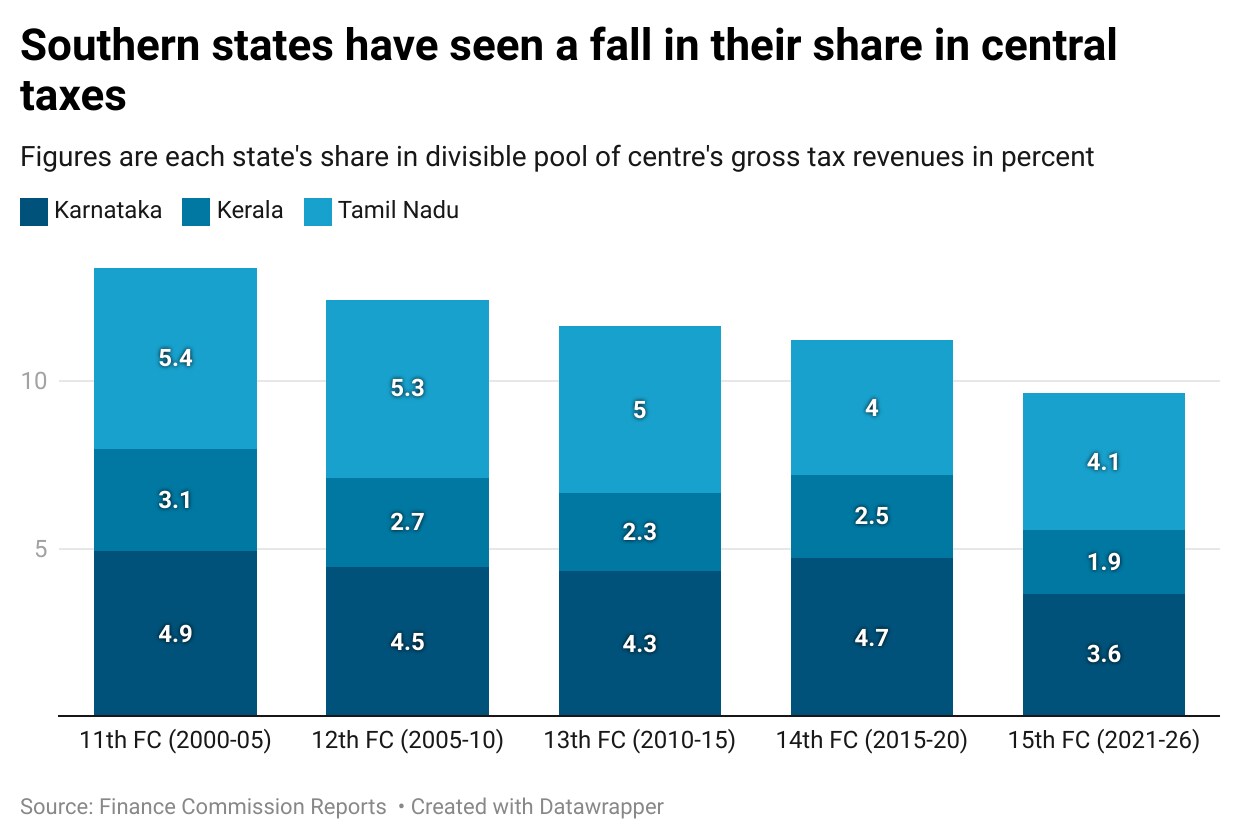
 Karnataka, Kerala and Tamil Nadu have seen a sharp fall in their share in central tax devolutionPrima facie, these three states have a reason to feel upset with the fiscal federalism framework in the country. A comparison of their share in central taxes, as per the awards of the 11th Finance Commission (2000-2005) onwards, shows that the combined share of these three states in central tax devolution has fallen by almost 28% from 13.4% under the 11th Finance Commission to 9.7% under the 15th Finance Commission (2021-2026).
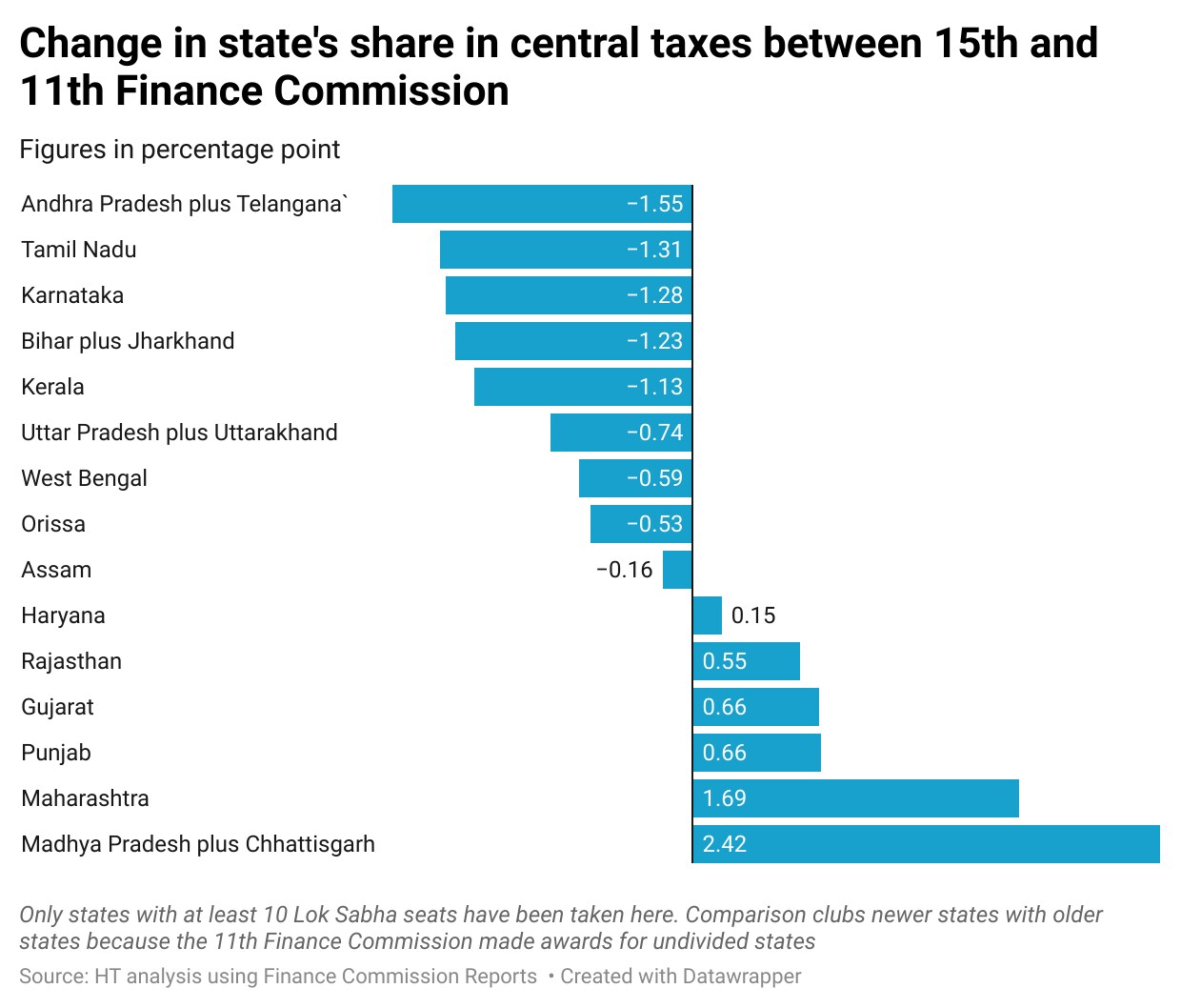
- To be sure, they are not the only states that have seen a fall in their share in central taxesCounter-intuitive as it sounds, even states such as undivided Bihar and Uttar Pradesh have seen a fall in their share of central taxes compared between the 11th and 15th Finance Commission awards. The comparison here clubs together states which were created after 2000 because the 11th Finance Commission made its awards for united Bihar, Madhya Pradesh and Uttar Pradesh. So, are Karnataka, Kerala and Tamil Nadu protesting without reason? Not really.
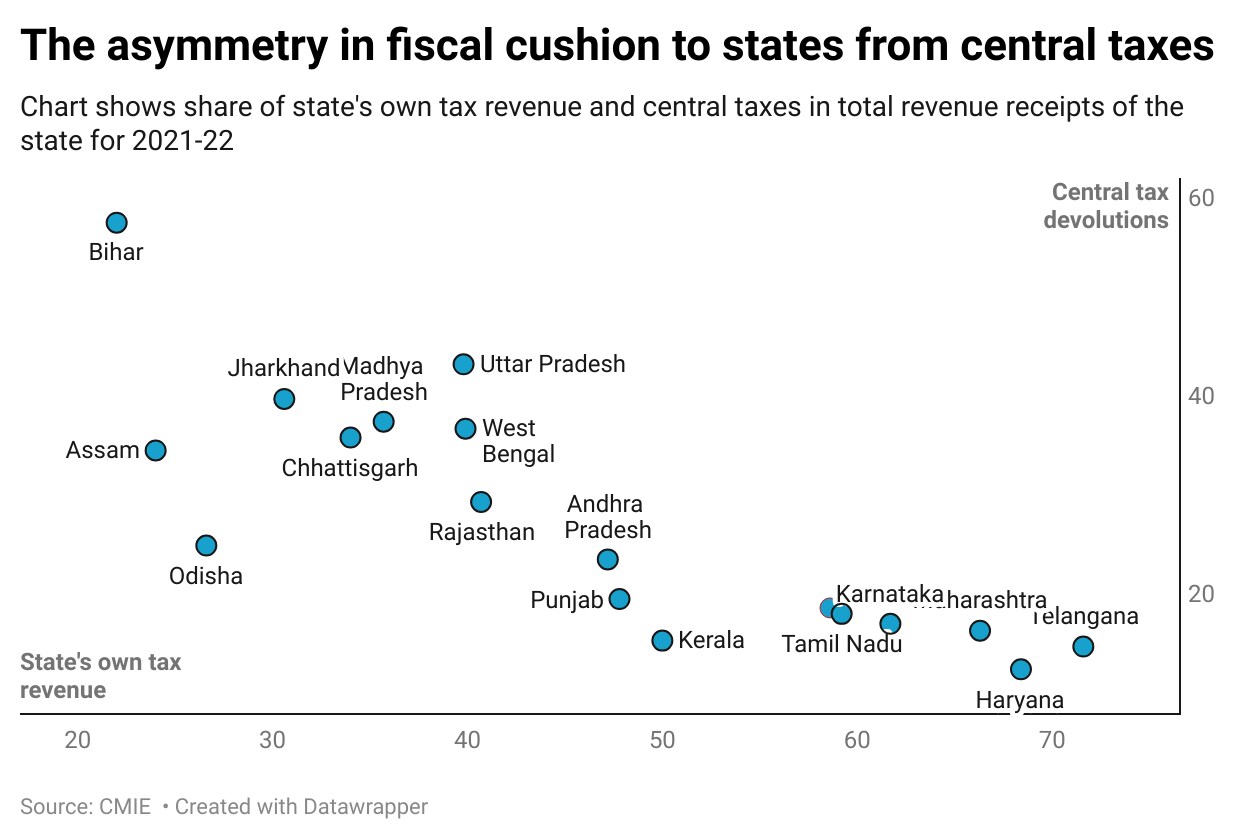
- There is a wide state-wise gap in the fiscal cushion which the Centre providesThe numbers speak for themselves. According to the Centre for Monitoring Indian Economy (CMIE) database, the share of own tax revenue in total revenue receipts of states varied from 71.6% for Telangana to just 22% for Bihar among the major states in 2021-22 (the latest period for which this information is available). The importance of central tax devolutions in total revenue receipts of the states follows an opposite pattern compared to the importance of own tax revenues. This clearly shows that the fiscal cushion on account of share in central taxes varies drastically across India’s states. It is here that the southern states are feeling that they are being given increasingly unjust treatment under India’s fiscal federalism framework.
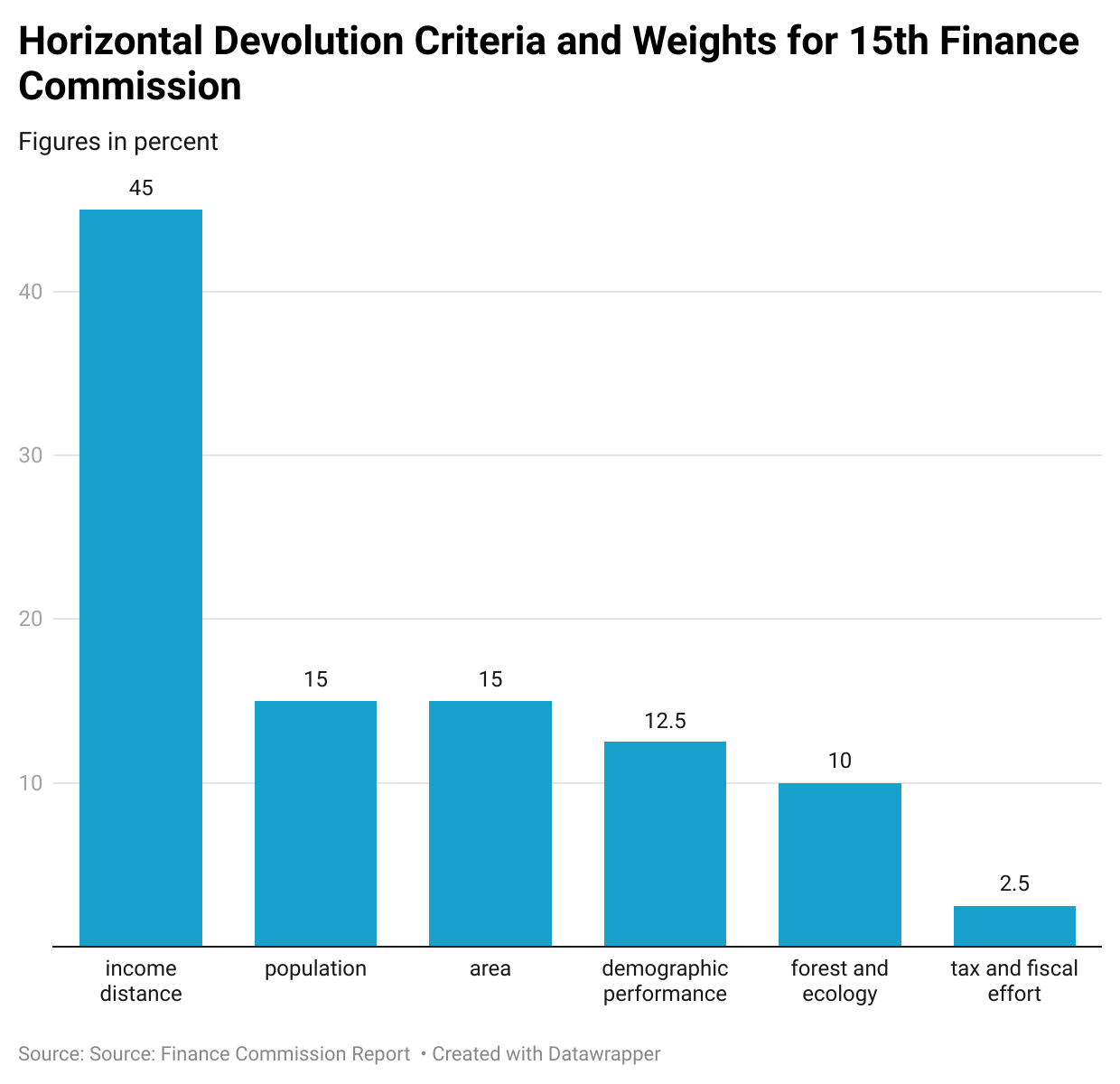
- How does the Centre distribute its taxes among states?This is the most important part of the fiscal federalism debate. Questions of tax devolution between the Centre and the states are decided by the Finance Commission – it is appointed every five years – under India’s constitutional framework. The Finance Commission decides on a devolution criterion to make its awards. The 15th Finance Commission, which upheld the goal of promoting “equity with efficiency” based its devolution formula on six factors, the largest of which was income distance with a weight of 45% in the overall sharing formula. The income distance criterion entails taking from the richer states (it uses per capita GSDP) and giving more to the poorer states to make up for their spending requirements. While a lot of the rhetoric coming from the southern states subtly questions this income distance criteria – richer states, by default, contribute a larger part of the total central tax collections – this has been a part of the Finance Commission’s methodology for a long time. It remains to be seen whether the southern states take an explicit position against this principle in the deliberations of the 16th Finance Commission.