NEW DELHI: India on Thursday brushed aside Canadian Prime Minister Justin Trudeau’s contention that US allegations about a plot to kill a Khalistani leader have resulted in a shift in New Delhi’s position on the issue and said the “core issue” continued to be the ability of extremists and terrorists to operate from Canadian soil.
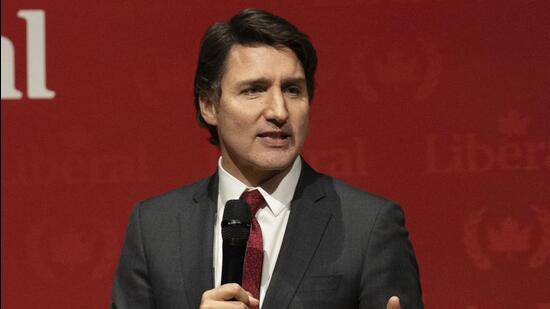
Trudeau, who triggered a diplomatic storm with his accusation in September about a potential link between Indian government agents and the killing of Khalistani leader Hardeep Singh Nijjar in British Columbia, said in an interview that there was a “tonal shift” in India’s position after US prosecutors filed an indictment that alleged an Indian official directed a plot to kill another Khalistani activist, Gurpatwant Singh Pannun.
Responding to Trudeau’s remarks, external affairs ministry spokesperson Arindam Bagchi told a regular media briefing India’s position had been consistent – that the main issue is the ability of anti-India elements to use Canadian soil for their activities.
“This is a comment by the prime minister of Canada and I wouldn’t like to comment on that. But I think our position has been quite consistent and whenever this has been raised, I think we have highlighted how we see the problem,” he said.
“Frankly, the core issue remains the space that is given to extremists and terrorists and anti-India elements in [Canada],” he said, adding this remains the “core of the problem”. If the Canadian side offers any information to back up its allegations, India will look into it, he said.
{{/usCountry}}“Frankly, the core issue remains the space that is given to extremists and terrorists and anti-India elements in [Canada],” he said, adding this remains the “core of the problem”. If the Canadian side offers any information to back up its allegations, India will look into it, he said.
{{/usCountry}}“I wouldn’t like to say whether they have noted a shift or not. Certainly, our position has remained consistent and we would hope that they would take action against such extremist elements that are misusing freedom of speech and expression in their country,” he added.
In an interview with Canada’s public broadcaster CBC, Trudeau was asked if there had been a change in India’s position after US prosecutors filed the indictment last month. He replied: “I wouldn’t say it’s changed, but there might be a tonal shift perhaps.”
Trudeau said, “I think there is the beginning of an understanding that they can’t bluster their way through this and there is an openness to collaborating in a way that perhaps they were less open before.”
He added, “There’s an understanding that maybe, maybe just churning out attacks against Canada isn’t going to make this problem go away.”
Trudeau indicated that Canada desires better relations with India but will continue to raise issues related to rights and the rule of law.
“We don’t want to be in a situation of having a fight with India right now over this. We want to be working on that trade deal, we want to be advancing our Indo-Pacific strategy, but it is foundational for Canada to stand up for people’s rights, for people’s safety and the rule of law, and that’s what we’re going to do,” he said.
India earlier dismissed Trudeau’s allegations regarding the killing of Nijjar as “absurd”. New Delhi subsequently suspended visa services for Canadian citizens and sought parity in diplomatic presence, forcing Ottawa to withdraw 41 diplomats from India. India-Canada relations are currently at a fresh low, and Indian officials say Canada has not been serious about taking action against the activities of Khalistani elements.
In marked contrast to its response to Trudeau’s allegations, the Indian side has said it has set up an inquiry committee to look into US allegations about the plot to kill Pannun, already declared a terrorist by New Delhi.