A recently discovered comet could be visible to the naked eye in dark night skies as it shoots past Earth in the coming weeks for the first time in 50,000 years, according to astronomers. The comet, C/2022 E3 (ZTF), named after the Zwicky Transient Facility which first spotted it in March 2022 using the wide-field survey camera.
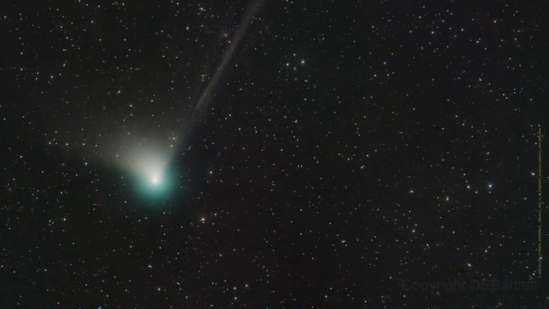
The long-period comet has brightened substantially since its discovery but is still too dim to see without a telescope, Nasa said late last month. The comet will be closest to the Sun on January 12 and closest to the Earth on February 1. While the brightness of comets is notoriously unpredictable, Nasa said, the C/2022 E3 (ZTF) could become “only just visible to the eye in dark night skies” by February 1.
An illuminated sky by the city lights or the Moon, however, can impact its visibility.
A fine telescopic image of the comet, made of ice and dust, shows its brighter greenish coma, short broad dust tail, and long faint ion tail. The comet is estimated to have a diameter of around a kilometre, reported AFP quoting an astrophysicist at the Paris Observatory. The estimated size of C/2022 E3 (ZTF) is significantly smaller than NEOWISE, the last comet which was visible to the naked eye when it passed Earth in March 2020.
While the comet will shoot past Earth for the first time in nearly 50,000 years, it could very well be the last time that C/2022 E3 (ZTF) is spotted near the Earth. Thomas Prince, a physics professor at the California Institute of Technology, said the comet's next visit to the inner Solar System was expected in another 50,000 years. Nicolas Biver, an astrophysicist at the Paris Observatory, however, said there was a possibility that the comet will be "permanently ejected from the Solar System" after its upcoming visit.
{{/usCountry}}While the comet will shoot past Earth for the first time in nearly 50,000 years, it could very well be the last time that C/2022 E3 (ZTF) is spotted near the Earth. Thomas Prince, a physics professor at the California Institute of Technology, said the comet's next visit to the inner Solar System was expected in another 50,000 years. Nicolas Biver, an astrophysicist at the Paris Observatory, however, said there was a possibility that the comet will be "permanently ejected from the Solar System" after its upcoming visit.
{{/usCountry}}According to Space.com, the comet is travelling on an open parabolic orbit, which is why it will move into deep space to never return again.
(With AFP inputs)