When Chinese foreign minister Huang Hua met Prime Minister Indira Gandhi on June 29, 1981, the two agreed that unless the boundary question was settled, it would be difficult to maintain friendship and goodwill between the two neighbours.
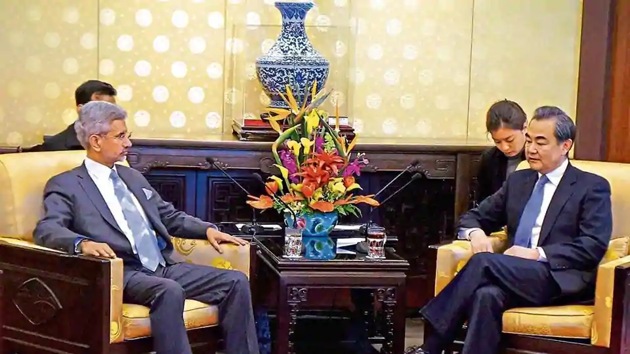
More than 39 years later, the People’s Liberation Army and the Chinese foreign ministry appear to be on different pages on this tenet. The PLA is hard at work in its single-minded effort to reach to the Green Line defined by a 1959 map drafted by then Chinese Premier Chou En-Lai while the foreign ministry is talking about building bilateral economic ties, which over the years, favoured Beijing.
Much as State Councillor and foreign minister Wang Yi tried to gloss over a near war-like situation in Ladakh during his two-hour-long meeting with his Indian counterpart S Jaishankar, the fact is that the 1981 parallel track policy of working to build on harmonious ties even as the two countries sorted out the boundary issue has not paid any dividends to India.
Instead, India has lost territory since then, letting 65 patrolling points defined by the China Study Group in 1976 turn into the de facto Line of Actual Control (LAC) in Ladakh. The patrolling points are well within the Indian perception of the LAC but the movement of the Indian forces to these points has been curtailed by the presence of Chinese troops, face-offs with PLA patrolling parties and on occasion, harsh weather and mountainous terrain.
{{/usCountry}}Instead, India has lost territory since then, letting 65 patrolling points defined by the China Study Group in 1976 turn into the de facto Line of Actual Control (LAC) in Ladakh. The patrolling points are well within the Indian perception of the LAC but the movement of the Indian forces to these points has been curtailed by the presence of Chinese troops, face-offs with PLA patrolling parties and on occasion, harsh weather and mountainous terrain.
{{/usCountry}}As Wang and Jaishankar arrived at a five-point consensus in Moscow to first disengage, and then de-escalate in Ladakh, the Communist Party of China mouthpiece Global Times continued to play up its war-mongering editorial line .
“If India wants peace, China and India should uphold the LAC of November 7, 1959. If India wants war, China will oblige,” the tabloid, considered an extended arm of the Chinese government, said. It claimed that India does not want to implement the 1959 LAC as it is still nursing a grudge for its failure in 1962 war. It is this 1962 mindset that pervades the regime of Xi Jinping. President Xi, who evidently sees himself as a true successor to Mao Zedong, who decided to target India in 1962 by creating an impression that India was out to occupy Tibet.
The aggressive line projected by the party’s mouthpiece is totally at odds with State Councillor Wang Yi’s stand at his meeting with Jaishankar where the Chinese side did not appear to acknowledge the role of the PLA in spiking tensions.
Given China’s expansionist plans to make unilateral cartographic changes in Ladakh, the disengagement process will not be easy. The PLA wants to reach the 1959 Green Line and push Indian Army troops beyond the self-designated line. This is completely in violation of the 1993 Peace and Tranquillity Accord, which talks about mutual and equal security on the border for both sides.
Under the circumstances, India will have to wait for PLA Commander-in-Chief and President Xi Jinping to give instructions to his western theatre command troops to return to their barracks if Beijing is seriously interested in rolling back the aggression. While the Chinese political mindset has not changed since 1962, the Indian mindset has. Beijing must take this into account before making the next move.