
Sign in

India, China troop disengagement in Ladakh is first step before de-escalation

State councillor Wang Yi had not answered to EAM Jaishankar’s questions on massive PLA build-up in Ladakh. EAM said positive bilateral relations are directly linked to border peace.

Updated on: Sep 11, 2020, 14:08:15 IST
Hindustan Times, New Delhi | By
Share
Share via
  • facebook
  • twitter
  • linkedin
  • whatsapp
Copy link
  • copy link

Indian and Chinese military commanders will meet in the next few days to discuss comprehensive disengagement from all friction points in Ladakh as the first step towards de-escalation. This is the crucial outcome of a terse meeting between external affairs minister (EAM) S Jaishankar and his Chinese counterpart Wang Yi.
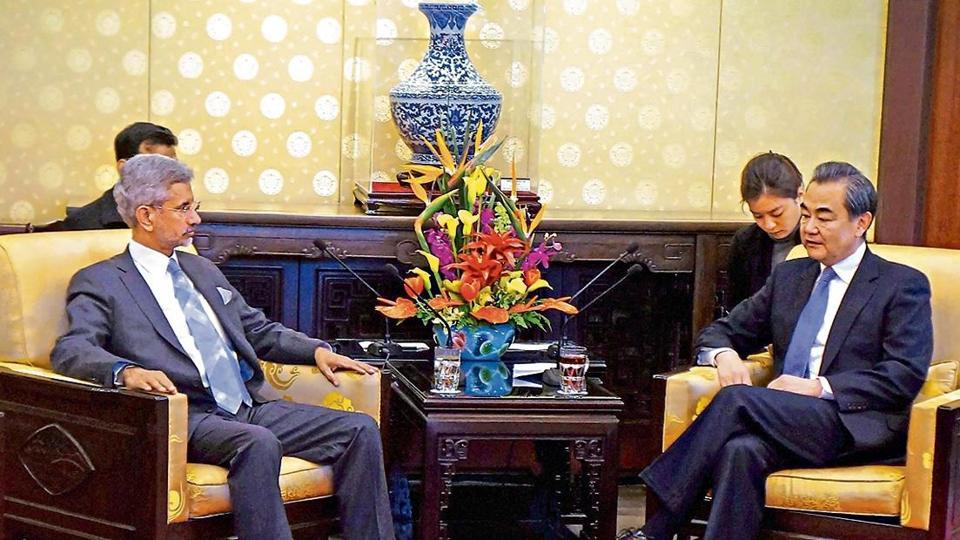
External affairs minister (EAM) S Jaishankar and his Chinese counterpart Wang Yi are seen in this photo. (HT Photo)

“The immediate task is to ensure a comprehensive disengagement of troops in all friction areas so that there are no untoward incidents in future. The final disposition of the troop deployment to their permanent posts and the phasing of the process is to be worked out by military commanders on the ground. That de-escalation should follow comprehensive disengagement was agreed to by State Councillor Wang Yi,” said a senior government official.

Also read | India forging key ties, with an eye on China

While state councillor and Chinese foreign minister Wang Yi wanted the bilateral ties to continue on a parallel track with on-going border friction in East Ladakh, he had no answers to probing questions from EAM Jaishankar who asked him about the immense build-up by People’s Liberation Army (PLA) in occupied Aksai Chin. At present, the PLA has deployed more than 50,000 men, 150 aircraft, tanks and missiles to pressurize Indian Army on the LAC.

External affairs minister (EAM) held a detailed discussion with the state councilor and foreign minister of China Wang Yi in Moscow on 10 September 2020 on the current tensions in the India-China border areas. The meeting lasted two and half hours.
Jaishankar underlined that since the resumption of Ambassadorial level relations in 1976 and holding of boundary talks since 1981, India-China relations have developed on a largely positive trajectory. While there have been incidents from time to time, peace and tranquility has largely prevailed in the border areas. As a result, India-China cooperation also developed in a broad range of domains, giving the relationship a more substantive character. While the Indian side recognized that a solution to the boundary question required time and effort, it was also clear that the maintenance of peace and tranquility on the border areas was essential to the forward development of ties. The recent incidents in eastern Ladakh, however, inevitably impacted the development of the bilateral relationship. Therefore, an urgent resolution of the current situation was in the interest of both nations.
In the meeting, the Indian side highlighted its strong concern at the massing of Chinese troops with equipment along the Line of Actual Control (LAC). The presence of such large concentration of troops was not in accordance with the 1993 and 1996 Agreements and created flash points along the LAC. The Chinese side has not provided a credible explanation for this deployment. The provocative behavior of Chinese frontline troops at numerous incidents of friction along the LAC also showed disregard for bilateral agreements and protocols. The Indian side clearly conveyed that it expected full adherence to all agreements on management of border areas and would not countenance any attempt to change the status quo unilaterally. It was also emphasized that the Indian troops had scrupulously followed all agreements and protocols pertaining to the management of the border areas.
At the end of their discussions, the ministers reached an agreement on five points that will guide their approach to the current situation.

According to authoritative government sources, Jaishankar made it very clear to councillor Wang that positive bilateral ties in the past two decades were due to peace on the border and the PLA build-up had a direct implication on the relationship between two countries. “Jaishankar put across to Wang that good things in bilateral relations were due to peaceful borders, just as the relations will deteriorate if the borders are not quiet,” said a senior official.

Although state councillor Wang could not explain the sudden PLA build-up in the area in contravention with the 1993-96 agreement, he only talked about thinning of troops in the depth areas.

Also read | India bulks up amid provocation by China’s People’s Liberation Army

“The five-point joint statement are the issues on which the two sides agreed for disengagement on the border. The statement issued by the Chinese foreign ministry is their perception of the dialogue which was not agreed to by the Indian side. EAM Jaishankar said that the two sides should abide by the past agreements and protocols to make the border peaceful,” said an official from Moscow.

However, EAM Jaishankar was candid enough to tell his Chinese counterpart that there was no point of thinning troops in the depth areas when the front-line troops are at each other’s throats. The two ministers will now go back to the respective political leadership to get directions issued that comprehensive disengagement from all friction points will be the first step towards restoring peace to the border. “Given the upgrade of Chinese infrastructure in border areas as compared to India, the mutual disengagement is a must before thinning in-depth or else the PLA will occupy dominant heights on Line of Actual Control (LAC) faster than Indian Army,” said an official.

  • Shishir Gupta
    ABOUT THE AUTHOR
    Shishir Gupta

    Shishir Gupta is Executive Editor at Hindustan Times and one of India's top journalists covering national security, strategic affairs, foreign policy and geopolitics. Over the past three decades, he has extensively reported on India's military, diplomatic and security landscape, covering every major conflict and national security challenge, from the 1999 Kargil War and the 2020 East Ladakh standoff to Operation Sindoor in 2025. He has also covered major terror attacks, including the IC-814 hijacking, the 26/11 Mumbai attacks and the 2025 Pahalgam terror strike, along with numerous Pakistan-backed terrorist incidents in the Kashmir Valley and across India. He has reported on national and state elections for more than three decades. A recognised authority on strategic affairs, Gupta has covered India's nuclear programme since the Pokhran-II (Shakti series) tests in May 1998 and has written extensively on global nuclear issues, Indian diplomacy and the country's expanding global outreach. He has also reported widely on international conflicts and terrorism, with a special focus on the Indian subcontinent. Gupta has interviewed Prime Minister Narendra Modi more than four times, including Modi's first interview with the print media after becoming Prime Minister in May 2014. His other interviews include three with the Dalai Lama, as well as conversations with Benjamin Netanyahu, Amit Shah, Yogi Adityanath, S. Jaishankar, Nirmala Sitharaman and Piyush Goyal. He is the author of Indian Mujahideen: The Enemy Within (Hachette, 2011) and Himalayan Face-off: Chinese Assertion and Indian Riposte (Hachette, 2014). He was awarded the Chevening-Wolfson Joint Scholarship at Wolfson College, University of Cambridge, UK, in 1998 and participated in the International Visitor Leadership Program (IVLP) of the US State Department in 2006. He received the Ben Gurion Prize from Israel in 2011 and the K. Subrahmanyam Prize for Strategic Studies in 2015 from the Manohar Parrikar Institute for Defence Studies and Analyses (MP-IDSA). Since 2024, he has hosted Point Blank, Hindustan Times' weekly YouTube show on global geopolitics.Read More

Get the latest India News, breaking headlines and real-time updates from across the country. Stay informed about politics, government policies, crime, weather and major national developments.