Prime Minister Narendra Modi was determined to go after those who were responsible for the Pahalgam terror attack in Jammu & Kashmir, irrespective of whether they are on “earth, sky or in hell”, National Security Advisory (NSA) Ajit Doval has said.
Doval also said that through Operation Sindoor, a series of strikes on terrorist hubs in Pakistan that was launched in response to the attack days later, PM Modi sought to send a message that the fight against terror will only be over “when the last terrorist is eliminated”.
The top security official made the comments in the upcoming Discovery docuseries “Declassified: Operation Sindoor”.
Also Read | ‘I want it immediately’: NSA Ajit Doval reveals first question PM Modi asked after Pahalgam terror attack
The Prime Minister’s message was clear, Doval said. “We will go after them. Zameen mein ho, aasman mein ho, paatal mein ho, woh log jahan bhi hai (Whether they are on earth, in the sky or in hell, wherever they are). We will not forgive (them),” he added.
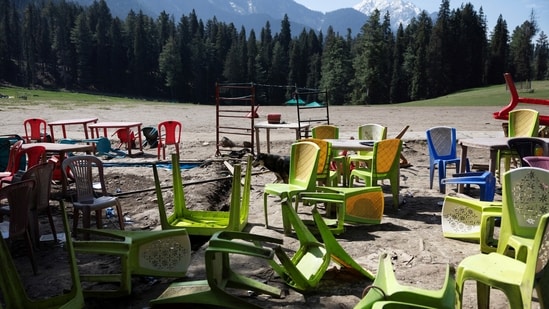
Operation Sindoor was launched early on May 7 last year to avenge the deadly April 22 terror attack at Baisaran – dubbed ‘mini Switzerland’ for its meadow. Twenty-six tourists, including one Nepali citizen, were killed in the attack.
{{/usCountry}}Operation Sindoor was launched early on May 7 last year to avenge the deadly April 22 terror attack at Baisaran – dubbed ‘mini Switzerland’ for its meadow. Twenty-six tourists, including one Nepali citizen, were killed in the attack.
{{/usCountry}}The Resistance Force (TRF), an off-shoot of Pakistan-based Lashkar-e-Taiba, claimed responsibility for the attack – the deadliest strike in the Valley since the 2019 Pulwama strike. It also coincided with US Vice-President JD Vance’s visit to New Delhi.
Also Read | One year of Operation Sindoor: How India crippled terror to avenge Pahalgam killings
As part of Operation Sindoor, the Indian forces conducted precision strikes on multiple terror infrastructures in Pakistan and Pakistan-occupied Kashmir (PoK). Pakistan later also launched offensives against India, and all subsequent counter-offensives by India were also carried out under Operation Sindoor. The military conflict between the two nuclear-armed neighbours, lasting nearly 88 hours, halted after they reached an understanding on the evening of May 10.
Opinion | Pahalgam targeted hope, tested India’s resilience
“We wanted the Pakistani army to realise that this support of terrorism or inability to take effective action against the terrorists is something which is not tolerable to us,” Doval said.
“Once anything starts, we are willing to go as far as it is necessary for our nation, to protect its sovereignty, there is no limit on that. You fight till the last drop of the blood,” he added.
He also said India's generosity and tolerance should not be mistaken for weakness, and asserted that the country can take risks and hit hard, irrespective of the consequences. “When the Prime Minister says that Operation Sindoor is alive, his intention is that the fight against terror will only be over till the last terrorist is eliminated,” he said.
Also Read | ‘We have been through hell’: Pahalgam attack victims' families mourn loss a year after tragedy
The NSA recalled how the PM cut-short his trip to Saudi Arabia and returned to Delhi after the Pahalgam attack. “As soon as he returned, the Prime Minister held a meeting at the airport itself. First he wanted to know all the facts. Then his first question to me was who has done it? Who is behind it? We should be very clear on who the perpetrators are. I want it immediately,” he said.
“Thanks to our intelligence agencies. They did a very great job in a very short time, we were able to arrive at a conclusion,” he added.
In the aftermath of the attack, India downgraded diplomatic ties with Pakistan and announced a series of measures, including the suspension of the Indus Waters Treaty of 1960 and revocation of visa services for Pakistani nationals.
Pakistan retaliated by announcing a series of measures, including closure of its airspace for Indian airlines. Islamabad also said that any move to divert water meant for it under the pact will be considered an "Act of War".