
Sign in

PM Modi’s meeting with Cai is a message to anti-India baiters in China

Cai Qi is right hand man of President Xi Jinping. He rarely meets foreign visitors.

Updated on: Sep 2, 2025, 10:34:22 IST
Share
Share via
  • facebook
  • twitter
  • linkedin
  • whatsapp
Copy link
  • copy link

New Delhi: In the power circles of the Chinese Communist Party, he is known as the man who does not smile. Known as the right-hand man of Chinese President Xi Jinping, Cai Qi is the most sought-after man by foreign diplomats in Beijing, but he is out of bounds for most. Yet, President Xi asked him to meet Prime Minister Narendra Modi and discuss India-China ties, literally triggering a major diplomatic earthquake in Tianjin.
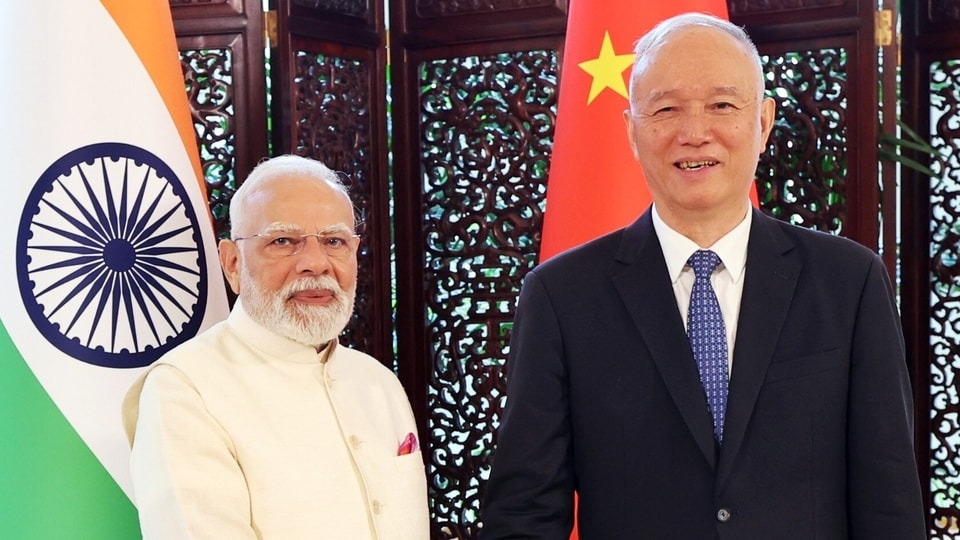
Prime Minister Narendra Modi holds a meeting with Cai Qi, Secretary of the Secretariat of the Chinese Communist Party, in Tianjin on Sunday. (DPR PMO)

Cai, who wears multiple hats in CPC and is a feared man in Beijing, met PM Modi for over 45 minutes discussing how to normalize ties between two Asian giants. And he smiled.

Before the start of the dialogue, Cai reportedly told PM Modi that he had been tasked (by President Xi) to give lunch to him but then I was told that you are not into eating. During the entire SCO summit, Cai did not openly meet any visiting leader and was present at the PM Modi-President Xi bilateral meeting the same day.

Although nothing classified was discussed during the PM Modi-Cai meeting, the engagement has sent signals to all anti-India baiters in China, as Cai carries respect in the Communist nation. That Cai was asked to meet PM Modi by President Xi bodes well for bilateral ties that have now speeded towards normalization. Cai is the first ranking member of Secretariat of Communist Party of China and member of the Politburo standing committee but ranks do not matter, only proximity to the paramount leader does.

While the close ties between China and Pakistan are a matter of serious concern to India, New Delhi cannot hold its bilateral ties with China hostage to Pakistan engagement. It has decided to normalise ties step by step with China and move towards pre-May 2020 level with stable and tranquil border being at the centre of the relationship. This also means that India and China will be seen converging on multi-lateral/global issues like terrorism, climate change and fair trade.

Given the history of border friction between the two giants, the step towards apex-level military dialogue at the commanders' (Lt General/Major General) level will help sort out border issues without delay and also help in demarcating the non-contentious portions of the border. The bilateral meetings with President Xi and strongman Cai Qi on the sidelines of the SCO summit fuel hope of stable ties between the two countries, who were military rivals just five years ago.

  • Shishir Gupta
    ABOUT THE AUTHOR
    Shishir Gupta

    Shishir Gupta is Executive Editor at Hindustan Times and one of India's top journalists covering national security, strategic affairs, foreign policy and geopolitics. Over the past three decades, he has extensively reported on India's military, diplomatic and security landscape, covering every major conflict and national security challenge, from the 1999 Kargil War and the 2020 East Ladakh standoff to Operation Sindoor in 2025. He has also covered major terror attacks, including the IC-814 hijacking, the 26/11 Mumbai attacks and the 2025 Pahalgam terror strike, along with numerous Pakistan-backed terrorist incidents in the Kashmir Valley and across India. He has reported on national and state elections for more than three decades. A recognised authority on strategic affairs, Gupta has covered India's nuclear programme since the Pokhran-II (Shakti series) tests in May 1998 and has written extensively on global nuclear issues, Indian diplomacy and the country's expanding global outreach. He has also reported widely on international conflicts and terrorism, with a special focus on the Indian subcontinent. Gupta has interviewed Prime Minister Narendra Modi more than four times, including Modi's first interview with the print media after becoming Prime Minister in May 2014. His other interviews include three with the Dalai Lama, as well as conversations with Benjamin Netanyahu, Amit Shah, Yogi Adityanath, S. Jaishankar, Nirmala Sitharaman and Piyush Goyal. He is the author of Indian Mujahideen: The Enemy Within (Hachette, 2011) and Himalayan Face-off: Chinese Assertion and Indian Riposte (Hachette, 2014). He was awarded the Chevening-Wolfson Joint Scholarship at Wolfson College, University of Cambridge, UK, in 1998 and participated in the International Visitor Leadership Program (IVLP) of the US State Department in 2006. He received the Ben Gurion Prize from Israel in 2011 and the K. Subrahmanyam Prize for Strategic Studies in 2015 from the Manohar Parrikar Institute for Defence Studies and Analyses (MP-IDSA). Since 2024, he has hosted Point Blank, Hindustan Times' weekly YouTube show on global geopolitics.Read More

Get the latest India News, breaking headlines and real-time updates from across the country. Stay informed about politics, government policies, crime, weather and major national developments.