E-Paper



Private doctors too should get ₹50L central aid, says SC
The Supreme Court stressed that all doctors who served during the pandemic deserve ₹50-lakh compensation, rejecting the government's restrictive criteria.


Warning that the country may not forgive the Supreme Court if it fails to stand by doctors who laid down their lives during the Covid-19 pandemic, a bench led by justice PS Narasimha on Tuesday underlined that even private practitioners who kept their clinics open during the pandemic and succumbed to the disease should be entitled to the ₹50-lakh compensation under the Centre’s Pradhan Mantri Garib Kalyan Package (PMGKP) insurance scheme.
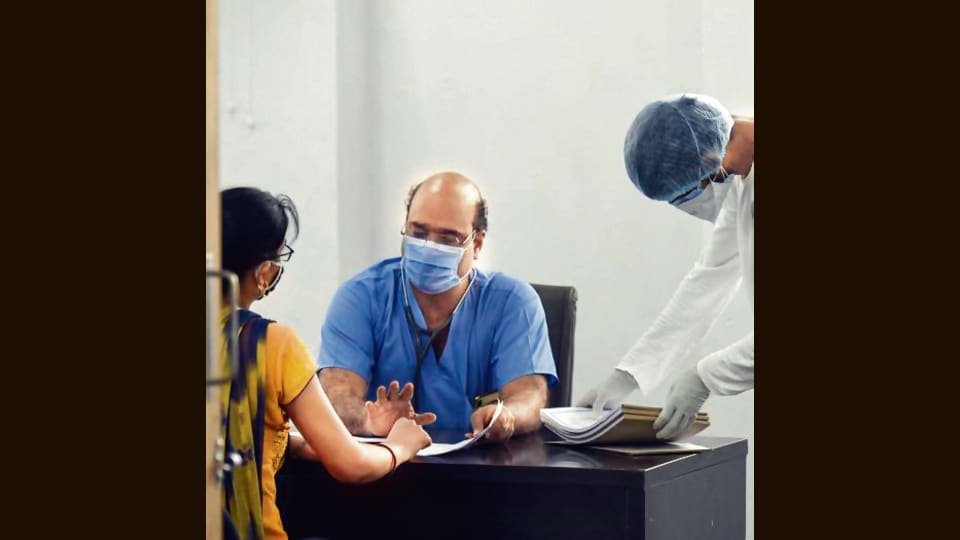
The bench, also comprising justice R Mahadevan, found fault with the Union government’s insistence that the benefit was confined to doctors formally requisitioned by state or central authorities. The scheme, introduced on March 28, 2020, under the National Disaster Response Fund (NDRF), provided insurance cover to public healthcare workers and private staff “drafted” for Covid responsibilities.
“If they opened their clinics during Covid time, what else were they opening it for? We are proud of our doctors. Hundreds of doctors have passed away. We are a great country where doctors were frontline warriors during Covid and offered their services, risking their lives and health,” the bench observed, reserving its judgment in the matter.
The court was hearing a plea by five widows of doctors from Maharashtra whose husbands died of Covid-19 but were denied the benefit on the ground that they were not formally requisitioned for Covid duties. The Bombay High Court in March 2021 upheld the government’s stand that only those “requisitioned” by the Centre or the state were eligible for the payout.
Rejecting the Centre’s contention that the scheme was an insurance measure with specific conditions and not a social welfare initiative, the bench said the intention behind the scheme and the circumstances of the pandemic had to be read together.
“If doctors open their clinics during Covid, they do not give haircuts there. It is very easy to say today that they could have stayed home, but what was the purpose of all your notifications at that time? Services of everyone who could help were being summoned,” Justice Narasimha remarked.
When Additional Solicitor General Aishwarya Bhati, appearing for the Union government, argued that only those “formally drafted” could claim the benefit, the bench countered: “But they have died. That is a fact. And the other fact is that they did offer their services. There is nothing on record to the contrary.”
Bhati maintained that the government’s position was guided by the terms of the scheme and warned that a wider interpretation “could open a Pandora’s box”. But the court was unmoved.
“Assumption that all private practitioners were profit-making individuals is not right. Hospitals were not available; doctors were not picking up calls. I still remember I had taken my son to a hospital and I came across a body being wheeled out. The situation was grim,” Justice Narasimha recounted.
The bench stressed that it was not for the government or the court to question the motive of private doctors who continued to treat patients during the pandemic.
“We have no reason to believe that all private doctors were only making money. Everyone is a citizen of this country and free to go to a private or government hospital. Just because someone went to a private practitioner can be no reason to believe that they did not suffer from Covid or Covid-related complications,” it emphasised.
Calling doctors “the first profession that protects human life,” the bench said it would lay down principles that would bind the authorities to disburse compensation to families of frontline health workers who died during Covid.
“These are our doctors, and the country will not forgive us if we do not stand for our doctors,” it remarked.
The bench indicated that its order would direct the government and the insurance company to process claims where two conditions were met—that the doctor had kept their clinic or establishment open to offer medical services during the pandemic, and that their death was due to Covid-19.
“Once these two conditions are satisfied, it is not for us to question whether the doctors opened their clinics only for Covid-related ailments or something more. That kind of an inquiry is not required,” the bench said, adding that it would issue binding legal principles rather than decide individual cases.
The PMGKP insurance scheme was introduced on March 28, 2020, under the National Disaster Response Fund (NDRF) to provide a ₹50-lakh insurance cover to healthcare workers fighting Covid-19. It covered doctors, nurses, paramedics, sanitation staff, and technicians in public healthcare institutions, and extended to private hospital staff, volunteers, and ad hoc workers who were formally drafted for Covid duties. Funds for the scheme were released through the New India Assurance Company.