
Prime Minister Narendra Modi on Thursday said he is glad that the Indian youth have not fallen into the trap of radicalisation and have successfully resisted extremist approaches.
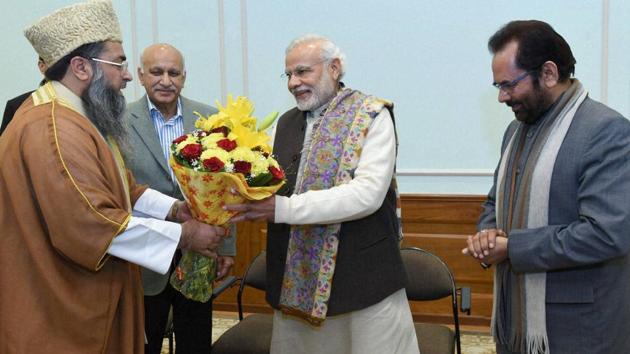
Interacting with a delegation of Muslim religious scholars, academicians, intellectuals and other eminent people, who called on him, Modi said he “feels proud” to see that while the number of jihadist recruits from several countries is in thousands, the number of Indian youth in such cases is negligible, a member of the delegation told IANS.
He said the credit for this should go to the long, shared heritage of our people.
The Prime Minister said that the culture, traditions and social fabric of India will never allow the nefarious designs of the terrorists, or their sponsors, to succeed.
Modi also stressed on the importance of education and skill development, which is the key to gainful employment and the way to grow out of poverty.
The delegation, led by Maulana Umer Ilyasi, President of the All India Imams Association, comprised several prominent Muslim faces, including AMU vice chancellor Zameeruddin Shah, Jamia Millia Islamia Vice Chancellor Talat Ahmed, former Supreme Court judge MY Eqbal, and journalists Shahid Siddiqui and Qamar Agha, among others.
The 38-member delegation interacted with the Prime Minister for more than an hour.
“We thanked the Prime Minister and the minority affairs minister for their efforts in getting the Haj quota of India hiked by 35,000. We also demanded that the so-called Haj subsidy should be ended, as it serves no useful purpose,” Ilyasi told IANS.
{{/usCountry}}“We thanked the Prime Minister and the minority affairs minister for their efforts in getting the Haj quota of India hiked by 35,000. We also demanded that the so-called Haj subsidy should be ended, as it serves no useful purpose,” Ilyasi told IANS.
{{/usCountry}}“Besides, we demanded that 175 mosques across the country, which are under the Archaeological Survey of India control, should be immediately opened for namaz. We also discussed with the Prime Minister the founding of model madrasas where both religious and modern education should be imparted,” Ilyasi added.
He said that the Prime Minister listened to the delegation and assured to do the needful.
Union minister of state for minority affairs Mukhtar Abbas Naqvi, Union minister of state for external affairs MJ Akbar and former Intelligence Bureau (IB) chief Asif Ibrahim were also present during the meeting.
ABOUT THE AUTHOR
Follow the latest breaking news, major developments and agenda-setting stories from India and around the world with the newsdesk at Hindustan Times. Operating round the clock, the desk brings together experienced editors, reporters and correspondents to deliver fast, accurate and contextual reporting across subjects that influence public policy, governance, business, society and international affairs. The HT News Desk covers politics, elections, government policies, the economy, business and markets, science and technology, the environment, law and order, infrastructure, education, climate issues and geopolitics, while closely tracking developments across states, institutions and global capitals. The team also leads coverage of major breaking news events, policy announcements, court proceedings, natural disasters, public emergencies and significant international developments. Reports published by the newsdesk are based on information gathered from reporters on the ground, official statements, government agencies, court records, regulatory filings, recognised institutions and other authoritative sources. Stories undergo editorial scrutiny and verification processes to ensure accuracy, fairness and relevance, and are updated as events evolve and additional information becomes available. Whether covering a key political decision in New Delhi, an economic policy shift affecting millions, a landmark court ruling or a major global event, the HT News Desk aims to provide readers with reliable, fact-based journalism that delivers not only the latest developments but also the context and analysis needed to understand their wider implications.