India and the other members of the Quadrilateral Security Dialogue, aka Quad, agreed on Thursday to expand their cooperation to promote a free, rules-based and inclusive order in the Indo-Pacific region by including other countries and forums.
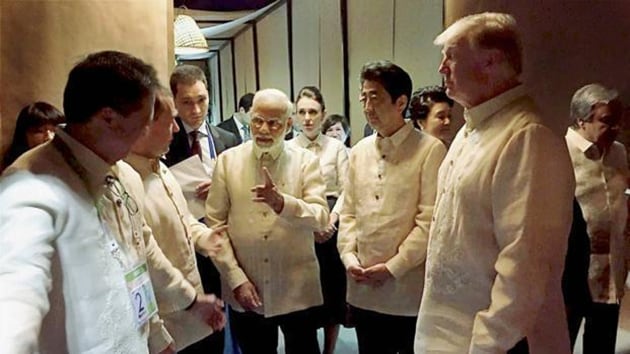
This was the third consultative meeting of the informal strategic group comprising Australia, India, Japan and the US since it was revived on the margins of the Asean Summit in the Philippines in November last year as a counterbalance to China’s growing presence in the region.
Senior officials of the Quad held the latest meeting in Singapore, also the venue of the second meet in June.
“The participants reaffirmed the Asean centrality as the cornerstone of a free, open and inclusive Indo-Pacific,” said a statement from the external affairs ministry.
This is the first time, though, that the Congress is using such tactics at the booth level. The BJP’s plan for 2019, too, revolves around booths and a “booth action plan” prepared by party president Amit Shah, who has already asked state units to compile a list of smartphone carrying voters in every polling station.
In the states going to polls, Congress nominees are given details of the booths where the party is strong and also workers who can be depended upon in each booth. Not surprisingly, “there is a mad rush from our candidates asking us to give them the details of the workers,” says Chakravarty.
{{/usCountry}}In the states going to polls, Congress nominees are given details of the booths where the party is strong and also workers who can be depended upon in each booth. Not surprisingly, “there is a mad rush from our candidates asking us to give them the details of the workers,” says Chakravarty.
{{/usCountry}}The Congress’ new efforts come even as the BJP has a clear playbook for reaching out to its ground force. Prime Minister Narendra Modi frequently interacts with BJP’s booth-level workers across the states via video conferencing. Senior BJP leaders have also been asked to hold regular meetings at the gram panchayats to get genuine feedback from the people and party workers.
Vidya, the Congress database, is derived from another online platform Shakti – which the party uses for enrolling workers and giving them more voice. After enrolment, a worker is given different tasks such as attending a rally or participating in a door-to-door campaign for the party. Each activity carries certain points. “The points indicate who is the most active and who should be considered as the best assets at a booth,” says Chakravarty.
The Congress also used Shakti extensively for candidate selection in the upcoming assembly polls, and insiders claim that in many seats the poll results decided the fate of the candidate. “Nearly 70% of new candidates are also the ones who did really well in Shakti,” adds a senior leader. Shakti has about 4 million members.
Shakti feeds into Vidya, which operates at the booth-level, the most important node in the political chain, according to experts. For many others, the ongoing elections might be about four big poll-bound states. For Chakravarty and his team, it’s an election season involving 172,345 booths.