Union defence minister Rajnath Singh on Thursday warned Islamabad of an overwhelming response if it attempted any mischief in the Sir Creek sector separating Gujarat from Pakistan’s Sindh province, his comments coming against the backdrop of the neighbour shoring up military infrastructure near the disputed area.
The response, he said, will be strong enough to alter the history and geography of the area, putting the spotlight on the 96-km disputed maritime strip between the two countries, on which both sides last held talks 13 years ago.
“If Pakistan dares to act in Sir Creek sector, the reply will be so strong that it will change both history and geography. In 1965, the Indian Army showed courage by reaching Lahore and, in 2025, Pakistan must remember that the route to Karachi also passes through the creek,” Singh said at the Bhuj military station where he spent Dussehra with soldiers and performed the traditional Shastra Puja.
Pakistan’s recent expansion of military infrastructure in areas near Sir Creek reflects its malicious intentions, he said. Even after 78 years of Independence, Singh said, Pakistan was still stirring up disputes in the area, despite India’s repeated efforts to resolve the issue through dialogue.
Talks on the Sir Creek issue were last held in June 2012 when the two sides discussed the land boundary in the area and delimitation of the International Maritime Boundary between India and Pakistan. In December 2015, they agreed to begin a comprehensive bilateral dialogue on various issues, including Sir Creek, but it failed to take off against the backdrop of the January 2016 terror attack on the Pathankot airbase and Pakistan’s continued support to cross-border terrorism.
{{/usCountry}}Talks on the Sir Creek issue were last held in June 2012 when the two sides discussed the land boundary in the area and delimitation of the International Maritime Boundary between India and Pakistan. In December 2015, they agreed to begin a comprehensive bilateral dialogue on various issues, including Sir Creek, but it failed to take off against the backdrop of the January 2016 terror attack on the Pathankot airbase and Pakistan’s continued support to cross-border terrorism.
{{/usCountry}}Singh said Operation Sindoor exposed Pakistan’s military weaknesses and showcased India’s decisive capabilities.
“Pakistan had tried to penetrate India’s defences in areas stretching from Leh to Sir Creek, but the swift and effective counter-action of the Indian forces not only exposed the weaknesses of Pakistan’s air defence system but also sent out a clear message to the world that India can inflict heavy damage at a time, place and manner of its choosing,” Singh said.
Operation Sindoor was New Delhi’s direct military response to the April 22 Pahalgam terror strike in which 26 people were killed. India launched the operation in the early hours of May 7 and struck terror and military installations in Pakistan and Pakistan-occupied Kashmir (PoK). It triggered a four-day military confrontation with Pakistan before the two sides reached an understanding on stopping all military action on May 10.
Singh attributed the success of Operation Sindoor to the seamless jointness displayed by the armed forces, adding that despite having the capability, India demonstrated restraint as the operation was aimed at countering terrorism, and not provoking a wider conflict.
To be sure, two days ago, Singh said jointness in the military — a prerequisite to the creation of theatre commands — cannot be achieved through structural reforms alone but will also require a change in mindset and the challenges involved will have to be tackled through dialogue and understanding, stressing that triservice integration is a must for survival in a fast-changing security environment.
Singh said all military objectives of Operation Sindoor were achieved and reaffirmed that India’s fight against terrorism will continue with full resolve.
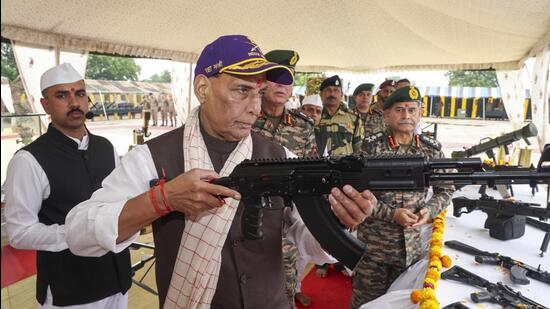
The address was delivered after Singh performed Shastra Puja at the Bhuj Military Station on the occasion of Vijayadashami. He said the ritual reflected India’s tradition of regarding weapons as instruments of dharma, similar to farmers worshipping their ploughs and students honouring their books.
“Knowledge without the power to defend it is vulnerable, and power without the guidance of knowledge leads to chaos. The balance of Shaastra (knowledge) and Shastra (weapons) keeps our civilisation vibrant and invincible,” he added.
Singh virtually inaugurated a berthing facility and a joint control centre in the Sir Creek sector. The facilities will act as major enablers for integrated coastal operations while significantly enhancing joint operational capability, coastal security coordination and the capability to mount a rapid response to any threat, the defence ministry said.
Referring to exercise Varunastra, which was conducted in the Sir Creek sector, Singh said it demonstrated the combined operational capability of the three services and their readiness to thwart any threat.
Singh also said India was advancing towards self-reliance in defence production under the Aatmanirbhar Bharat (Self Reliant India) programme and had started exporting equipment.
Along with highlighting the importance of shastra, Singh also talked about the challenges along the country’s borders. He said that the challenges were never simple, and came in different forms. “At times, these challenges appear in the form of external aggression, at times as terrorist organisations, and in today’s world, they also appear in the form of cyber warfare and information warfare,” he added.
He paid tribute to Mahatma Gandhi on his 156th birth anniversary, describing him as an example of moral strength that compelled the British to leave India.