Hyderabad As the ruling Congress and the opposition Bharat Rashtra Samithi (BRS) in Telangana are indulging in a blame game over the damages caused to the Medigadda barrage, the first of three barrages built as part of the Kaleshwaram lift irrigation project on Godavari river, the irrigation authorities have ruled out the possibility of bringing the project back into operation in the near future.
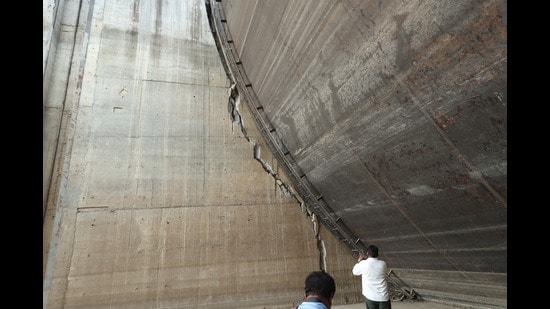
The result would be that the Kaleshwaram project, said to be the most expensive lift irrigation scheme in the country at nearly ₹1 lakh crore, would be rendered useless unless the National Dam Safety Authority (NDSA) decides whether the entire barrage has to be rebuilt or the damaged portions are repaired.
On Tuesday, senior officials of the NDSA inspected the Annaram barrage, the second one above the Medigadda barrage of the Kaleshwaram project, after the irrigation authorities noticed water leakage from this barrage on February 16 and reported the same to the NDSA.
Following instructions from the NDSA, the irrigation department took up dewatering of Annaram barrage to prevent further risks of potential cracks in the barrage, as had happened in Medigadda. “The NDSA officials have visited the barrage site and inspected if there are any damages to the piers of Annaram barrage as well,” a senior engineer associated with Kaleshwaram project, said on condition of anonymity.
The NDSA authorities are also expected to visit the third barrage at Sundilla to inspect the quality of works and find out whether it, too, had suffered any damages due to lack of quality in construction.
{{/usCountry}}The NDSA authorities are also expected to visit the third barrage at Sundilla to inspect the quality of works and find out whether it, too, had suffered any damages due to lack of quality in construction.
{{/usCountry}}State irrigation minister N Uttam Kumar Reddy declared in the state assembly on Saturday, while presenting a white paper on the irrigation sector, that the entire Kaleshwaram project had plunged into a state of uncertainty. “The NDSA declared both Medigadda and Annaram barrages non-operational. We have also asked the authority to inspect Sundilla barrage as well,” he said.
Quoting the NDSA authorities, Reddy said, a fault in Block-7 of the Medigadda barrage adversely affected the performance of the entire barrage.
“The barrage in its present condition will not be functional until it is completely rehabilitated. Damaged blocks need to be structurally restored. This can happen to other blocks as well. This leads to total barrage recovery,” he said.
The minister said, Annaram and Sundilla barrages were also built on similar patterns of Medigadda barrage.
“These too are likely to get damaged. Annaram already has such signs, which is a sign of failure. These barrages should also be examined urgently for signs of distress,” he said.
The Kaleshwaram project was taken up on river Godavari at Medigadda in Jayashankar Bhupalpalli district to lift 190 TMC (thousand million cubic feet) of water and pumped first into Annaram barrage and from there into Sundilla and taken to Sripada Yellampalli project to provide irrigation facility to 19.63 lakh (1.96 million) acres in northern Telangana.
As part of the project, 1,500 km of canals and 200 km of tunnels were constructed to carry water to the tail-end areas of northern Telangana, filling up 15 reservoirs during the course. As many as 21 pump houses and 19 substations have been constructed as part of the gigantic lift irrigation scheme, which was dedicated to the nation on June 19, 2019.
According to the report tabled in the assembly, the Medigadda barrage, the most important part of the Kaleshwaram project, collapsed on October 21, 2023 due to the sinking of 20th pier in the 7th block. As a result, the panels and parapet wall of the bridge from pier No. 21 to 16 collapsed.
The authorities noticed that there was extensive damage to pier No. 20 with major cracks along its entire wall and it had a cascading effect on the adjacent piers in the block. Irrigation chief engineer Sudhakar Reddy, in-charge of the project, in his presentation to delegation of the MLAs and ministers last week, said pier 20 along with 18, 19 and 21 of Block 7 of the barrage had sunk.
A six-member committee of the NDSA which visited the barrage on October 24 submitted its report to the government on November 1, stating that the barrage had suffered damages due to defects in planning, design, quality, control and management. The main cause of failure was sagging of the barrage raft due to piping, movement of sand under piers, insufficient bearing capacity of foundation material (sand), barrage load.
A team of officials from Vigilance and Enforcement department which conducted inspections at the barrage found that the cracks in Medigadda barrage were detected in 2020 itself and the cement concrete blocks in the wiring coat were found to be washed away. Similar incidents were reported in 2021, 2022 and 2023 as well. “The irrigation department authorities informed the higher-ups about seepage of water from vents 17, 18, 19 and 20 in the 7th block,” the report said.
The NDSA authorities reported, according to the minister, that filling the damaged portions of the barrage reservoir in its current state will cause further damage to the barrage and hence, it cannot be restored in the present conditions.
The BRS leaders, however, sought to underplay the damage caused to the Medigadda barrage of Kaleshwaram project. “Such damages are not new to any irrigation project. There was damage to the Pulichintala project on Krishna river. Even in the Devadula lift irrigation scheme built on Godavari river in Warangal district, there was bursting of the pipes. The Congress government is exaggerating it only to throw blame on the K Chandrasekhar Rao government,” said senior BRS legislator and former irrigation minister T Harish Rao, while taking part in the discussion on the white paper on irrigation.
He said if one or two piers of Medigaddda barrage had sunk, the government should repair them at the earliest and bring the barrage to operation to provide irrigation to the crops under the project.