The building is run down, hidden in a row of other identical buildings. It has two floors and a large metal gate. But unlike the others, which are homes, and from where the usual stirrings of life are visible even on a cold December morning, this building is silent.The gate, which has not been opened in months, has been claimed by cobwebs. A large grey lock protects what is inside, but rust has begun to spread across the metal. The lettering on the building has started to fade: The Lord Krishna English Medium Secondary School, Sadarpur village, Gautam Buddh Nagar. The school no longer exists; it closed a little over a year ago, another inanimate victim of the pandemic.
The school, that opened in 2005, once boasted at least 700 students, spanning Classes 1-8, and served Sadarpur, a semi-urban village in the National Capital Region. Except, after the second wave in May 2021, unable to cope with the economic ramifications of government mandated school closures, the owners upped and left. “Most of the children in this locality used to go to this school. The fee was around ₹400 per month. While they stayed during the first lockdown, they could not sustain after the second lockdown that came in April-May,” said Rajender Chauhan (62) from Sadarpur. The village has tried to get in touch with the owners to ask them if they will return. But they have since moved to Pilkhuwa in Uttar Pradesh, and the fate of the school is uncertain.
Across the country’s metros, small towns and villages, if there was one signboard that captured India’s aspirations, it was the rickety board advertising an “English Medium” private school. The advertisements were everywhere, painted on walls in tier 2 towns, on tattered posters pasted on lampposts in urban villages, even on billboards. The schools were everywhere too, a growing industry servicing the space between the desire to move children out of ill-equipped government schools and the inability to pay for more expensive private institutions. And in English, of course.
{{/usCountry}}Across the country’s metros, small towns and villages, if there was one signboard that captured India’s aspirations, it was the rickety board advertising an “English Medium” private school. The advertisements were everywhere, painted on walls in tier 2 towns, on tattered posters pasted on lampposts in urban villages, even on billboards. The schools were everywhere too, a growing industry servicing the space between the desire to move children out of ill-equipped government schools and the inability to pay for more expensive private institutions. And in English, of course.
{{/usCountry}}Except, even as the pandemic and school shutdowns ravaged education, it devastated the economics of Low Cost Private Schools. If government schools, and larger private schools had the wherewithal to withstand months of no classes, these institutions run out of buildings on rent, and usually with slim profit margins, found they could no longer pay rent or salaries. In this third of a five-part series on the effects of the pandemic on India’s schools and children, HT looked at the fate of these small private schools that closed down in the vicinity of the national capital, and what that has meant for owners, teachers, students, and the larger education ecosystem.
What the pandemic has meant for LCPS
Twenty-four kilometres away from Sadarpur, 56-year-old Kamlesh Srivastava sits forlorn at home. In 1998, he founded Kanchan Public School in a village called Gadhi Chaukhandi in Gautam Buddh Nagar, from nursery to Class 5, with 26 teachers, and around 800 students. “In 2020 when the pandemic hit, we still had some hope. We had two buildings in the same compound one of which was on rent of ₹40,000 per month while the other was ours, which we bought in 2011. We first let go of the rented building and continued through 2020 with online teaching. However, as time went by, we were unable to pay salaries as parents stopped paying fees. The strength of students reduced from about 800 to just 150 when we reopened in October 2021. After the second Covid wave, there were barely 50 students across the school who would pay fees, and even then only about half of what they owed. As a result, we had to shut the school,” said Srivastava. Fees at the school started from ₹250 per month for nursery classes to ₹475 per month for Class 5.
With no other source of income left, his married daughters now support Srivastava financially. But he isn’t the only one associated with the school that is now struggling. Priyanka Yadav, 35, was one of the teachers at the school, earning ₹8,000 a month. A resident of Mamura village, Yadav now gives English tuition classes to children in her village, and her monthly income has dropped to ₹4,500.
“My husband lost his job last year when the pandemic started but got another one this year at a garment factory in Sector 63. We have three children to feed and rent to pay, and with my salary cut to half, we are barely able to make ends meet,” she said.
Rekha Chauhan, who runs the low budget Adarsh Vatika School in Challera village and is a member of the local Public School Welfare Association of Gautam Buddh Nagar, said that of the 200 schools registered with the body, at least 40 have downed shutters for good. “A major problem is that the parents are unable to pay even ₹500 a month. At my school too, the strength has reduced from 800 students to just 200. It has left owners like us high and dry,” she said.
Dharmendra Saxena, Gautam Buddh Nagar’s Basic Education Officer said that it is true that several schools closed during the pandemic in the district, but that there is no data on this. “The repercussions of the brunt of the pandemic on LCPS will only show up on paper, in government data, by 2023 when we start removing schools that have not updated their data for three years,” added Saxena.
The national perspective
According to a 2017 report titled “Understanding the Affordable Private School Market in India” compiled by non-profit FSG, 86% of children from low-income households in urban India attend affordable or low cost private schools. The report estimated that there were 130,000 -160,000 such schools in urban India that charge fees between ₹500- ₹1,650 a month.
In March 2021, UNICEF released a report highlighting the impact of pandemic on low-cost or affordable private schools, stating, “COVID-19 has hit low-cost private schools (LCPS) especially hard. The economic shock of the pandemic has placed LCPS under significant financial stress; teachers reported losing their jobs, having their salaries cut, or not being paid at all. Thousands of LCPS have already shut down, and thousands more are on the brink of permanent closure.”
Officials at the Union ministry of education said that the Unified District Information System for Education (UDISE) 2020-21, to be released in July, will likely shed some light on the scale of school closures. “The report maps district-wise numbers of schools, students and teachers. The closure of schools amid the pandemic will be reflected in this year’s report,” said a senior official at the ministry. Still, that report will likely ignore the impact of the second wave since it will only include data till March 2021.
The shift to government schools
For the past decade, that she studied in a private “English medium” school, was a matter of pride for 16-year-old Sweety Malik. In March 2020, she passed her class 10 board exam from Angel Public school in the Kasna area of Gautam Buddh Nagar. Then the pandemic hit, the school shut down and every student was given a transfer certificate.
There was another problem. She used to pay a fee of ₹1,100 a month, and even as a desperate family looked around, there were no other schools around them within that fee structure. “So in October 2020, I had to get admission at the Navjivan Inter College in Gejha village. Moreover, my father’s income reduced from ₹7,000 to ₹2,500 a month during the lockdown. So the ability to pay for private school just wasn’t there anymore,” said Malik, a resident of Haldoni village. Her father is a construction worker while her mother works as a house help in the high rise apartments of Greater Noida west.
For Malik, the shift has been difficult to adjust to. “I am not very happy being here as all subjects are being taught in Hindi. But my classmates are fascinated with my spoken English and many take lessons from me.”
Her father, Vikas Malik (38), said that he never wanted Sweety, and her two younger siblings, to go to a government school. “I always wanted my children to go to an English-medium private school so they could have a better life. However, the pandemic brought such conditions that both I and my wife were jobless for almost four months and our savings started drying up. When Sweety’s school shut down, I could not find any other affordable private school.”
This shift to government schools is a pattern that is showing up across the country. According to the Annual Status of Education Report (ASER) 2021, a significant number of schoolchildren in India have switched from private schools to government-run schools amid the Covid-19 pandemic. The report found a jump in enrolment in government schools between 2018 and 2020, going up from 64.3% to 65.8%. In 2021, it leapt to 70.3%. On the other hand, enrolment in private schools decreased from 28.8% in 2020 to 24.4% in 2021, the report said.
On the ground, data from Gautam Buddh Nagar district in Uttar Pradesh shows that government primary schools had a strength of 86,651 while secondary schools had 74,497 students enrolled in 2019-20. For 2021-22, the number of students in primary schools has increased to 94,626 while in secondary schools it has increased to 80,477.
In Ghaziabad, there were 93,459 students studying in primary government schools in 2019-2020 which increased to 100,982 in 2021-22. In secondary classes, there were 83,987 students studying in government schools in 2019-2020 which increased to 89,452 in 2021-22.
What this shift means
Situated in the busy main market of Gejha village, the entrance of Sweety Malik’s new school, Navjivan Inter College is easy to miss. The name of the school, written across the building in red paint, has faded away. Inside, there are dirty toilets, broken benches, cracked black boards, and the playground is lined with overgrown shrubs.
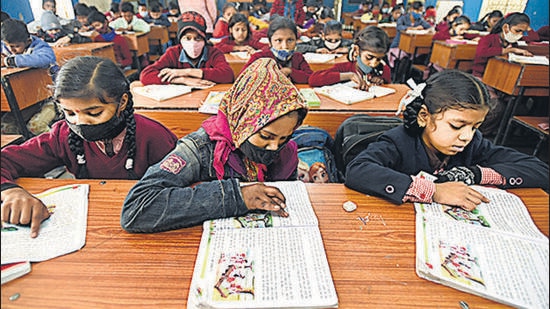
The school didn’t have great infrastructure even before the pandemic, and now it has to serve more students: the strength has increased from 800 in 2020 to 1500 in 2021. “We were already overburdened with about 100 students in one class but now there are about 150 students in one class with one teacher for one subject. The teachers are overburdened and there is not enough infrastructure to fit in these many students,” said Pushpendra Singh, the school’s principal.
In Uttar Pradesh, schools first shut in 2020 in March, and were then reopened in October 2020. In the second wave, the schools shut in April 2021, and then reopened in August 2021. When Singh’s school reopened on August 16 with the 700 extra students, some classes had to be shifted outside, where 40 benches have been placed in rows. Even inside the class, more than half the students have to sit on the floor.
“In the winter students do not mind sitting outside in the sun. But during the summer, we often have to either cancel classes or wait for the ‘games period’ of another class so that we can take classes in their classroom,” said RK Singh, a teacher at the school.
Lakshay Chhabaria, president of Affordable Private Schools’ Association, said, “Government schools in India, as we already know, suffer a shortage of staff with many posts for teachers and school staff lying vacant. On top of that when more students get admitted to the school, how can we ensure quality education?”
Then, there are those for whom even government schools were not an option. Sanju Chaudhary, 17, was a Class 9 student at Gautam Buddh Nagar’s Amar Public School in sector 37, where he paid a monthly fee of ₹700 a month. He was also one of the brightest among a group of students at a tuition centre run by the NGO Social and Development Research and Action Group (SADRAG) where he sought to improve his skills on a computer. His father, a driver, lost his job during the pandemic, and the eldest of four siblings, Chaudhary was forced to find work. Mala Bhandari, founder of SADRAG said, “We tried very hard to get Sanju admission into a government school but his parents needed him to start earning. This is not just a one-off case but a story of many other children in the pandemic.” In Chaudhary’s story, he has gone from talented Class 9 student, with dreams and aspirations, to a worker at a bakery in Noida. He has no idea of when, if at all, he will be able to return to education.
(With inputs from Fareeha Iftikhar)