Former Bangladesh premier Sheikh Hasina, in her first telephonic interview with Indian media, has questioned the Bangladesh Nationalist Party (BNP) government’s move to link her extradition to a possible visit to New Delhi by Prime Minister Tarique Rahman, saying she intends to return home on her own by December.
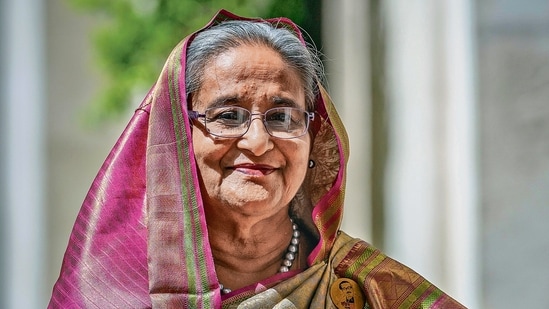
Hasina, who spoke to HT from an unspecified location, also questioned the BNP government’s decision to acquire combat jets from China under a $2.3-billion deal at a time when Bangladesh is grappling with electricity and gas shortages, lack of fertilisers and a cost of living crisis.
Excerpts from the telephonic interview:
The Bangladesh government says your press conference from Indian soil on August 5 vitiated the preparations for a visit by Prime Minister Tarique Rahman and Dhaka has set your extradition as a condition for this visit. What is your response to these developments?
I addressed a press conference at an international forum. How can this be a problem for relations between two countries? Tarique Rahman signed a stamp paper and given an undertaking that he would not do politics when he [left Bangladesh and] went to Britain in 2007. He indulged in politics from London and, in place of his mother [Khaleda Zia], acted as the chairman of his party. He participated in public and party meetings via video-conference. Did I ever tell the British government to stop a fugitive from my country from holding such meetings? I never made such an accusation. What is his problem?
Also Read | Bangladesh PM's early trip to India falls through, August visit possible
{{/usCountry}}Also Read | Bangladesh PM's early trip to India falls through, August visit possible
{{/usCountry}}The way the leaders and workers of the Awami League are being persecuted and tortured, and their homes are being attacked — this was started by [interim government chief] Muhammad Yunus and it is being continued [by the Bangladesh Nationalist Party]. Not a day goes by without people being killed. Take the case in Rangpur, where four members of a family were killed, and the way a member of our youth wing was killed in Bogura city. Every day and every night, they are killing, arresting or registering cases against our party people. They are entering homes and assaulting men and women, beating up and harassing the elderly. In these circumstances, I can’t understand how my extradition is a condition.
I am going back to my own country, I don’t understand why he [Tarique Rahman] is objecting to that. They are talking about the extradition treaty, I want to go back on my own to my country. I will go back. Can I stay abroad my whole life? I have to return to my country, to my own people.
India-Bangladesh relations are not damaged by truth. They are damaged when democracy is destroyed, extremism is allowed to rise, minorities feel unsafe, regional security is put at risk, and state institutions are used for political revenge. A stable, democratic, secular and development-oriented Bangladesh is important not only for Bangladesh, but also for India’s security and South Asia’s stability.
Also Read | India again distances itself from Sheikh Hasina’s remarks
The issue of extradition is being used for political purposes. Legal and diplomatic processes will take their own course.
Have you finalised a timeframe for your return? Do you plan to return with other Awami League leaders in self-exile? Why did you say at your press conference you could be killed or arrested on your return?
I have said I intend to return by December because Bangladesh’s political crisis cannot be allowed to continue indefinitely. I will announce the specific date, time and point of entry in due course.
I want to return because Bangladesh is being pulled away from the path of development, democracy and stability. During our time in government, Bangladesh’s economy grew from about $70 billion to around $450 billion. Per capita income rose from $482 dollars to $2,784 dollars. That progress is now being damaged. GDP growth has fallen to 2.22% from 6.80% during the Awami League period. For the first time in 54 years, the industrial sector has recorded negative growth. Poverty has sharply increased, investment has turned negative. More than two crore people have become newly unemployed, and electricity and gas shortages have returned.
Also Read | Bangladesh sets Sheikh Hasina's extradition as condition for PM Tarique Rahman’s India visit
This is not only an Awami League issue, it is a national crisis. When development stops, jobs disappear. When law breaks down, people lose security. When extremist networks regain space, Bangladesh becomes a regional concern.
Many Awami League leaders are outside the country, many others remain inside Bangladesh but are forced to live in hiding. Who returns and when will be decided through party consultation and after assessing the security situation. I do not want any leader, activist or supporter to be exposed to unnecessary danger.
More than 600 fabricated cases have been filed against me. The judiciary has been turned into an instrument of political revenge. Threats to my life are not new. In 1975, I lost my family. After returning to Bangladesh, I faced military rule, dictatorship, conspiracies and repeated assassination attempts. On August 21, 2004, grenades were thrown at my public rally in Dhaka in an attempt to assassinate me. Twenty-four people were killed and more than 300 were injured. I survived, but many of my colleagues did not. That attack could not stop me then, and threats will not decide my duty now.
Also Read | Sheikh Hasina’s event can hit positive momentum in ties, says top aide to Bangladesh PM
I am not worried about my own future. My return is not about power. It is about standing beside the people.
Have you started preparations for your homecoming and for reviving the Awami League?
Of the political parties in Bangladesh, the Awami League is the only one created in 1947. It worked for the country since its creation. My father, Bangabandhu Sheikh Mujibur Rahman, took this party to make the country independent. The Awami League did the most work for Bangladesh’s development, and the people — from the poor to business people and salaried class, the administration, law enforcement agencies, institutions. We were about to graduate Bangladesh from a least developed to a developing country. At the international level, Bangladesh was in the 35th spot among the strongest economies, and in South Asia, we were number two, after India. Today, they have finished everything. The Awami League is a political institution that rose from the common people, not people who grabbed power unconstitutionally or illegally. Military dictators have grabbed power in Bangladesh and imposed martial law, formed political parties, and Muhammad Yunus also formed an unconstitutional government and created a party.
Why did they ban the Awami League? If the Awami League has done a lot of bad things, let the people decide. Whether we are good or bad, we will go to the people in an election, and they will decide. If we have done bad things, the people will reject us. What right do those who have grabbed power have to ban our party?
Also Read | Dhaka’s request for Sheikh Hasina’s extradition is being examined, says India
Countless Awami League leaders and workers, from the grassroots to the top, are tied up in the courts, 600,000 cases have been filed against them. Should nobody speak out against this? Those who indulged in arson, attacks and killings since July 15, 2024, those who killed police personnel and people like Dipu Das — they have been given indemnity and cases won’t be filed against them. Terrorists and extremists have a free hand in Bangladesh.
The Awami League, as an institution, is there and will remain. They can ban or take any other action against the Awami League, its public support and the institution will remain. I speak regularly to our leaders and workers and am in touch with them, even though one crore of them are homeless and two crore can no longer contact their own families. Despite such torture of Awami League members, if there is any party that is still popular among the public, it is the Awami League, people still have faith and trust in it.
Have you consulted the Indian government or the government in Dhaka on your future plans?
My decision to return is my own, and it is a matter of political discussion within my party. I have no political understanding with the Dhaka government. Those who banned the Awami League and filed thousands of cases against our leaders cannot be partners in any secret arrangement.
Some reports have suggested that the BNP government is pushing for your extradition because of pressure from the opposition Jamaat-e-Islami and National Citizen Party. What is your response?
Instead of me, you should ask this question to the BNP or to Prime Minister Tarique Rahman, I don’t want to comment on it. I can only say that Jamaat and BNP were always together, they fought elections together in the past. In a genuine sense, there is no difference between them. Secondly, Muhammad Yunus joined them and these three groups are all the same. I don’t know what is going on within these groups, but we always think there should be friendly relations with a neighbouring country. When I was in power, our foreign policy, which was given by my father, was friendship with all and enmity with none. When I was in power, Bangladesh had good relations with all countries. We kept good relations with every country, and our focus was Bangladesh’s economy, poverty alleviation, creating jobs for the youth, opportunities in modern science, computers, technology, so that they could build themselves up internationally. I knew that if I didn’t give importance to the private sector, jobs wouldn’t be created. If the purchasing power of my people in the villages doesn’t increase, then there won’t be industrialisation. We have an agro-based economy, but I also wanted industrialisation.
At your last meeting with Prime Minister Narendra Modi, there was talk of working with India on developing the Teesta river. We now see the BNP government working with China on this project, and this has created concerns on the Indian side. Bangladesh is also increasing defence cooperation with China and there is a plan to acquire Chinese J-10CE combat jets for $2.3 billion. What are your thoughts?
I can only say that I increased power generation to almost 29,000 MW and provided electricity to every home. You have to buy certain commodities to generate power, but Bangladesh has no money for this. People aren’t getting electricity. Five out of our six fertiliser factories are shut because of lack of gas. They can’t supply fertilisers. Prices of essential commodities are going up. They don’t have a massive social safety net programme like we had. They didn’t buy vaccines and thousands of children died of measles, they can’t provide running capital for industries.
In such difficult circumstances, why this indulgence of acquiring fighter jets? That is also my question. But you should also ask this to the BNP government.
On the Teesta project, we had spoken with the Indian side about India cooperating in this matter. I have nothing to say on what their government is doing.
Your son Sajeeb Wazed Joy spoke about Bangladesh becoming “another Pakistan” and about the security threat from the activities of different extremist and terrorist groups. Could you throw more light on this issue?
What Joy said was not emotional rhetoric. It was a serious warning based on Bangladesh’s current security reality. The phrase “another Pakistan” does not refer to the ordinary people of any country. It refers to a dangerous conglomeration of extremism, communal politics, terrorist networks, political patronage and weakened institutions. Bangladesh is being pushed in that direction, and that is dangerous not only for Bangladesh, but for the entire region.
The UN Security Council’s monitoring mechanism has raised concerns that al-Qaeda in the Indian Subcontinent may be trying to use Bangladesh to establish terrorist cells. Local investigations are also pointing to the same danger. Recent reports have linked a chain of incidents from Keraniganj to Savar to the same extremist network, involving pressure-cooker bombs, pipe bombs, grenades, explosive materials, weapons and Neo-Jamaat-ul-Mujahideen Bangladesh links. When international warnings and domestic investigations point in the same direction, no responsible government can deny the threat.
Religious mob violence has increased sharply. Across the country, shrines, dargahs, sculptures, cultural spaces and secular symbols have come under attack. At the same time, Bangladesh’s counter-terrorism capacity is being weakened. There are discussions about dismantling specialised units such as Counter Terrorism and Transnational Crime and Anti-Terrorism Unit. When militants are released and counterterrorism officers are persecuted, the result is a national security vacuum.
If extremist networks regain safe space in Bangladesh, the impact will reach India, Myanmar, the Bay of Bengal, regional trade, migration, maritime routes, diplomatic security and international counterterrorism cooperation. Joy’s warning should therefore be seen not as a political slogan, but as a regional security alert.
How have you been spending your time in India? What do you miss most about Bangladesh?
For any political leader, being away from one’s people is the hardest thing. Exile is not new to my life, but separation from the people never becomes easy. I am staying in India with dignity and respect, and for that I am grateful to the government and people of India. But my mind remains in Bangladesh.
I follow developments in Bangladesh every day. I keep track of our leaders and workers, the families facing persecution, the economy, law and order, minority safety and the frustration of young people.
What I miss most is the people of Bangladesh — their faces, language, simple trust and the soil of rural Bengal. I miss the Bangladesh that was moving forward with hope, not fear.