
 E-Paper



Shubhanshu Shukla becomes second Indian astronaut in space: Who was the first?
Before lift-off, Shukla said that he hoped to inspire the youth, in the same way that Rakesh Sharma had back in the day.

 Prefer HTon Google


Indian Air Force (IAF) Group Captain Shubhanshu Shukla is among the four member team aboard the SpaceX Dragon aircraft which is travelling to space on the Axiom-4 mission.
Shukla, who is the mission pilot for Axiom-4, is only the second Indian astronaut to travel to space. While the mission was postponed multiple times due to technical delays, the aircraft finally performed lift-off at 12.01 pm on Wednesday.
Shukla thus became the first Indian astronaut to travel to the International Space Station in the last forty years. He is accompanied by mission commander and former NASA astronaut Peggy Whitson, and mission specialists Slawosz Uznanski-Wisniewski (Poland) and Tibor Kapu (Hungary).
Circling back to the first Indian astronaut in space
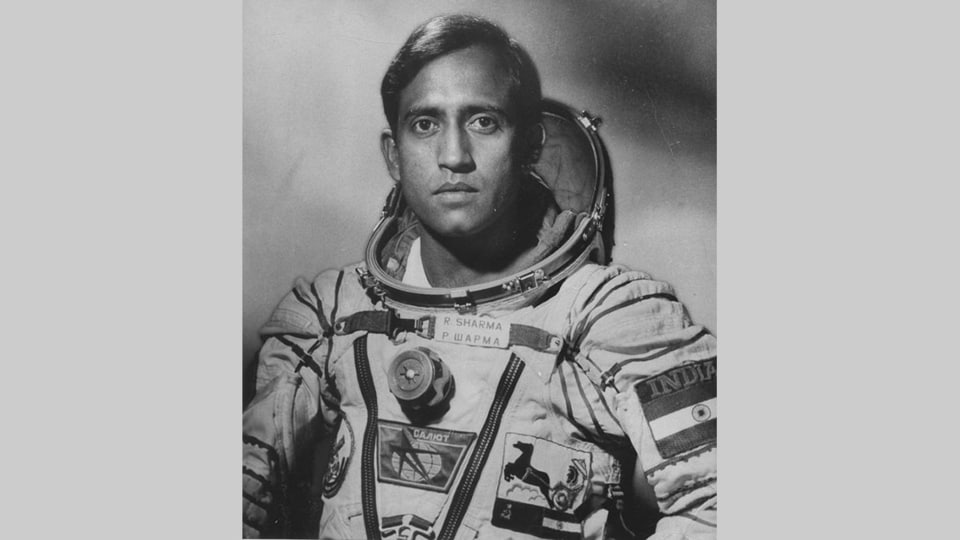
Before lift-off, Shukla said that he hoped to inspire the youth, in the same way that Rakesh Sharma had back in the day. Sharma, who was the first Indian astronaut in space, spent eight days in orbit in 1984. He stayed at the-then Soviet Union's Salyut-7 space station.
Sharma was sent to space aboard the Soyuz T-11 spacecraft under the Soviet Interkosmos programme. The programme had sent 17 non-Soviet cosmonauts to space between 1978 and 1991. The T-11 was the sixth expedition to the Soviet Salyut-7 space station.
Also Read | ‘Even if…’: Group Cpt Shubhanshu Shukla aims big for Axiom Mission 4
Early life
Born in Punjab's Patiala on January 13, 1949, Sharma went to St. George’s Grammar School, Hyderabad, completing his graduation from Nizam College in the same city.
He then attended the National Defence Academy in Pune's Khadakvasla, and went on to become a commissioned officer in the Indian Air Force in 1970. He joined the IAF as a test pilot, flying 21 combat missions in a MiG-21 during the 1971 Bangladesh war.
Training and tests
For his first space mission, Sharma had to undergo several tests alongside other candidates at the Institute of Aerospace Medicine in Bangalore, and then in Moscow as well. He was shortlisted with another IAF pilot, Ravish Malhotra.
It was decided that one of them would travel to space, while the other would be on standby. However, the final call on who would travel to space was taken at the very last stage.
Before that, both the IAF pilots undertook rigorous training for almost two years at the Yuri Gagarin Cosmonaut Training Center at Star City, located outside Moscow.
Travel to Soviet space station
The final lift-off took place on April 2, 1984, following which the rocket docked and Sharma, along with two other astronauts – spaceship commander Yury Malyshev and flight engineer Gennadi Strekalov – were transferred to the space station.
They spent 7 days, 21 hours and 40 minutes aboard the space station, during which Sharma took aerial photographs of India. He conducted scientific and technical studies, including on biomedicine and remote sensing.
Sharma retired as a wing commander in the IAF and later joined Hindustan Aeronautics Limited as chief test pilot, where he served till 1992.


