Chief Election Commissioner (CEC) Sunil Arora on Friday said that social media platforms will be held responsible if they fail to make adequate arrangements to counter misuse and don’t take prompt action against adverse posts ahead of the Bihar assembly elections.
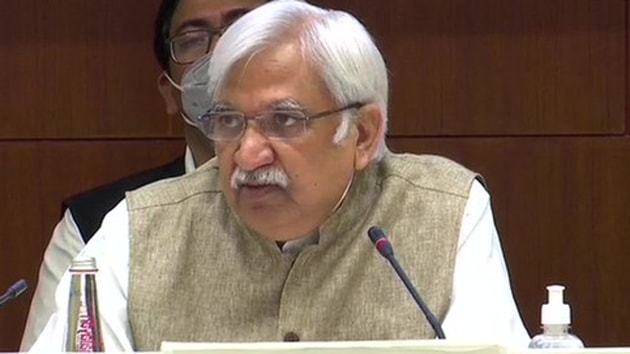
“Adverse use of social media platforms has emerged as a new challenge in recent times,” Arora said. “If adequate arrangements aren’t made to counter the misuse of the social media then they will not be allowed to take pretext of being only a provider and shall be held responsible if necessary action is not taken promptly and adequately.”
The Commission has also asked political parties and candidates to sensitise their representative not to indulge in ‘malpractices, malicious propaganda and instances of hate speech’, as such actions will be dealt with ‘sternly’ and ‘harshly’.
“The commission would like to make it emphatically clear that anyone who misuses any such platform, such as for fomenting communal tensions, etc for electoral purposes, shall have to face consequences under the law of the land,” Arora said.
Also read: India targets Pakistan at UN body over counter-terrorism record
{{/usCountry}}Also read: India targets Pakistan at UN body over counter-terrorism record
{{/usCountry}}Ahead of the 2019 Lok Sabha polls, the Commission and social media platforms such as Facebook, Twitter, Whatsapp along with IAMAI had signed a voluntary code of ethics. According to the code, while the participants ‘recognise they are neither the author nor the publisher of such content’, they are ‘committed to helping support democratic processes by improving the integrity and transparency of electoral processes’.
Hindustan Times reached out to Facebook and Whatsapp for a comment but did not receive one until press time. Twitter declined to comment.
Arora’s statement also comes in the wake of the Wall Street Journal reports in August which alleged Facebook had selectively exercised its hate-speech policy to favour the ruling Bharatiya Janata Party. Information technology minister Ravi Shankar Prasad, however, wrote to CEO Mark Zuckerberg saying that the platform allowed people to make posts against prime minister Narendra Modi, with BJP alleging that there was nexus between the Congress and Facebook.
According to Twitter’s recently updated civic integrity policy, a person may not use Twitter’s services for the purpose of manipulating or interfering in elections or other civic processes. This includes posting or sharing content that may suppress participation or mislead people about when, where, or how to participate in a civic process. The microblogging site’s hate conduct policy also bars promotion of violence, direct attacks, threats on the basis of race, ethnicity, national origin, caste, sexual orientation, gender, gender identity, religious affiliation, age, disability, or serious disease.
Also read: Is BMC always this swift to demolish, asks HC judge in Kangana Ranaut case
According to people familiar with the matter, the Commission draws its reservoir of power from Article 324 of the constitution. “Elections are conducted under Constitution and the Supreme Court in its judgment has held on a number of occasions that Article 324 gives vast powers to the Commission subject of certain restrictions such as fairness and transparency,” said such a person on the condition of anonymity. The person added that a call would have to be taken on a case-to-case basis.
Article 324 allows the Election Commission the “superintendence, direction and control of elections”. The EC had invoked this provision in West Bengal in May last year, curtailing campaigning in the state ahead of Parliamentary elections after clashes between cadres of the BJP and the Trinamool Congress (TMC) in Kolkata.
Experts, however, say the ECI’s powers to regulate the social media platforms are limited.
“Their authority to regulate platforms is not clearly provided,” global cybersecurity lead and Asia Pacific policy director at Access Now Raman Jit Singh Chima said. “They are stretching authority they have to regulate electronic media and threatening companies by proposing to further regulate or prosecute them.”
“It’s commendable that the CEC is speaking about this, however, the ECI has failed to advance any reforms to protect electoral democracy in the digital age in India. Prior to the 2019 general elections, many groups working on electoral reforms, democracy and fundamental rights issues wrote to the ECI and went public with their suggestion on how the ECI can take steps in this area. They also recommended they engage all stakeholders on this important issue and should not only consult political parties in Delhi, web companies and their industry lobby group. This has not yet occurred, which is deeply disturbing,” he added.