Specific threats to both the northern and southern routes leading to the holy Amarnath cave forced the hand of the administration in calling off the Amarnath Yatra two weeks ahead of the scheduled close of the pilgrimage on August 15, Hindustan Times has learnt.
According to top security officials based in New Delhi and Kashmir, an anti-personnel landmine manufactured by a Pakistani ordnance factory and a sniper rifle with a 1.5 kilometer kill range were recovered from Sangam top, just 3 kilometres short of the cave, by a 3 Sector Rashtriya Rifles unit deployed on the northern axis.
An improvised explosive device was recovered by a 1 sector Rashtriya Rifles unit, 1.5 kilometres north-east of Sheshnag, around 14 kilometres from the holy cave, on the southern route. The yatra was called off on Friday after the recoveries in the last week of July because it had become evident that Pakistani jihadists were out to target the pilgrims.
Watch| Tight security in J&K after terror threat intel, Amarnath Yatra curtailed
{{/usCountry}}Watch| Tight security in J&K after terror threat intel, Amarnath Yatra curtailed
{{/usCountry}}Under Operation Shiva, the security forces, on the basis of actionable intelligence inputs that indicated the targeting of civilians by the Jaish-e-Mohammed (JeM) terror group, put in place enhanced measures to neutralise the opportunities available to the jihadists to target the yatris.
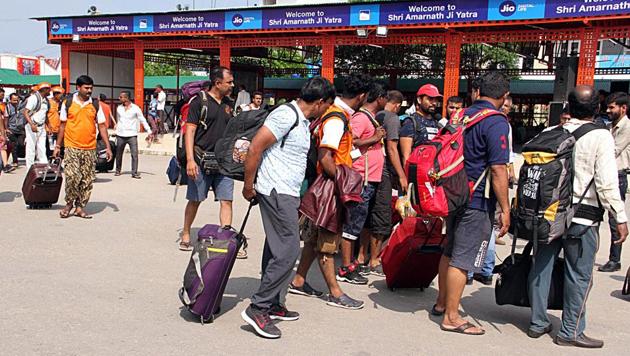
Also read: In wake of terror threats, over 6,200 passengers flown out of Srinagar
The roads to Chandanwari and Baltal, the starting points of the two routes to the cave, were covered by road opening parties of paramilitary forces, whose search and anti-sabotage teams were pressed into service. The Indian army’s Victor Force units searched parallel areas.
Preliminary reports suggest that the US-made M24 sniper rifle may have been procured from the Taliban by the JeM, a fellow Deobandi proponent, after the weapon was looted from the Afghan army. With the weapon having a range of 1.5 kilometres, the pilgrims would have been sitting ducks for the sniper, who would have been positioned around Sangam top.
With JeM seeking to avenge the February 26 Indian air force strikes on its camp in Pakistan’s Balakot camp, in which an unspecified number of its recruits were believed to have died, there has been a continuous flow of intelligence about the regrouping of the Pakistan-based group to attack Indian security forces in Kashmir.
Intelligence reports indicated that JeM cadre were planning an improvised explosive device (IED) attack on a security forces convoy on the Srinagar-Baramulla-Uri national highway on the lines of the February 14 Pulwama suicide car bombing that killed 40 Central Reserve Police Force (CRPF) troopers. Material for the IED’s fabrication, as per the reports, had already reached the Valley.
Another input highlighted the presence of a batch of three JeM terrorists in the Nezapir area of Poonch who could be used to plant IEDs on tracks used by Indian troops deployed in the posts of Barood, Sher, Shakti and Kaiyaan.
It is quite evident from the intelligence reports, whose contents were disclosed to Hindustan Times by security officials, that Pakistan had taken no action to restrain JeM. Fifteen Jihadists were moved to JeM camps in Markaz, Sanam bin Salma and Tarnab farms in Peshawar in Khyber Paktunkhwa (KPK) province after completing training in “askari jihad” at camps in the Jamrud area. Four of these 15 are from Nowhar and Peshawar, four from the Ali Masjid area en-route to Landi Kotal,located on the route across the mountains to Peshawar, and the remaining from Khyber province.
Given the serious threat posed by JeM to the Amarnath Yatra and the Kashmir valley as a whole, the Narendra Modi government decided to call off the pilgrimage rather than risk the lives of the pilgrims. On July 23-24, National Security Advisor Ajit Doval conducted an on-ground threat assessment in the Valley and briefed the three service chiefs and intelligence chiefs the same week on the need to reinforce security in the Valley to meet the terror threat.