
 E-Paper



Decoded: Why the government decided to curtail the Amarnath yatra
Inputs also indicated that trained JeM cadre had also formed Border Action Teams under the leadership of Ibrahim Azhar and moved to forward Pakistan army posts across the Line of Control (LoC) action.

 Prefer HTon Google


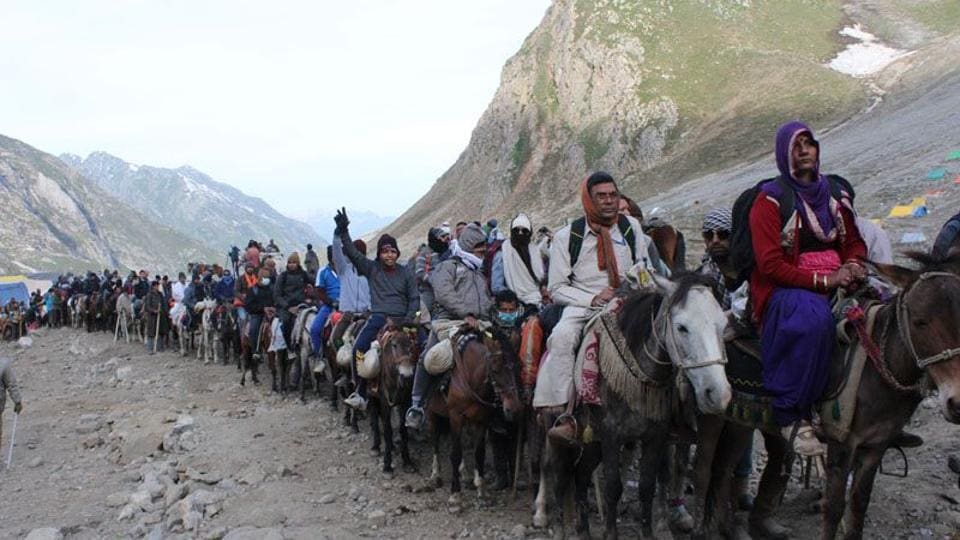
The government decided to end the Amarnath yatra and strengthen the counter-insurgency grid in Kashmir by fresh induction of forces after Indian intelligence reports indicated the possibility of multiple suicide attacks in the Valley and targeting of security forces by improvised explosive device (IED) in Sopore area by Pakistan-based terrorist groups, particularly the Jaish-e-Mohammed (JeM) group, two persons familiar with the development said.
According to one set of inputs that reached the national security establishment, Ibrahim Azhar, elder brother of JeM chief Masood Azhar, was sighted in Muzaffarabad in Pakistan-occupied Kashmir (PoK) last month.
Watch: ‘Pakistan based terrorists plotting attack on Amarnath yatra’: Army
Intelligence reports indicate that Ibrahim Azhar, the main orchestrator of the IC-814 hijacking in 1999, wanted to infiltrate into the Valley and lead attacks against Indian establishment to avenge the death of his son, Usman Haider, in a security operation in Jammu and Kashmir.
Inputs also indicated that trained JeM cadre had also formed Border Action Teams under the leadership of Ibrahim Azhar and moved to forward Pakistan army posts across the Line of Control (LoC) action.
Also read | Airlines waive off cancellation/rescheduling charges in Kashmir after govt tells Amarnath pilgrims to leave
Ibrahim Azhar’s son had infiltrated into Jammu and Kashmir in October 2018 and was gunned down by the Indian security forces in Awantipora area of Pulwama on October 30, 2018.
Another relative Talha Rasheed, son of Abdul Rasheed, brother-in-law of Masood Azhar, was killed on November 6, 2017 at Kandi Aglar, Pulwama by security forces.
Intelligence intercepts indicate that Ibrahim Azhar had fired up the Jaish cadre, telling them that he wanted to die fighting Indian security forces in Kashmir, the same way his son had died.
A senior security official said intelligence inputs around the Ibrahim Azhar’s groundwork to lead the terror attacks from the ground in Kashmir played a crucial role in the government’s decision.
Also read: Pilgrims urge government to review decision on Amarnath yatra
Already, the Indian intelligence establishment had noticed heightened activities of Pakistan-based terror groups including JeM and Lashkar-e-Tayyeba (LeT).
“With major threat coming from Pakistan based groups particularly JeM and recovery of M 24 sniper rifle and anti-personnel mines along the Amarnath pilgrimage route, the government decided not to take chances and curtailed the yatra. With personnel freed from yatra duties, the security forces can now concentrate on counter-insurgency grid,” said a senior JK Police offer.
Intelligence reports detail how the Pak-based groups were in the process of aggressively planning series of infiltration of armed cadre to step up violence in Kashmir. This included suicide attacks at multiple locations in Kashmir Valley.
Intelligence reports also spoke of JeM targeting the Indian security forces by IED in Sopore area of north Kashmir. Trained JeM cadre, an official said, are being readied in Peshawar to infiltrate into Kashmir and engage the Indian security forces through spectacular attacks.
Other terror groups like Hizbul Mujahideen, according to intelligence reports, were asked to coordinate with Pakistan based terror groups for IED attacks in South Kashmir and Srinagar.


