The critically endangered Lesser Florican, the world’s smallest bustard, uses a high-density migration corridor of nearly 60,000 sq km across western and central India while remaining strongly dependent on grasslands even when it moves through croplands and other open habitats, a new satellite-tracking study has found.
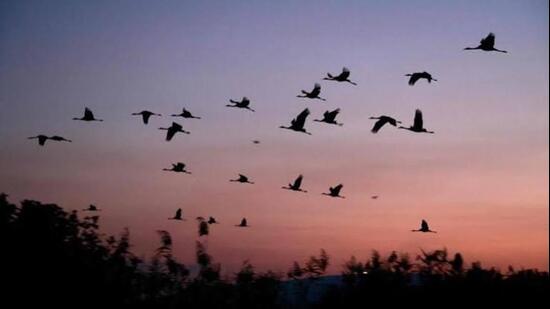
The study, published in Frontiers in Conservation Science on Wednesday, mapped a broad migration flyway spanning about 206,000 sq km across India for the endangered Lesser Florican (Sypheotides indicus).
“By linking fine-scale movement behaviour with landscape-scale patterns of land-use change and population decline, this study reinforces a central conclusion: the Lesser florican remains fundamentally a grassland specialist whose persistence is significantly constrained by the amount, configuration, and quality of remaining grassland habitat. While some behavioural flexibility exists through seasonal habitat shifts and divergent migratory strategies, this flexibility is unlikely to offset the ongoing trajectory of grassland loss, fragmentation, and agricultural intensification,” the study said.
The study was authored by Principal Chief Conservator of Forests (PCCF) and chief wildlife warden of Gujarat Jaipal Singh, lead researcher of the Gujarat forest department Mohan Ram, deputy director of The Corbett Foundation Devesh Gadhavi, along with Tahir Ali Rather, Vidhi Modi and Dushyantsinh Jhala of the Foundation.
Researchers fitted Global Positioning System (GPS)-Global System for Mobile Communications (GSM) transmitters on 12 lesser floricans between 2020 and 2022 and tracked them until 2025. The birds were tagged at Blackbuck National Park in Velavadar in Bhavnagar district and the Kutch Bustard Sanctuary and adjoining Naliya grasslands in Kutch, sites separated by about 450 km.
{{/usCountry}}Researchers fitted Global Positioning System (GPS)-Global System for Mobile Communications (GSM) transmitters on 12 lesser floricans between 2020 and 2022 and tracked them until 2025. The birds were tagged at Blackbuck National Park in Velavadar in Bhavnagar district and the Kutch Bustard Sanctuary and adjoining Naliya grasslands in Kutch, sites separated by about 450 km.
{{/usCountry}}The researchers described the 12 birds as the largest cohort of lesser floricans tracked through a single tagging effort in India. The tracking produced 160,166 location records, of which 150,147 GPS fixes were retained for analysis. The transmitters were active for a combined 4,466 days.
The lesser florican has suffered an estimated 80% population decline over the last three to four generations. A nationwide assessment cited in the study estimated the total lesser florican population at about 480 birds, based on a conservative estimate of 240–264 territorial males and an assumed equal sex ratio, compared with an estimated 3,530 birds in 1999. Gujarat’s Blackbuck National Park is one of the remaining strongholds, with an estimated 95 to 115 males.
Grasslands remain critical to lesser florican
The study found that grassland was the most selected habitat during both the breeding season, June to September, and the non-breeding season. Resident birds remained closely tied to grasslands throughout the year. Migratory birds used croplands and shrublands more than residents outside the breeding season, but grassland remained their most selected habitat.
The researchers found a strong relationship between the birds and their distance from grassland. The probability of habitat use fell sharply as the distance from a grassland patch increased, indicating that the birds remained dependent on grassland remnants even when moving through agricultural areas.
The finding is important because cropland does not appear to provide a substitute for grassland. Although lesser floricans spent substantial time in croplands, they remained spatially linked to grassland remnants and used the surrounding agricultural matrix only secondarily, particularly outside the breeding season, the study found.
The study recommends restoring degraded grasslands, including village gauchars, community grazing lands and revenue lands, by removing invasive and woody vegetation. It also calls for maintaining suitable grassland structure through regulated grazing and seasonal restrictions on intensive land use, while involving local pastoral communities in restoration and management. It says such restored grasslands can provide refuge patches for lesser floricans while also improving fodder availability and livestock security for local communities.
Three tracked birds showed local migratory movements. A female moved from Gujarat to Telangana in November 2020 and stayed there for about six months before dying during her return journey after colliding with a high-tension power line in Maharashtra. Two males showed different migration strategies. One followed a repeated seasonal circuit through Maharashtra, Karnataka, Gujarat and Rajasthan, while the other moved more widely, including a prolonged period in Madhya Pradesh and a monsoon stay in Gujarat.
Over four years of tracking, one male travelled 3,036 km during migration, spending 196 days in transit and averaging 15.49 km a day. The other travelled 4,873 km over 134 migratory days, averaging 36.36 km a day, the study said.
Broad migration flyway, low flight height
The migration flyway did not follow a single fixed routes.
“Spatial smoothing of trajectory density revealed a broad migration pathway characterised by overlapping but partially parallel routes rather than a single concentrated track. The resulting flyway surface indicated repeated use of multiple spatially adjacent pathways across migration cycles and among individuals. A total of 14 migration cycles were analysed to construct the flyway surface,” the study said.
The broader flyway covered 206,322 sq km, while the high-density corridor covered 59,826.59 sq km. Its mean width was 70.8 km, although its width varied across the landscape.
The birds moved farther and faster during the monsoon than during other seasons and were more active during the day, the tracking showed. It also showed that the birds fly at low heights.
The tracking showed that the birds flew at an average height of 24.4 metres, putting them within the 10–40 metre range of overhead power lines and increasing collision risk. The study recommends line marking, flight diverters, underground cabling and keeping infrastructure away from key breeding and feeding areas.