The Supreme Court on Tuesday said no individual, group or organisation could claim an indefinite right to occupy a designated protest site, underlining that others too have an equal constitutional right to use the same public space to raise their grievances.
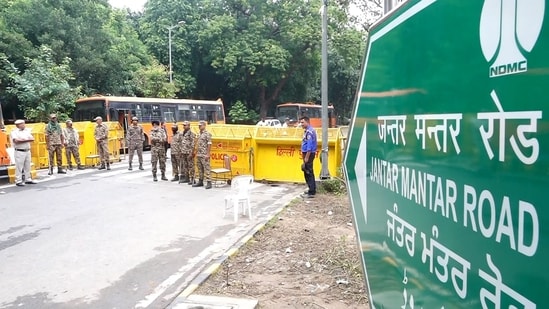
The observations came as the court heard a clutch of petitions arising from the police action during the July protests led by the Cockroach Janata Party (CJP), including allegations of mass detentions, police excesses, internet restrictions and the closure of metro stations.
The protests, which saw a proposed march towards Parliament and incidents of violence, also triggered a separate challenge by Delhi’s traders, who said the prolonged demonstrations had disrupted business and affected their livelihoods.
“Even the right to protest at a designated site has to be for a certain period. You cannot occupy a protest site for all time to come…where will farmers, traders, journalists go? Everyone has a right to protest. Designated sites must be given for a designated period,” a bench, comprising Chief Justice of India Surya Kant and justices Joymalya Bagchi and V Mohana, observed.
The bench made it clear that permission to hold a protest at an identified site could not translate into an open-ended licence to occupy it.
{{/usCountry}}The bench made it clear that permission to hold a protest at an identified site could not translate into an open-ended licence to occupy it.
{{/usCountry}}“You cannot occupy a protest site indefinitely. You cannot prevent other people from protesting, saying ‘I can protest and you cannot’,” said the court, adding that the order granting permission must spell out the reasons for allowing or refusing a protest and, if allowed, the duration for which the site could be used.
Among others, the court was hearing a petition filed by the Kirana Committee Delhi and other traders’ bodies, represented by senior advocate Mukul Rohatgi, who said businesses in parts of the capital had suffered because of the demonstrations, particularly during the festive season. He told the bench that the Ramlila Ground was close to Connaught Place and that the surrounding stretch was home to millions of residents as well as several shops and commercial establishments.
Rohatgi urged the court to consider a solution that would protect the right to trade and earn a livelihood, including that of small traders, daily-wage workers and transport operators. He sought a prohibition on protests and dharnas in Delhi for the next two months, whether held with or without permission.
The bench, however, cautioned against treating the dispute as one in which either side must surrender its rights.
“It is a competing right -- your right to trade, business and earn livelihood and someone’s right to protest peacefully,” it said. The right to livelihood, it added, was not confined to business profits but extended to daily wagers and small traders.
“These are two competing claims -- right to protest is recognised by the Constitution and right to trade and earn livelihood,” said the bench, adding that the way forward was to identify public spaces for demonstrations without hampering the ability of others to earn their livelihood.
Solicitor General Tushar Mehta, representing the Centre and Delhi police, told the bench that permission for the July 20 demonstration had been granted for only a day, but the protesters occupied the site for 17 days and subsequently called for a march to Parliament without permission. He said those organising a bandh or protest must take responsibility for its consequences.
The bench asked Rohatgi to implead the organisations that had organised the demonstrations, saying their responses were necessary before the court could decide the competing claims. It also asked him to place on record an assessment of the financial losses suffered by traders.
The proceedings also covered petitions raising concerns over police action during the July demonstrations, including alleged illegal detentions, the use of facial recognition technology and surveillance of protesters. The court noted nine categories of issues arising from the petitions and allowed the Centre and Delhi Police to file their responses either during the day or shortly thereafter.
To be sure, the Supreme Court had earlier invoked its powers under Article 142 of the Constitution to quash FIRs registered against students who participated in the July 20-25 protests over the NEET-UG examination. It directed that any other FIRs relating to the same incidents across the country would not be pursued or investigated and would be treated as closed, while permitting action against 2,873 individuals identified by Delhi Police as having serious criminal antecedents.
The court is also examining the controversy over the Delhi Police’s decision to denotify Jantar Mantar as a designated protest site and shift demonstrations to Ramlila Ground, Burari Ground and CBD Ground. It has issued notice on a challenge to the decision, saying it would examine whether the authorities had independently applied their minds to the suitability and efficacy of Jantar Mantar as a protest venue.
Surveillance at protest sites
On the surveillance challenge, advocate Prashant Bhushan, appearing for the Software Freedom Law Centre, India, questioned the legal framework under which facial recognition was being used and its implications for the right to privacy.
The court said the issue could not be reduced to the mere presence of CCTV cameras at a public place. The court would have to examine whether the use of technology to identify individuals and match their images against databases affected privacy, and whether such use was backed by a legitimate state aim. The bench also referred to amendments to the Identification of Prisoners Act that enable the collection and use of biometric information, including iris scans.
The court had, at an earlier hearing, directed the Centre to produce the orders issued under Section 163 of the Bharatiya Nagarik Suraksha Sanhita during the protests. On Tuesday, senior advocate Menaka Guruswamy, appearing for some petitioners, said the relevant orders had still not been supplied to them,
The Centre maintained that its affidavit covered the issue. Senior counsel Mukta Gupta, N Hariharan, CU Singh, Meenakshi Arora, PV Dinesh and Arundhati Katju also appeared in the matter on behalf of the petitioners and applicants.
The bench said the petitions would be taken up category-wise, with lawyers allotted fixed time to advance their arguments, to ensure that the wide range of issues could be addressed in an orderly manner.