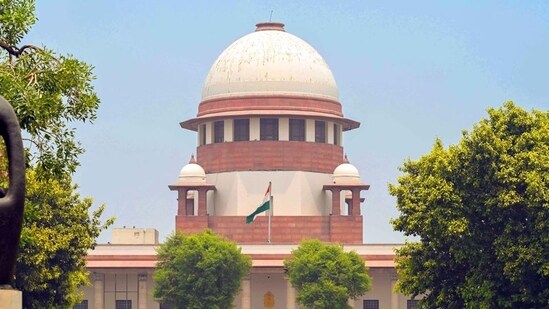
The Supreme Court on Monday dismissed pleas challenging the 1976 amendment that added the terms “socialist,” “secular,” and “integrity” to the Preamble of the Constitution.
A view of the Supreme Court of India in New Delhi. (Hindustan Times)
A bench comprising Chief Justice Sanjiv Khanna and Justice Sanjay Kumar had reserved its verdict on November 22 on pleas by former Rajya Sabha MP Subramanian Swamy, advocate Vishnu Shankar Jain, and others, contesting the addition of “socialist” and “secular” to the Constitution's Preamble.
{{^htLoading}} {{/htLoading}}
{{^usCountry}}{{/usCountry}}
The petitioners also questioned the legitimacy of the 1976 Parliament, which operated during the Emergency and under an extended tenure. Advocate Vishnu Shankar Jain, representing Singh, argued, “The tenure of the Lok Sabha was extended to address emergency requirements, not to amend the Constitution. Adding these words without public consultation distorted the original intent of the framers.”
Swamy argued that the inclusion of the terms made the Preamble inconsistent with its original adoption. He suggested that the words be recognized as later additions, rather than implying they were part of the original text.
However, dismissing the petitions, the Chief Justice of India said that they did not warrant a detailed hearing.
{{/usCountry}}
{{#usCountry}}
However, dismissing the petitions, the Chief Justice of India said that they did not warrant a detailed hearing.
{{/usCountry}}
“The two expressions ‘socialist’ and ‘secular’ were made in 1976 through amendments and the fact that the Constitution was adopted in 1949 does not make any difference... the retrospectivity arguments if accepted will apply to all amendments,” CJI Sanjiv Khanna.
The bench emphasised that Parliament’s authority under Article 368 to amend the Constitution extends to the Preamble. The court reiterated that the amendment has undergone extensive judicial scrutiny and legislative endorsement in the decades since its enactment.
During previous hearings, the court addressed concerns over the meaning of ‘socialism,’ affirming that the term in the Indian context signifies a welfare state and does not conflict with the growth of the private sector.
{{^htLoading}} {{/htLoading}}
"Socialism in India is about equitable distribution of resources and equality of opportunity. It does not hinder private enterprise, which thrives in our country,” the bench remarked.
Follow the latest breaking news, major developments and agenda-setting stories from India and around the world with the newsdesk at Hindustan Times. Operating round the clock, the desk brings together experienced editors, reporters and correspondents to deliver fast, accurate and contextual reporting across subjects that influence public policy, governance, business, society and international affairs. The HT News Desk covers politics, elections, government policies, the economy, business and markets, science and technology, the environment, law and order, infrastructure, education, climate issues and geopolitics, while closely tracking developments across states, institutions and global capitals. The team also leads coverage of major breaking news events, policy announcements, court proceedings, natural disasters, public emergencies and significant international developments. Reports published by the newsdesk are based on information gathered from reporters on the ground, official statements, government agencies, court records, regulatory filings, recognised institutions and other authoritative sources. Stories undergo editorial scrutiny and verification processes to ensure accuracy, fairness and relevance, and are updated as events evolve and additional information becomes available. Whether covering a key political decision in New Delhi, an economic policy shift affecting millions, a landmark court ruling or a major global event, the HT News Desk aims to provide readers with reliable, fact-based journalism that delivers not only the latest developments but also the context and analysis needed to understand their wider implications.
Get Latest News, breaking headlines, and top India News, and today real-time updates from across the nation. Stay informed on politics, government policies, crime, Today Weather, and major developments on Hindustan Times
Get Latest News, breaking headlines, and top India News, and today real-time updates from across the nation. Stay informed on politics, government policies, crime, Today Weather, and major developments on Hindustan Times
Home/India News/Supreme Court dismisses pleas against ‘socialist’ and ‘secular’ in Constitution's Preamble
{{^htLoading}}
Advertisement
{{/htLoading}}
SHARE THIS ARTICLE ON
{{#usCountry}}{{/usCountry}}
Notifications
Get breaking alerts directly from the newsroom
Notifications are on!You'll be notified when news breaks