A constitution bench of the Supreme Court on Monday upheld the central law for 10% reservation benefits to the economically weaker sections (EWS) 3-2 with Justice Dinesh Maheshwari saying it does not violate the Constitution’s basic structure or equality code by taking into account economic criteria.
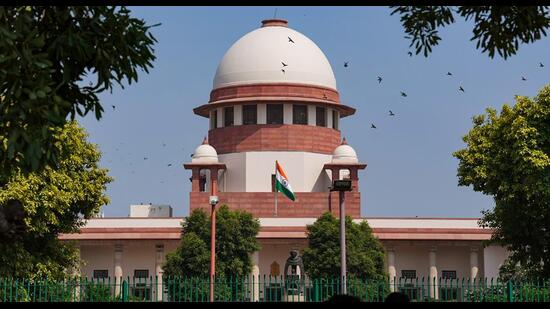
“It does not also cause damage to any essential feature by exceeding the 50% ceiling for quota since the ceiling is itself flexible,” he said. Justice JB Pardiwala, who also ruled in favour of the law, said reservation should not continue for an indefinite period to make it a matter of vested interest.
Justice Bela M Trivedi also upheld the law while Justice S Ravindra Bhat dissented, calling it discriminatory and violative of basic structure. “EWS quota law is based on the principle of exclusion, perpetuates discrimination.” Chief Justice of India (CJI) Uday Umesh Lalit concurred with Justice Bhat.
The constitution bench ruled on a batch of legal issues surrounding the validity of the 103rd Constitution Amendment providing for 10% reservation for EWS.
By the amendment, Articles 15(6) and 16(6) were introduced in the Constitution providing 10% reservation in jobs and admissions to EWS or people from other than Scheduled Castes (SC), Scheduled Tribes (ST), and Other Backward Classes (OBC) and whose annual family income is below ₹8 lakh.
{{/usCountry}}By the amendment, Articles 15(6) and 16(6) were introduced in the Constitution providing 10% reservation in jobs and admissions to EWS or people from other than Scheduled Castes (SC), Scheduled Tribes (ST), and Other Backward Classes (OBC) and whose annual family income is below ₹8 lakh.
{{/usCountry}}The legal issues included whether the amendment can be said to breach the basic structure of the Constitution by permitting the State to make special provisions, including reservation, based on economic criteria; or by permitting the State to make special provisions in relation to admission to private unaided institutions.
The court’s verdict was expected to change the paradigm that has governed reservations in India, preventing states from enforcing quotas that take the proportion above the 50% mark laid down in 1992 by the apex court. It also takes a call on economic criteria being the chief yardstick to provide reservation to those belonging to upper castes while keeping the conventionally defined backward classes such as SC, ST, and OBC out of the scope of the quota benefits under this law.
The court on September 27 reserved its verdict on the petitions that questioned the constitutional validity of the EWS quota, saying the 103rd Constitutional Amendment violated the 50% ceiling under the 1992 judgment. The pleas said the amendment was also unconstitutional as it considered economic status as the sole criterion for identifying backwardness.
The petitioners opposed reservation for EWS also on the ground that any affirmative action is meant for backward classes and that the law is also bad for excluding those among SC, ST, and OBC from its purview.
The central government defended the 10% reservation claiming that it was a shift from the caste-based reservation. In September, the Centre told the court that the 50% cap on the reservation is “not sacrosanct”. It added the economic criteria are perfectly valid and have been judicially affirmed as a relevant factor for the determination of social and educational backwardness.
The Centre maintained that the Preamble of the Constitution provides for the upliftment of EWS, which could be through reservations in educational institutions, posts in public employment, and a series of welfare measures that the State is bound to provide to weaker sections of society.
It maintained the EWS quota will not impact the seat share of reserved or open category candidates as an additional over 200000 seats will be created in central educational institutions at an earmarked budget of ₹4,315 crore.
Madhya Pradesh, Assam, and Andhra Pradesh supported the Centre and defended the law. Tamil Nadu opposed the EWS quota.