Defence minister Rajnath Singh on Friday said that the progress in negotiations with China should help resolve the ongoing border dispute but he “couldn’t guarantee to what extent the situation will be resolved”, underling that progress in resolving the tensions along the contested Line of Actual Control (LAC) between the two nuclear powers has been a challenging and arduous process.
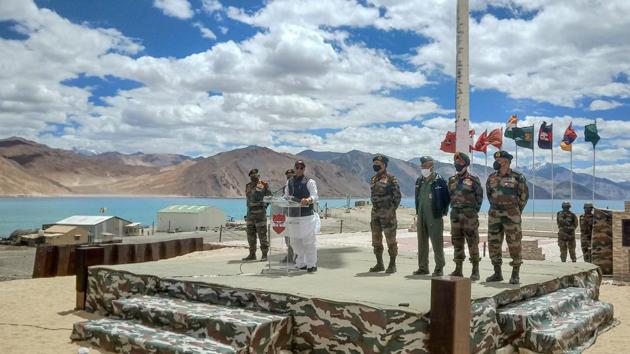
Addressing soldiers at Lukung on the western bank of Ladakh’s Pangong Tso, which has been at the centre of the current border tensions, Singh also said that no power could “touch or grab even an inch of Indian territory”. Lukung is 43km from Finger 4 on the northern bank of Pangong lake.
The defence minister’s comments came a day after India said the complex disengagement process with China on the LAC is specifically aimed at preventing “face-off situations”, and any unilateral attempts to change the status quo on the disputed border won’t be accepted. Two days after senior military commanders from both sides met at Chushul, the Indian Army on Thursday said complete disengagement is an “intricate process” requiring “constant verification”.
Singh, who landed in Leh on Friday morning, was briefed on the security situation in the sensitive sector including the actual position of troops on both sides of the contested border, people familiar with the developments said. He also witnessed a series of combat manoeuvres at nearby Stakna featuring C-130J special operations aircraft dropping paratroopers, Apache AH-64E attack helicopters, T-90 tanks, infantry combat vehicles and Mi-17 helicopters — with the military imagery meant to signal India’s resolve and readiness to deal with any eventuality in the region.
{{/usCountry}}Singh, who landed in Leh on Friday morning, was briefed on the security situation in the sensitive sector including the actual position of troops on both sides of the contested border, people familiar with the developments said. He also witnessed a series of combat manoeuvres at nearby Stakna featuring C-130J special operations aircraft dropping paratroopers, Apache AH-64E attack helicopters, T-90 tanks, infantry combat vehicles and Mi-17 helicopters — with the military imagery meant to signal India’s resolve and readiness to deal with any eventuality in the region.
{{/usCountry}}The combat drills he saw in Stakna demonstrated “the application of integrated combined force in high altitude terrain”, said one of the officials cited above.
Singh, who was accompanied by chief of defence staff General Bipin Rawat and army chief General Manoj Mukund Naravane, recalled the brutal clash in Galwan valley on June 15 and paid tribute to the 20 Indian soldiers killed in the skirmish. He added that India had neither attacked any country nor grabbed anyone’s territory or hurt their self-respect. “But if anyone attempts to hurt India’s self-respect, we will not tolerate it and will give a befitting reply,” he said. He said India’s leadership was strong and Prime Minister Narendra Modi was capable of taking decisions.
While Singh said that nothing could be better than finding a solution to the dispute through dialogue, and that process was on at the military and political level, military affairs experts said the minister’s comments on not being able to guarantee the outcome of the talks pointed to the complexity of the dialogue process.
“It clearly highlights the complications and difficulties in the negotiations between the two sides. The comments also indicate that India and China have not been able to narrow down their differences on Pangong Tso and Despsang,” said former Northern Army commander Lieutenant General (retired) DS Hooda.
“The minister has indicated that while disengagement has begun, the larger issue of de-escalation is the tough task ahead and contingent on Chinese behaviour now and in the future,” said Sameer Patil, member, international security at Gateway House, a Mumbai-based foreign policy think tank.
Officials and experts indicated the army is preparing for the long haul as disengagement isn’t likely in the short term.
India’s high-powered China Study Group (CSG) on Wednesday reviewed the latest developments in eastern Ladakh, with the focus on the next stage of disengagement following the 14-hour meeting between the corps commanders on July 14.
The disengagement -- which began earlier this month after talks between the two Special Representatives -- national security adviser Ajit Doval and foreign minister Wang Yi on July 6 -- involves rival troops pulling back a specified distance from face-off sites, with further retreat taking place in phases as the plan progresses on a verifiable basis on the ground every 72 hours.
The focus of the current military talks is to reach consensus on easing tensions between the two armies in Finger Area near Pangong Tso and Depsang plains, as well as pulling back weapons and equipment from “friction points” in other sectors.
A fifth meeting between delegations led by Lieutenant General Harinder Singh, commander of Leh-based 14 Corps, and Major General Liu Lin, commander of the South Xinjiang military region, is expected to be held in two weeks to take things forward.