E-Paper



Tariff crisis looms over carpet industry
In India's carpet city and its twin to the south of Mirzapur, 800,000 people directly employed by carpet making units, another 1.2 mn are indirectly employed.

 Prefer HTon Google


Aslam Mehboob, a carpet factory owner in Uttar Pradesh’s Bhadohi town, is worried about his future. The 55-year-old runs a ₹10 crore business that exports 3,000 hand-knotted carpets every year. His biggest market: the US.
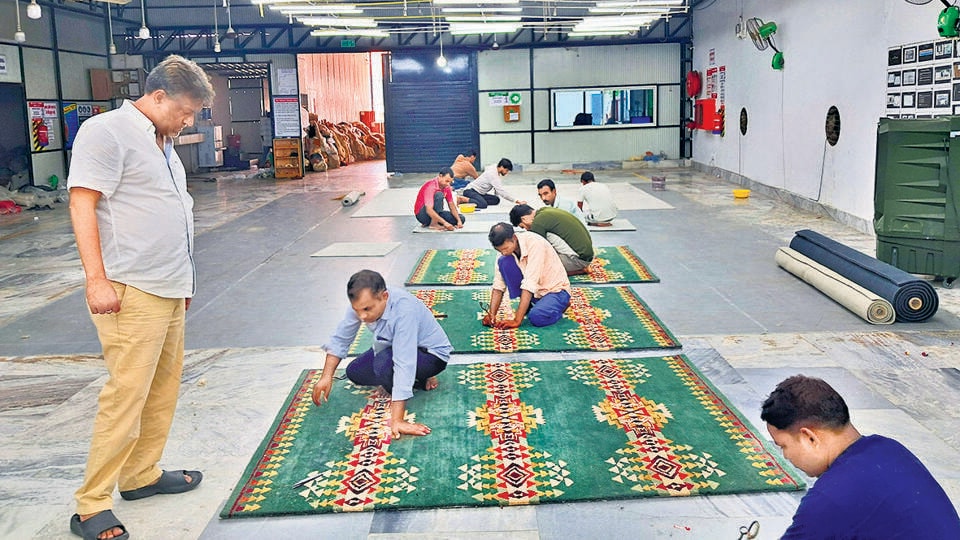
Mehboob’s factory, Alam Rugs, employed 30 people just two months ago. Today, it has dwindled to 10 as the industry faces uncertainty.
“All handmade carpet manufacturers are tense due to the tariff. It has caused uncertainty in the handmade carpet sector. Consequently, carpet makers like me have cut their production up to 30%,” said Mehboob.
Aslam creates woollen carpets in a variety of styles, including Tibetan, Turkish, Persian, Handloom, with prices ranging from ₹5,000 to ₹50,000 depending on the quality of the raw materials used and the craftsmanship involved. The carpets are exported to the US and Australia.
“The tariff war has left us sleepless,” said Mehboob.
The secondary tariff of 25% on India’s exports to the US kicked in this week, taking the overall tariff to 50%, a level at which almost all Indian exports to the US — pharma and electronics products are exempt from the tariff, for now — will be uncompetitive.
In Bhadohi itself, where 1,400 export-oriented carpet making units employ 800,000 weavers and artisans, that’s bad news.
Shaezib Mehboob, another carpet maker in Bhadohi, pointed out that the US is the largest buyer of handmade carpets. “We don’t face much competition from other Bhadohi manufacturers. The main competition comes from Turkey’s machine-made carpets, which are significantly cheaper,” he said.
But buyers prefer handmade ones; only, they will be even more expensive now, and more buyers may move to the machine-made ones. The prices can’t be cut further, Mehboob explained -- profit margins are already only 5-10%.
The tariffs have upturned the economics of the business -- and of this Uttar Pradesh town.
“About 60% of all handmade Indian carpets are exported to the US. However, due to high tariffs, US buyers are now demanding price reductions of over 25%. If the orders currently on hold end up being cancelled, it would deal a severe blow to carpet manufacturers. This could significantly reduce production, ultimately impacting the livelihoods of the weavers,” Mehboob added.
If almost everyone in India’s carpet city and its twin to the south Mirzapur is worried about the impact of the 50% US tariff on the hand-knotted carpet sector, it’s because in addition to the 800,000 people directly employed by carpet making units, another 1.2 million are indirectly employed.
Weaving here began during the reign of Mughal emperor Akbar in the 16th century. Iranian master weavers were brought to the area, setting up looms near the village of Khamaria in Bhadohi. Gradually, carpet weaving started in Bhadohi and spread to Mirzapur.
Over the years, the industry has battled growing competition in the international market, particularly due to the availability of cheaper, machine-made carpets. Covid-19 dealt a blow, as did the continued shortage of skill wavers. But the industry survived all of this.
Now, Piyush Barnwal, director of the Carpet Export Promotion Council (CEPC), is worried that the tariffs will deal a body blow to the region, which exports carpets worth ₹5,000 crore, of which around 60% are to the US, according to data from the council
He said that American buyers were “bargaining” to decrease the rate by up to 45% on every order to compensate for the import duty they have to pay. Competing with his products were carpets from Turkey and Pakistan, which were 50% and 30% cheaper. Turkey faces a tariff of 15% and Pakistan 19%.
“For instance, if an American buyer places an order worth ₹1 crore, they will have to deposit ₹50 lakh in import duty before receiving the consignment,” said Barnwal.
“They want us to give them carpets at 45% less so that they can compensate for the tariff tax they have to deposit.”
That’s just not feasible, but manufacturers fear that if they do not accept these demands, the buyers may cancel their pending orders and purchase carpets from other countries such as China, Turkey, Belgium, and Pakistan.
Weaver Rajdev Yadav, a resident of the Gaurihat village near Bhadohi, said most weavers earn between ₹250 and ₹300 per day if they work continuously. “We’ve heard something about a tariff imposed by the US on Indian goods, but we don’t know much about it. We just weave carpets to earn our daily wages”, he said.
Rajesh Kumar, vice president of the All India Carpet Manufacturers Association (AICMA), said that buyers were anyway free to turn to other countries for machine-made carpets, which are available at lower rates, and the tariffs will only serve to push more consumers towards cheaper products.
Vinay Kapoor, former president of AICMA, confirmed that buyers had started asking for a rate reduction. “It is not feasible for the carpet makers/exporters to suddenly reduce the rates since this business doesn’t include so much profit. The government’s support is required in this hour of need.”
Ashraf, another Bhadohi-based carpet maker who gave only one name, said that the industry was living in “uncertainty” and feared that if orders were cancelled, makers would be forced to shut down production. “Nearly 50% of orders have been put on hold by buyers, and around 20% are currently in the process of being cancelled,” Mehboob said.
Raju Gautam, a weaver at Mehboob’s factory, hoped that the issue is resolved as soon as possible so that weavers like him can continue to earn their livelihood by creating world-class carpets—a tradition that has sustained their families for generations. “If the tariff continues, the carpet industry will face a significant decline in the long run and our livelihoods will be hit,” he said.
The industry has now asked for a bailout package. Carpet Export Promotion Council (CEPC) chairman Kuldeep Raj Wattal wrote to Prime Minister Narendra Modi on August 4, highlighting that the new tariffs could lead to mass order cancellations, job losses, and a rapid loss of market share to competitors.
Ashutosh Pathak, deputy commissioner of industries in Bhadohi, said talks are on to provide incentives to carpet manufacturers to help reduce the burden caused by the tariffs. “We held regular meetings with carpet manufacturers to understand their concerns and suggestions. Based on these discussions, we prepared a dossier that has been submitted to the Uttar Pradesh government.”