Two adult tigers were photographed in Arunachal Pradesh’s Dibang Valley Wildlife Sanctuary in 2018 during the tiger estimation survey by the National Tiger Conservation Authority (NTCA), according to the 656-page “Status of Tigers, Co-predators and Prey in India” report that was released on Tuesday.
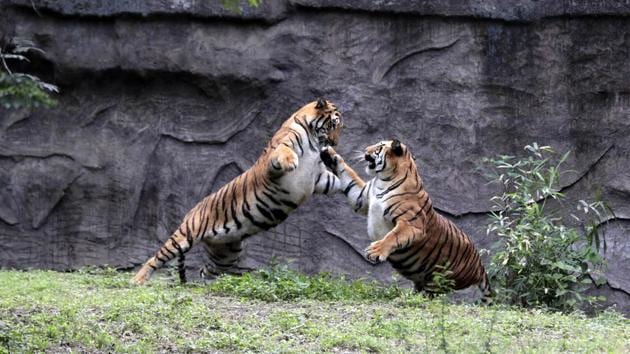
The Union Ministry of Environment, Forest and Climate Change (MoEFCC) has brought out the 2018 report.
Dibang Valley holds unique importance for in-situ conservation of this “unique and genetically diverse lineage of tigers” as the local aboriginal community, Idu Mishmis, a sub-tribe of Mishmi and of Mongoloid origin, who speaks the Tibeto-Burman language, considers tiger as the ethnic group’s elder brother, the NTCA has said in its report.
In the Dibang-Kamlang-Namdapha block, the report has estimated the presence of 29 tigers based on scat samples and camera-trap images.
The confirmation of the presence of tigers in Dibang Valley holds immense importance to the Idu Mishmis because large forest areas around the Dibang Valley Wildlife Sanctuary are being considered for diversion.
The proposed 3,097 mega-watt Etalin Hydropower Project is likely to impact 1150.08 hectares (ha) of forestland and the Dibang Multipurpose Dam will impact 4,577.84 ha of un-classified state forest and other community lands.
{{/usCountry}}The proposed 3,097 mega-watt Etalin Hydropower Project is likely to impact 1150.08 hectares (ha) of forestland and the Dibang Multipurpose Dam will impact 4,577.84 ha of un-classified state forest and other community lands.
{{/usCountry}}Both the projects are under different stages of consideration by the MoEFCC.
In 2014, an adult tiger was photographed in the Dibang Valley during the estimation process. Molecular signs were also noted.
“Tiger presence is repeatedly being seen during camera-trap exercises. The Dibang Valley is an ideal natural habitat for tigers,” said SP Yadav, member-secretary, NTCA.
The 2018 estimation has recommended that discussions be conducted with the Idu Mishmis before proceeding with any legal notification of the sanctuary to be a tiger reserve.
During a three-year-long camera trap-based study in the Dibang Valley Sanctuary and the adjoining Mishmi hills, 11 tigers, including two cubs, were identified by a team of researchers from the Wildlife Institute of India (WII), who had published their results in the Journal of Threatened Taxa in 2018.
But, WII in a report titled, “Wildlife Conservation Plan for the Impact Zone of Etalin HEP”, said there was no tiger presence in the project area.
“These projects will impact both the tiger and its prey. Some of the prey cross the Talon river or they are found in abundance along the river like the Mishmi Takin. If the MoEFCC authorities consider the tiger to be an important species, then they will not consider projects that will be disastrous for the animal’s habitat. The community had always known about tigers’ presence in their homeland,” said Anoko Mega, member, State Wildlife Advisory Board, Arunachal Pradesh.
“If at all a tiger reserve is declared in the area, the boundary should be demarcated after consulting the local indigenous population in a bid to ensure that there is no impact on human habitation,” he added.
The Idu Mishmi community members consider tigers as their kin with whom they have been co-existing through the generations.
The Idu Mishmi Cultural & Literary Society (IMCLS), an apex community body, had written to NTCA and MoEFCC authorities in 2018, stating that the community would like to be consulted before proceeding with notifying the Dibang Valley Sanctuary to be a tiger reserve.
“Based on years of empirical research on ecological and social aspects of tigers in Dibang Valley, we strongly believe that the right strategy to develop a new kind of tiger reserve that is built not with fences and armed patrol guards, but around a cultural model. It is a culture, which has so far proven to be effective in saving the tiger,” IMCLS had written.
The 2018 NTCA report has cited that Arunachal Pradesh has large contiguous forests over 136,000 kilometres (km), including Pakke Tiger Reserves in the west; Tale Valley Wildlife Sanctuary, Mouling National Park, D’Ering Wildlife Sanctuary, Mehao Wildlife Sanctuary in the centre; Dibang Wildlife Sanctuary in the north, and Kamlang and Namdapha Tiger Reserve in the east.
“Compared to earlier surveys this landscape unit shows a persisting low-density tiger population … the largest tiger population of Arunachal Pradesh is within pockets of this landscape,” it has said.
The Trans Arunachal Highway — a 1,811-km-long trunk road — would become a barrier for the movement of the wildlife species in several of these corridors in the years to come, it has warned.