The Narendra Modi government plans to bring in legislation to ban instant triple talaq, or talaq-e-biddat, in the winter session of Parliament, providing a legal framework to prosecute Muslim men calling off marriages using a custom outlawed by the Supreme Court.
Government sources said on Tuesday that the government had set up a ministerial panel and will either bring a new law or amend existing provisions to ban talaq-e-biddat and punish those practising it.
Talaq-e-biddat involves Muslim men divorcing their wives by mentioning the word ‘talaq (divorce)’ three times in one go, sometimes over email, WhatsApp messages or letters. In August, the top court had struck down the custom as arbitrary and unconstitutional in a verdict that was hailed as a watershed moment for gender justice in India.
But in the next few months, several complaints of instant triple talaq poured in from across the country with Muslim women saying they were divorced through the custom despite the SC order. “Even police are helpless as no action can be taken against the husband in the absence of punitive provisions in the law,” the sources said. The government’s proposed move could help plug that loophole.
“It is to this end that the positive step being taken by the government of enacting a legislation will go a long way in deterring the Muslim husbands from divorcing their wives…,” the sources added. They said the reason behind the new cases of triple talaq could be lack of knowledge about the SC decision, or the absence of legal punishment.
{{/usCountry}}“It is to this end that the positive step being taken by the government of enacting a legislation will go a long way in deterring the Muslim husbands from divorcing their wives…,” the sources added. They said the reason behind the new cases of triple talaq could be lack of knowledge about the SC decision, or the absence of legal punishment.
{{/usCountry}}‘Consult Muslims’
Muslims organisations reacted to the government’s decision with caution.
Maulana Khalid Rasheed Farangi Mahli, who is a member the All India Muslim Personal Law Board (AIMPLB), said the government should consult all stakeholders before introducing a legislation in Parliament.
“Whatever the present government is doing, it is in sync with the apex court verdict,” he said.
Siddiqullah Chowdhury, minister in charge of library and mass education in the West Bengal government, said “quashing” Muslim law through legislation will be wrong. “The government can certainly table a Bill on the basis of the Supreme Court judgement. But I think the right to talaq comes under the purview of Muslim personal law, and quashing it through legislation may tantamount to interfering with fundamental rights,” said Chowdhury, who is the president of the Bengal unit of Jamiat Ulema-e-Hind, an organisation that runs the largest number of madarsas in the state.
Mohammad Kamruzzaman, general secretary of the All Bengal Minority Youth Federation, too wanted the government to consult Muslims. “Interference of the government in this matter is not desirable,” he said.
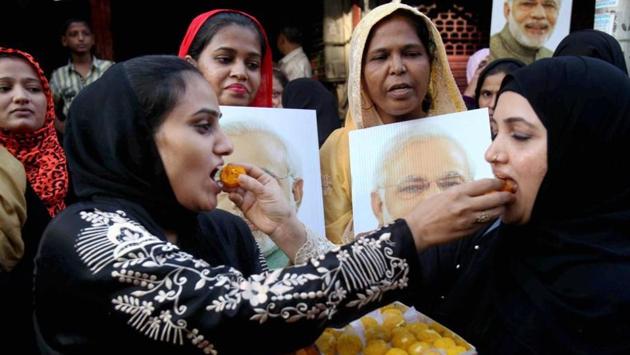
Shaista Amber, president of All India Muslim Women Personal Law Board, welcomed the government’s decision. “I want to thank the judges of Supreme Court for banning triple talaq and I’m happy that the government is keeping its promise of making a law within six months of the SC verdict,” she said.
The Congress said it will support any progressive step that protects the status of a Muslim woman but insisted on seeing the contents of the bill first.
“Unless we see the contents of the bill, we can’t comment on it. But having said that we support and stand by any progressive step that protects the status of a Muslim woman,” Congress leader Sushmita Dev said.
“I am skeptical because there is a difference in what they (government) say and what they do.”
The top court in August said instant triple talaq was against the tenets of Islam and violated gender equality. Its decision came on the petitions of several Muslim women affected by the custom.
Ahead of the Uttar Pradesh assembly elections early this year, the issue of triple talaq dominated the public discourse, with the BJP terming it as an issue of gender justice and equality.
Prime Minister Narendra Modi had said that lives of Muslim women could not be allowed “to be ruined” by triple talaq,”
While the opposition parties cried foul, accusing the BJP of trying to politicise the issue, the ruling party rejected the allegations, re-iterating the party’s commitment to gender justice. After the party’s resounding victory in UP, BJP leaders claimed a section of Muslim women had voted for the party because of its stance on triple talaq.
The government’s move to bring a bill in the forthcoming winter session of Parliament is likely to resonate in poll-bound Gujarat, too.
Talaq-e-biddat is banned in 22 Muslim-majority countries, including Pakistan and ultra-conservative Saudi Arabia. Muslim men in India can still divorce using two other forms of talaq that have a three-month cooling off period.