E-Paper



Top 5% own 53% of ACs in India
What data about ownership of ACs tells us about the country

 Prefer HTon Google


Access to an air-conditioners (ACs) can make a very big difference to one’s ability to cope with summer in large parts of the country. How many Indian households have ACs in their home? The traditional sources of asset data for Indian households are not enough to answer this question. The 2011 decadal census, which has information on various kinds of assets such as radio/TV or two-wheelers/cars or computer and internet did not seek information about ownership of ACs. The National Family and Health Surveys (NFHS) do seek information about AC ownership but this data has been clubbed with air coolers. The Multiple Indicator Survey (it was conducted for the first time in 2020-21 and its results were published in March) is the first official statistical source which can tell us about household ownership of ACs in India. Here is what the data shows.
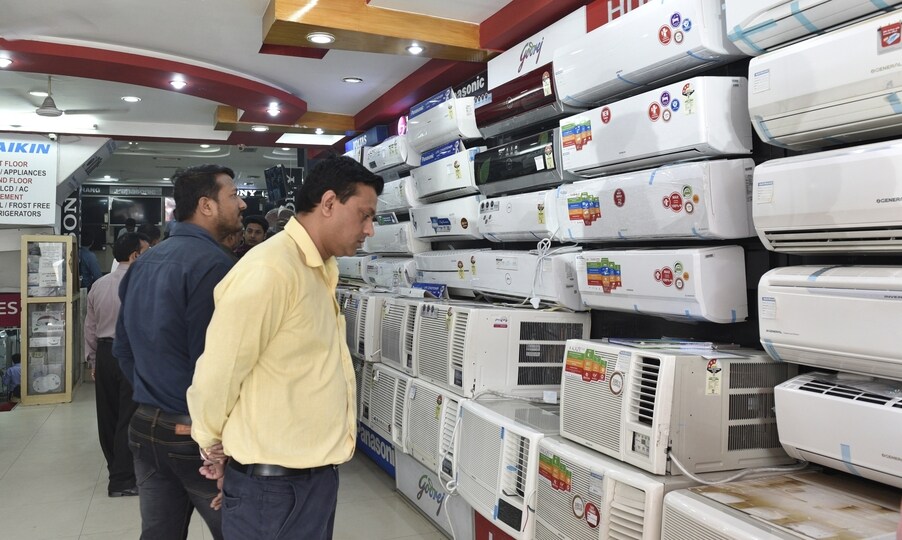
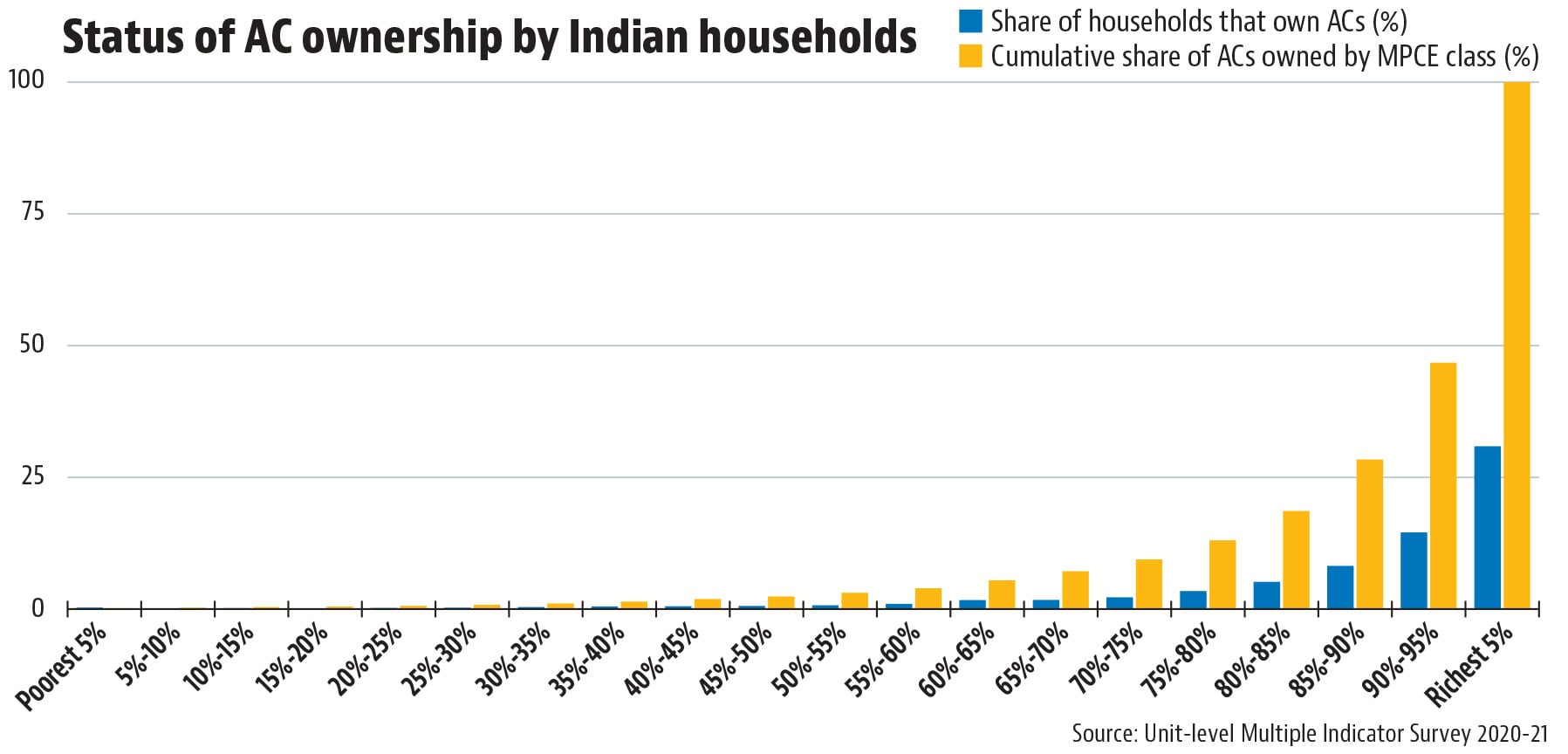
 Top 5% of Indians own 53% of total ACsNot only does the MIS tell us whether or not a household owns an AC, it also tells us the number of ACs owned. This information can be used to look at the inequality in AC ownership across households in India. To be sure, the MIS is only a survey and therefore the results are likely to be an approximation. An analysis of unit level MIS data shows that just the top 5% of richest Indians own 53% of all ACs and the top 10% richest own 72% of the total ACs which are installed in residential dwellings in India.
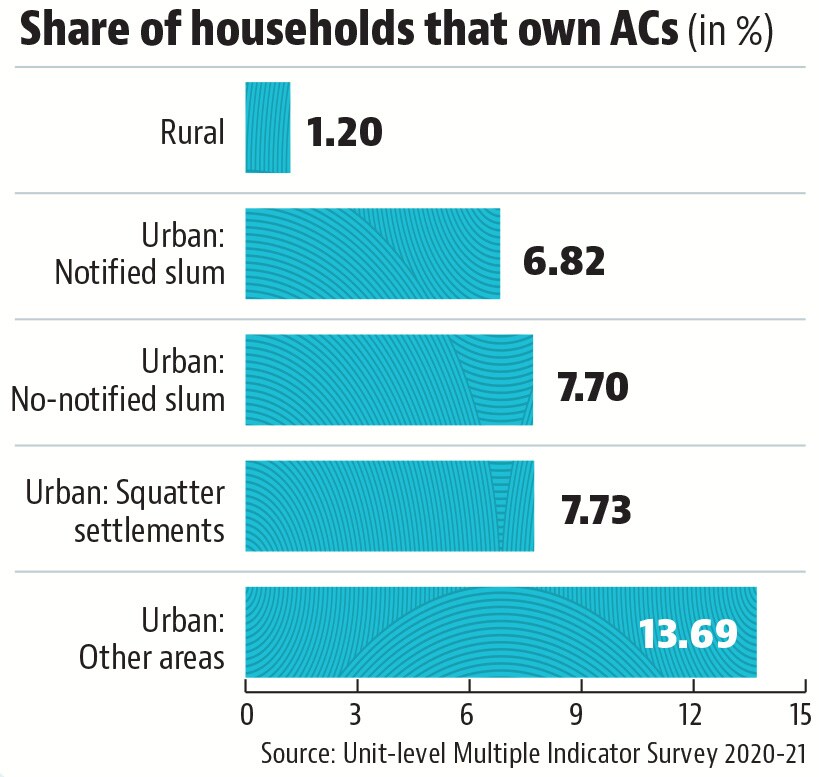
- This also means that ACs are mostly a posh urban amenityAs the distribution of ACs by class suggests, it is largely an urban amenity. Just 1.2% rural households own at least one AC compared to 12.6% of urban households. However, even urban areas are not homogeneous. People living in slums often have metal roofs that can make their houses warmer. For example, a study conducted in Mumbai by World Resources Institute (WRI) found slums to be five to six degrees warmer than housing societies in their neighbourhood. However, slums and squatter settlements had around half the AC-ownership levels of other urban areas according to MIS. To be sure, people need not live in squatter settlements only for economic reasons. Almost a tenth of India’s richest 10% people live in such areas. Therefore, even slums and squatter settlements have around four to six times the AC ownership levels compared to rural areas.
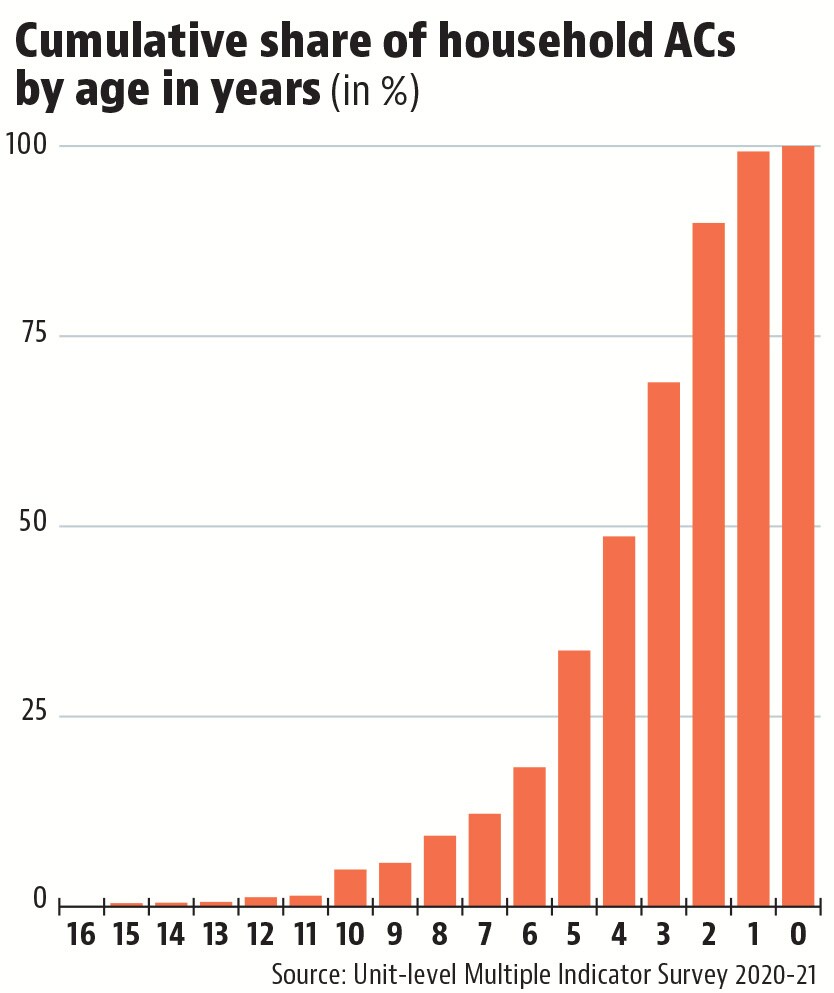
- MIS also shows that there has been a sharp increase in AC ownership in the recent pastMIS also tells us the age of each AC that households reported they had. This shows that 50% of residential ACs were bought only three years ago and 80% of total ACs were bought at most five years ago. MIs data shows that only around 2% of ACs in Indian houses are more than a decade old.
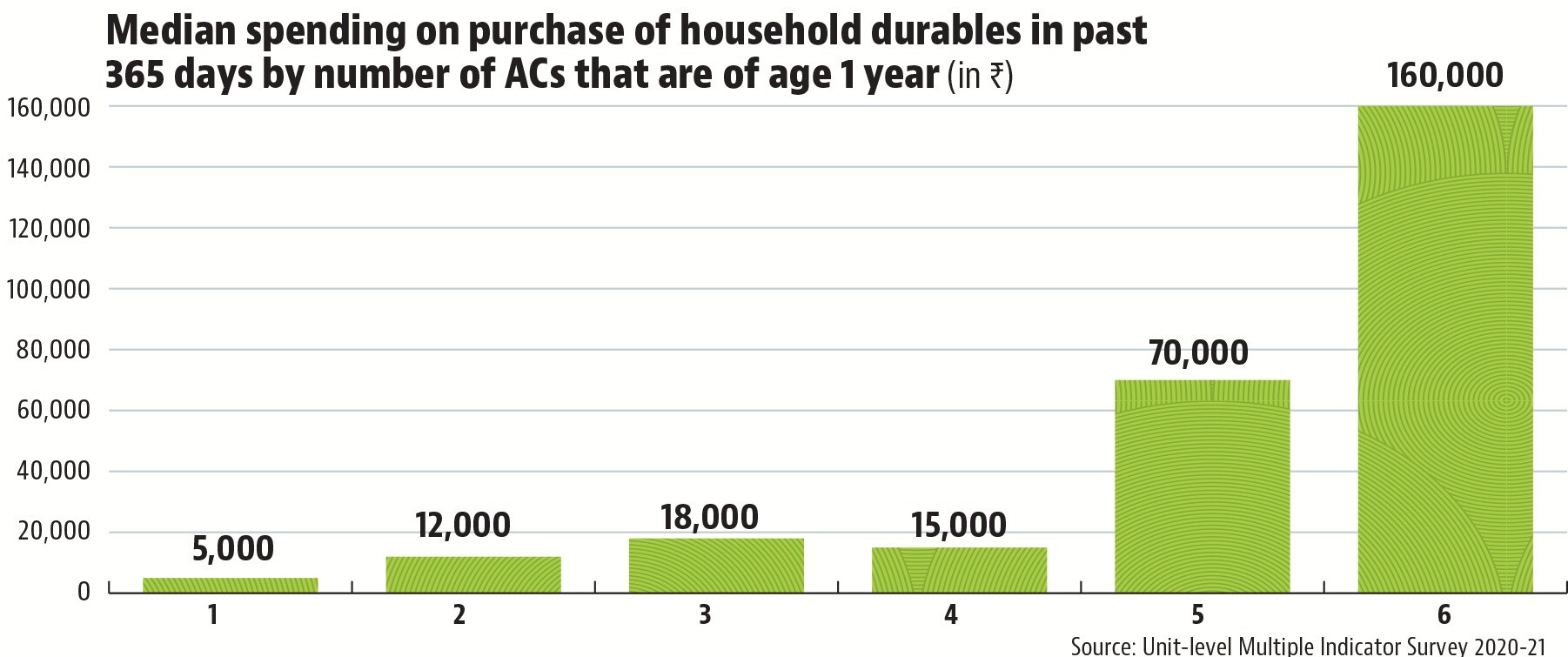
- To be sure, more households seem to be renting ACs than buying themTo be sure, more households seem to be renting ACs than buying them MIS also seeks responses on the average spending incurred by a household on durable goods in the last one year. If one separates the households who report having one AC of age one year and looks at the total spending on durable goods in the past year, 80% of such households report such spending of less than ₹25,000, which, one can reasonably argue is less than the cost of an AC. Of course, a household cannot be expected to incur such spending on ACs alone. 50% of such people reported a spending of ₹5,000 or less and 20% did not report any spending on durables at all. Logically speaking, this suggests either a misreporting of actual spending or extent and duration of AC ownership, or households renting rather than buying ACs. Whatever the case might be, there is reason to observe caution in reading the number on face value. However, the fact remains that MIS is the only official source for AC ownership in India.