
 E-Paper



UP revives eatery nameplate diktat after Kanwar Yatra row
UP CM Yogi Adityanath ordered eateries to display staff names and undergo police verification, reigniting controversy over food safety measures.

 Prefer HTon Google


Chief minister Yogi Adityanath rekindled a controversy on Tuesday by ordering that all restaurants and eateries in Uttar Pradesh will have to prominently display the names and addresses of operators, proprietors, managers and staff, and that police verification drives will be held to ensure compliance with what the authorities described as measures against adulteration.
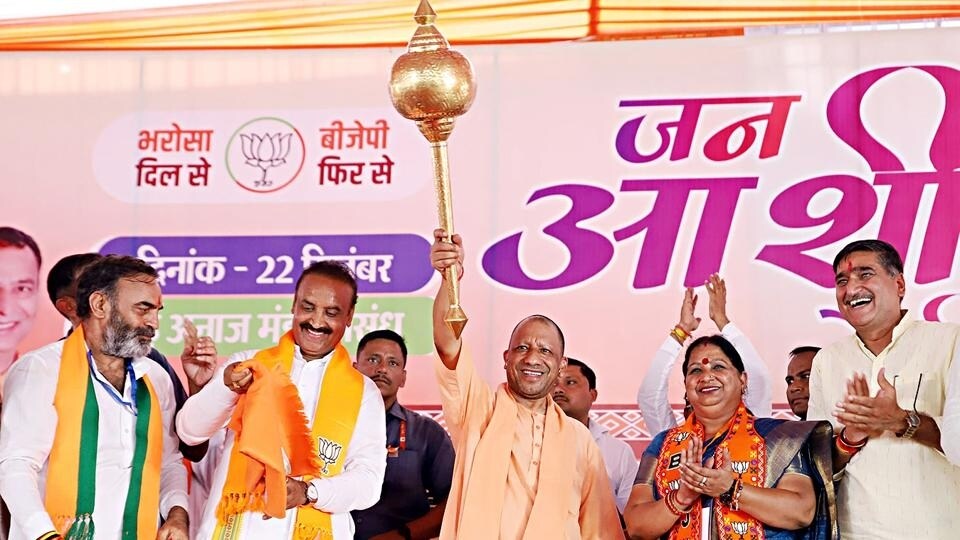
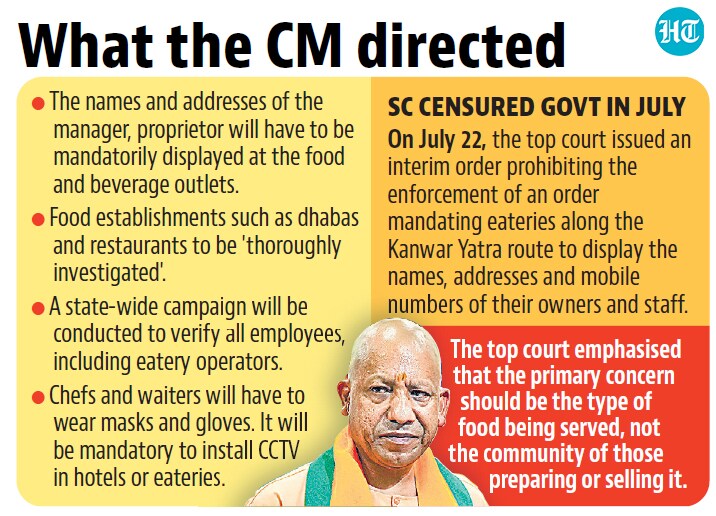
The decision came roughly two months after the Supreme Court temporarily suspended a state government order mandating eateries along the Kanwar Yatra route to display the names, addresses and mobile numbers of their owners and staff.
At the time, the top court had sharply criticised the state government and said the primary concern should be the type of food being served, not the community of those preparing or selling it.
ALSO READ- ‘Student who used to get 20 marks, got 30’: Amit Shah's jibe at Congress
But on Tuesday, that decision made a comeback of sorts as Adityanath held a high-level meeting and directed a thorough investigation and verification of all hotels, dhabas, restaurants, and eateries in the state. He also called for amendments to existing rules, ensuring the health and safety of the general public, said a UP government statement after the meeting.
“It is essential to thoroughly investigate food establishments such as dhabas and restaurants. A state-wide intensive campaign should be conducted to verify all employees, including the operators of these establishments. This verification process must be completed swiftly by a joint team comprising the Food Safety and Drug Administration, police, and local administration,” the statement added.
“Now whether it is a chef or a waiter, they will have to wear masks and gloves and it will be mandatory to install CCTV in hotels/restaurants,” the CM said.
The order sparked a controversy as opposition parties called the move a diversionary tactic.
UP Congress committee chief Ajay Rai said, “This is proof the government is not able to do the work it was elected for. Poor people will now be harassed even more in the name of police verification. Small shop owners will be extorted in the name of compliance.”
The decision came against the backdrop of a mounting controversy over unsubstantiated allegations that some vendors were allegedly spitting on food or mixing urine in fruit juice. On September 11, Saharanpur police arrested a hotel stafferafter a viral video that purportedly showed him spitting on rotis. Then, on September 14, a juice vendor in Ghaziabad and a 15-year-old boy working at his outlet were also held for allegedly mixing urine in juices. Police claimed they recovered a plastic can filled with urine from the outlet.
On September 19, while inaugurating a floating restaurant at Ramgarh Taal in Gorakhpur, Adityanath referred to the row. “It is good that people here will at least not be served Hapur-wala juice or rotis with spit. Whatever served here will be pure,” he said.
On Tuesday, Adityanath issued several guidelines on food safety and quality. “In this context, necessary amendments should be made to the Food Safety and Standards Act to ensure compliance”, he said.
He also referred to the recent controversy. “In recent times, incidents of adulterating food items like juice, dal, and roti with human waste, inedible, or dirty substances have been reported from various parts of the country. These acts are atrocious, posing a serious threat to public health. Such malicious practices are completely unacceptable. To prevent such occurrences in Uttar Pradesh, concrete measures must be put in place to ensure food safety and protect the health of the common man.”
He told officers that CCTV cameras should be installed not only in the areas where customers dine but also in other parts of the establishment. “It is imperative that every operator ensures the security of the CCTV footage and makes it available to the police or local administration upon request,” he said, according to the statement.
The CM framed it as a question of public hygiene and safety.
“Cleanliness must be maintained at all food centres. It is essential to ensure that all personnel involved in preparing and serving food wear masks and gloves, with no room for negligence in these practices. There can be no compromise on the health interests of the general public,” he said.
“Strict action must be taken against anyone who attempts to jeopardise public health. Rules concerning the production, sale, and other related activities of food items should be made more stringent while considering practicality. Immediate action should be taken against any violations of these regulations,” he added.
But opposition leaders pointed out that the order was just an expansion of the logic first used earlier this year to order eateries on the Kanwar Yatra to display details of owners.
The directives, first passed by Uttar Pradesh and then followed by Uttarakhand and Madhya Pradesh, purportedly aimed at respecting the dietary preferences of Hindu pilgrims and maintaining law and order during the Kanwar Yatra, have sparked political controversy. But opposition leaders condemned the directives as an overreach of government power and an encouragement of discrimination based on caste and religion. They also raised concerns about potential communal tensions and the stigmatisation of certain groups, particularly Muslims, who own many of the eateries along the yatra route.
ALSO READ- Kangana Ranaut says farmers should demand return of farm laws, Cong reacts
On July 22, the top court issued an interim order prohibiting the enforcement of the controversial directives and saying that food business operators would only need to display the kind of food they are serving.
“We deem it appropriate to pass an interim order prohibiting the enforcement of the above directives. In other words, food sellers, including dhaba owners, hawkers etc. may be required to display the kind of food they are serving, but they don’t need to display the names of owners, staff and other details,” stated the bench in its order, as it issued notices to the three states where these directives are in vogue.
Hearings in the case are still on; the stay is also in place.
Allies of the ruling National Democratic Alliance (NDA), including Rashtriya Lok Dal (RLD), Janata Dal United, Lok Janshakti Party-Ram Vilas (LJP-RV) and the Ajit Pawar-led Nationalist Congress Party (NCP) had all criticised the UP government order and welcomed the court’s decision.
The Samajwadi Party also hit out at the move.
The party’s spokesperson, Abdul Hafiz Gandhi said, “Measures for eliminating adulteration and maintaining the food standards are essential for the good of the society. But what is the need of displaying names and other particulars of dhaba and restaurant owners. What purpose does it serve? This is nothing but a return of the orders issued earlier whereby fruit vendors and dhaba owners were asked to display their names.”


