
 E-Paper



G20 expert group conveners meet US Treasury Secy Yellen
Co-conveners of the expert group on strengthening MDBs, Larry Summers and NK Singh, met US Treasury Secretary Janet Yellen to discuss reforming multilateral development banks and boosting their financial capacity. The US has not committed to increasing its financial commitment to MDBs yet. However, there appears to be some openness in Washington, as President Biden and Prime Minister Modi discussed the issue and emphasized the need for comprehensive efforts to address global challenges. The joint statement during Modi's visit also indicated the possibility of greater financial commitment by sovereign countries to support the bank's expanded mandate.

 Prefer HTon Google


Building on the agreement between US President Joe Biden and Prime Minister Narendra Modi on the need for reform of multilateral development banks (MDBs), including boosting their financial capacity, the co-conveners of the independent expert group on strengthening MDBs, Larry Summers and NK Singh, met US treasury secretary Janet Yellen in Washington DC last week.
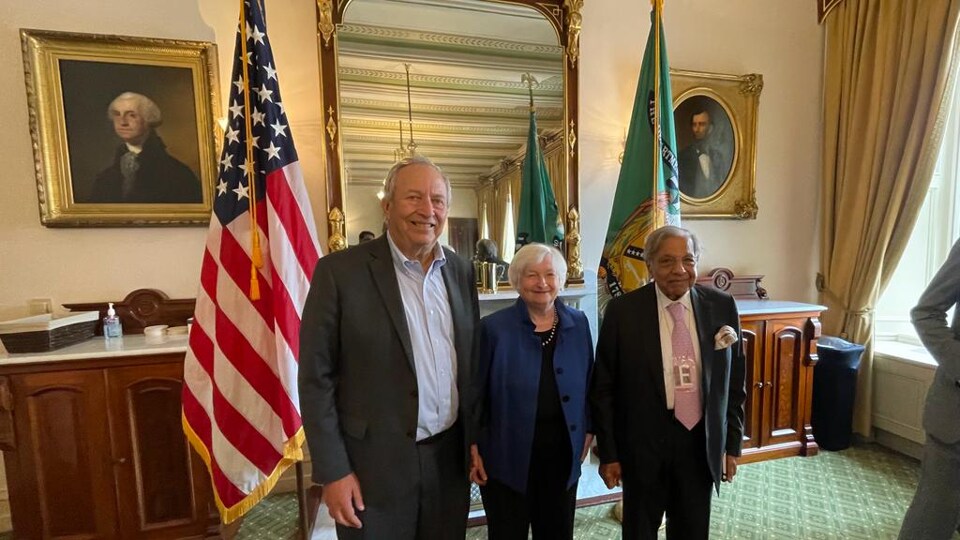
The group has been set up under India’s G20 presidency, and in a measure of the serious intent and commitment of India to the process, Summers and Singh were accompanied by the government of India’s chief economic advisor, V Anantha Nageswaran, to the meeting.
During the meeting, which was first a smaller interaction between Yellen, Summers and Singh, and then a wider meeting between top officials of the treasury department and a high-level delegation working on MDB reform, the group conveners thanked Yellen for “an open and transparent approach”.
“This open and transparent approach extended to a multiplicity of sensitive issues. These included the options and opportunities for balance sheet optimisation of MDBs, the garnering of private capital, and also recapitalisation of the bank to meet financing challenges to address the needs of the 21st century,” Singh told HT.
The US has, so far, not expressed any commitment to increase its financial commitment to MDBs, a necessary even if not sufficient condition to enable international financial institutions (IFIs) to meet newer challenges such as the climate crisis without compromising on its developmental goals.
But there appears to be some openness in this regard in Washington. Biden and Modi are understood to have discussed the issue of MDB finances, and the joint statement during Modi’s state visit to Washington DC had an entire paragraph dedicated to the subject, including a reference to the expert group.
Both leaders committed to “pursuing ambitious efforts to strengthen” MDBs “to address shared global challenges of the 21st century”. “In this regard, they emphasized the need for comprehensive efforts by MDBs to evolve their vision, incentive structure, operational approaches and financial capacity so that they are better equipped to address a wide range of SDGs and transboundary challenges including climate change, pandemics, conflicts and fragility.”
Biden and Modi specifically acknowledged the work being done under India’s G20 presidency, “including the report of the G20 Expert Group on Strengthening MDBs”. “By the G20 Leaders’ Summit in New Delhi, the United States and India will work together to secure G20 commitment to create a major new dedicated pool of funds at the World Bank to deploy concessional lending for global challenges, and to enhance support for crisis response in International Development Association recipient countries,” the joint statement said, indicating the possibility of greater financial commitment by sovereign countries to back the bank’s expanded mandate.
In an interview to HT before Modi’s visit, Biden’s national security adviser, Jake Sullivan, too, spoke of the importance of MDB reforms. He had said that both India and the US shared a “common interest” in the evolution of MDBs and IFIs, “so that we can mobilise more capital to solve the challenges of the developing world”.
“As G20 chair, India is playing a leadership role in this effort and the US is coming to the table with ideas and resources to help make this happen. That goes both for the affirmative mobilisation of capital through the World Bank and the IMF (International Monetary Fund) and other institutions and dealing with the debt challenges that have burdened developing countries coming out of the pandemic. So we are looking to help make India’s G20 presidency a landmark G20 presidency on both of these issues,” Sullivan had said.
It is to give concrete shape to these discussions that Summers, a former US treasury secretary, and Singh met Yellen. If Yellen was accompanied by senior officials from her department, Singh and Summers were accompanied by Nageswaran, Centre for Global Development (CGD) president Masood Ahmed, CGD senior fellow and former treasury department official Nancy Lee, Brookings senior fellow Homi Kharas, Indian Council for Research on International Economic Relations (ICRIER) director and chief executive Deepak Mishra, and ICRIER fellow Radhicka Kapoor. All these economists have advised the high level independent expert group on the subject in the past few months.


