India will have a key role in defence cooperation and post-Covid-19 recovery efforts in the Indo-Pacific by the US and Australia, which plan to strengthen partnerships in the region to ensure it remains secure, inclusive and rules-based.
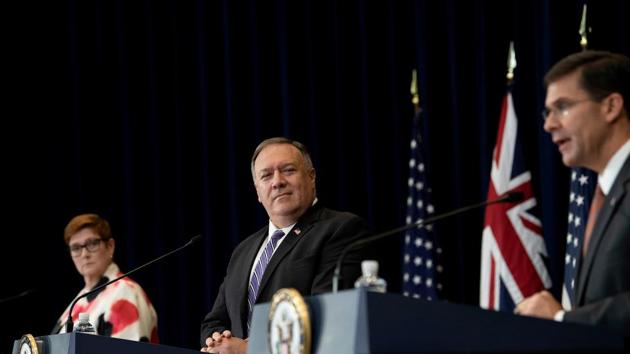
The matter figured in a meeting between US secretary of state Mike Pompeo and defence secretary Mark Esper and their Australian counterparts Marise Payne and Linda Reynolds in Washington on Tuesday, with a joint statement issued by the two sides making several references to India’s role in the Indo-Pacific.
The US and Australia also expressed serious concerns about China’s “recent coercive and destabilising actions across the Indo-Pacific”, and the two countries said the Covid-19 pandemic has “created incentives for some actors to pursue strategic gains in ways that undermine the rules-based international order and regional stability”.
The development comes at a time when India is set to include Australia in the Malabar naval exercise that it conducts with the US and Japan, and against the backdrop of the months-old border standoff with China.
The US-Australia joint statement said the Indo-Pacific remains the focus of their alliance and that two countries are “working side-by-side, including with Asean, India, Japan, the Republic of Korea, and Five Eyes partners, to strengthen our networked structure of alliances and partnerships to maintain a region that is secure, prosperous, inclusive, and rules-based”.
{{/usCountry}}The US-Australia joint statement said the Indo-Pacific remains the focus of their alliance and that two countries are “working side-by-side, including with Asean, India, Japan, the Republic of Korea, and Five Eyes partners, to strengthen our networked structure of alliances and partnerships to maintain a region that is secure, prosperous, inclusive, and rules-based”.
{{/usCountry}}On the issue of regional coordination, the two countries said they are committed to “trilateral dialogues with Japan and Quad consultations with Japan and India”, and were looking forward to further ministerial meetings of these forums.
The Quadrilateral security dialogue or Quad, which includes India, Australia, Japan and the US, was upgraded to the ministerial level last September. China has often expressed its opposition to the group, though India has said it is not aimed at any country.
The US and Australia also referred to bilateral defence cooperation such as the joint naval activity by their warships in the South China Sea, and said they are committed to “pursue increased and regularised maritime cooperation in the region, as well as the Indian Ocean, bilaterally and in concert with other likeminded and regional partners”.
Sameer Patil, fellow for international security studies at Gateway House, described India as the “most natural partner” for security-related initiatives by the US and Australia both in the Indian Ocean and the wider Indo-Pacific region.
“Though China is its biggest trade partner, Australia has growing concerns about what it perceives as China’s interference in domestic politics and issues such as cyber security. Australia also has concerns about China’s growing influence in the South Pacific, which it sees as its strategic backyard and which has been the focus of attention from Prime Minister Scott Morrison,” he said.
“These concerns and similar worries for the US are areas of convergence with India. Australia certainly feels that if the Quad can get its act together, the four countries can counter the rising Chinese influence in the Indo-Pacific,” Patil added.