New Delhi: The US will remove regulations that have prevented cooperation between key Indian nuclear entities and American companies, US National Security Advisor Jake Sullivan said on Monday, marking a major step forward in implementing the landmark 2005 civil nuclear agreement.
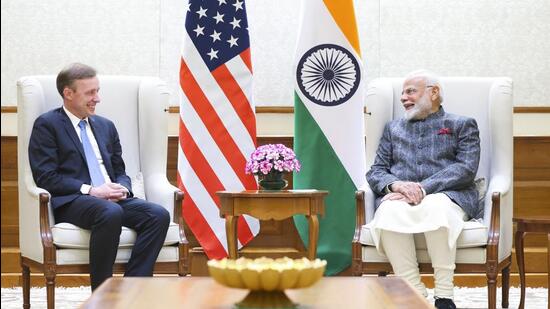
The top official of the outgoing Joe Biden administration made the announcement during a public address at the Indian Institute of Technology (IIT)-Delhi following meetings with his Indian counterpart Ajit Doval and external affairs minister S Jaishankar. The move, Sullivan said, is an opportunity to move away from “frictions of the past” and acknowledges India’s “open and transparent engagement” with the US.
India and the US unveiled an ambitious plan for civil nuclear cooperation during a meeting between then prime minister Manmohan Singh and former president George W Bush in July 2005. The India-US civil nuclear agreement was sealed in 2008 but plans for the supply of US nuclear reactors to India did not materialise because of regulatory hurdles.
Sullivan, who was speaking on the theme of “The US and India: Building a shared future”, described the move to remove the regulations as a “history step”. Referring to the unrealised vision of civil nuclear cooperation laid out by Singh and Bush, he said: “Today, I can announce that the US is now finalising the necessary steps to remove long-standing regulations that have prevented civil nuclear cooperation between India’s leading nuclear entities and US companies.”
{{/usCountry}}Sullivan, who was speaking on the theme of “The US and India: Building a shared future”, described the move to remove the regulations as a “history step”. Referring to the unrealised vision of civil nuclear cooperation laid out by Singh and Bush, he said: “Today, I can announce that the US is now finalising the necessary steps to remove long-standing regulations that have prevented civil nuclear cooperation between India’s leading nuclear entities and US companies.”
{{/usCountry}}He added, “The formal paperwork will be done soon, but this will be an opportunity to turn the page on some of the frictions of the past and create opportunities for entities that have been on restricted lists in the US to come off those lists and enter into deep collaboration with the US, with our private sector, with our scientists and technologists to move civil nuclear cooperation forward together.”
Though Sullivan didn’t give details of the Indian entities covered by the move, US documents state that several organisations linked to the Department of Atomic Energy are on the list of restricted entities for nuclear cooperation and commerce.
They include the Bhabha Atomic Research Center (BARC), Indira Ghandi Atomic Research Centre (IGCAR), nuclear research centres such as the Indian Rare Earth (IRE), and fuel reprocessing and enrichment and heavy water facilities involved in India’s nuclear programme. Nuclear reactors not under the safeguards of the International Atomic Energy Agency (IAEA) are also among the Indian nuclear entities listed by the US.
Sullivan said the Biden administration had “determined that it is past time to take the next major step in cementing” the US-India partnership at a juncture when both sides are working to build clean energy technologies to enable growth in artificial intelligence and to help US and Indian energy companies unlock their innovation potential.
“This is a statement of confidence in the progress we’ve made and the progress we will continue to make as strategic partners and as countries who share a commitment to peaceful nuclear cooperation,” he said. “It’s also the result of India’s open and transparent engagement with our administration over the course of four years, which has enabled us to open this new chapter together.”
At the same time, Sullivan acknowledged that India and the US have navigated “our fair share of turbulence, legacy relationships, tensions over trade, as well as over human rights and the rule of law at home and abroad”.
“But we’ve navigated these issues together with our eye on the long game and our ability to do so reflects the deep and enduring resilience between the US and India across generations, across administrations and yes, across the aisle,” he said, pointing to the bipartisan support in the US for ties with India with a fortnight to go for the inauguration of president-elect Donald Trump.
Sullivan also announced that the India-US commercial and civil space partnership is set to “lift off” after President Joe Biden signed off on updates to the US missile technology control export policies.
During his address, Sullivan highlighted the weaponising of interdependencies in the field of supply chains and criticised China’s “predatory industrial strategies” in crucial fields such as semiconductors, clean energy and emerging technologies.
“The US, India and other key democratic partners have all been reminded abruptly and sharply that we cannot ignore the ways in which interdependencies can be weaponised against us. We’ve seen countries lose access to critical minerals that support our clean energy,” he said.
“We’ve seen companies struggling to compete against China’s predatory industrial strategies in chips and clean energy and other emerging technologies. And of course, we’ve seen repeated attacks on industries tied to our infrastructure, which is heightening the risks not only of cyber-espionage but of destructive sabotage,” he said.
This was the reason why Biden and Prime Minister Narendra Modi “made it a priority to invest in national programmes that are spurring production and sectors that have become overly reliant on a single country”, he said in an obvious reference to China.
These programmes include the US Chips and Science Act, the India Semiconductor Mission and India’s Production-Linked Incentive scheme in areas such as biopharmaceuticals, he pointed out. US companies looking for greater resilience in their markets and supply chains are shifting out of China and expanding into India, he noted.
“Take, for example, Apple’s significant investment in Indian production. Within the next couple of years, over one-fourth of all iPhones in the world will be made right here in India,” he said.
Sullivan also highlighted the growth of the India-US defence partnership over the past two decades, describing it as “nothing short of remarkable” since both sides had no defence trade relationship or frameworks for information-sharing or logistics cooperation 25 years ago.
“Today, the US isn’t just selling defence systems to India. We are making them here in India and the US has become a top destination for Indian defence exports...And on top of this, in the past two years alone, the Biden administration has approved technology proposals that would enable India to become the first global producer of Stryker combat vehicles, a leading producer of advanced munitions systems, and the first foreign producer of cutting-edge maritime systems,” he said.
The two sides have also announced a groundbreaking initiative to enable India to manufacture jet engines to power the future indigenous fighter fleet, and these initiatives can “eventually help countries across the Indo-Pacific region upgrade their defensive capabilities as well”, Sullivan said.
“Because that is a critical goal that unites us to ensure a more free, more secure, more prosperous and more resilient Indo-Pacific region. And in fact, the stronger defence cooperation between the US and India is already enabling greater security across the region,” he said.