The Uttarakhand high court (HC) on Tuesday dismissed the public interest litigation (PIL) filed by Bharatiya Janata Party’s (BJP) Rajya Sabha (RS) member Subramanian Swamy against the state government’s takeover of the Char Dhams and 51 other shrines through the formation of the Char Dham Devasthanam Management Board.
The court ruled that the ownership of the temple properties would vest in Char Dham shrines and power of the Board would be confined only to the administration and management of the properties.
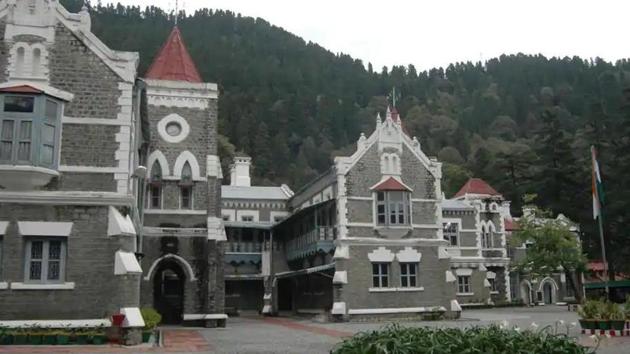
A two-member HC division bench, comprising Chief Justice Ramesh Ranganathan and Justice RC Khulbe, delivered the landmark 129-page judgment on Tuesday.
HT has a copy of the order, which dismissed both the writ petitions.
Sri Five Mandir Samiti Gangotri Dham had filed the other writ petition.
The HC order stated: “Except to the limited extent that the words ‘shall devolve’ (regarding ownership of temple properties) in Section 22 (of Char Dham Devasthanam Management Board Act, 2019) must be read as ‘devolve on the Char Dham and shall be maintained by the Board’, and the words ‘may further acquire land’... shall be read as ‘may further acquire land on behalf of the Char Dham’, the challenge to the validity of the 2019 Act, on the ground that it violates Articles 14, 25, 26 and 31-A of the Constitution of India, must fail ... the properties of the Char Dham temples shall continue to vest in it, as declared in Section 4(2) of the 2019 Act … and the power of the Board would thereby be confined only to the administration and management of the properties of the Char Dham Devasthanam...”
Kartikey Hari Gupta, the counsel representing intervenor, Rural Litigation and Entitlement Kendra (RLEK), a non-governmental organisation (NGO), in the matter that had supported the state government’s stand, said the court after hearing all the parties concerned had reserved its judgement in the matter on July 6 and delivered its verdict on Tuesday.
{{/usCountry}}Kartikey Hari Gupta, the counsel representing intervenor, Rural Litigation and Entitlement Kendra (RLEK), a non-governmental organisation (NGO), in the matter that had supported the state government’s stand, said the court after hearing all the parties concerned had reserved its judgement in the matter on July 6 and delivered its verdict on Tuesday.
{{/usCountry}}“There is no unconstitutionality in the Char Dham Act. The recent judgement of the Supreme Court (SC) in Marthand Varma vs. the State of Kerala given in the case of the Padmanabhaswamy temple is not applicable in the present context, as the facts are totally different. In the Kerala shrine case, the uninterrupted management of the Travancore royal family was found to be from 1686. But, in the case of Badrinath Temple, the uninterrupted management was disrupted in 1899, when the administration of these temples was made by the then HC bench of Kumaon that had separated the religious and temporal affairs. No religious sentiments have been violated by this Act. The Board has only taken over secular management, which is legally permissible,” Gupta said.
“The 1939 Act for the management of these temples records that the law was needed due to the mismanagement of temples and also to alleviate pilgrims’ plight. The new Act has been passed to further that objective and it is valid,” he said.
Gupta cited that the shrines’ mismanagement led to a separation of religious and temporal functions.
“Irish lawyer Edwin T. Atkinson has recorded the fact of gross mismanagement of temples in the Himalayan Gazetteer published in 1884. The SC in its Ayodhya Ram Mandir judgement last November had also held that gazetteers are key evidence that courts can rely on,” he had cited in his previous argument before the court.
Earlier, Gupta had apprised the HC that “Manusmiriti, which is the ancient text for Hindu laws, in its Chapter 7 lays down that it is the choice of the King as to whom he wants to keep a priest and all rites and sacrifices in temples are performed by priests on his behalf. Priests have no inherent right to manage temples. Scholar and educational reformer Madan Mohan Malaviya in 1933 had also published a book appealing to the public to hand over the management of temples for their better upkeep.”
The PIL had challenged the constitutional validity of the Uttarakhand Char Dham Devasthanam Management Act, 2019, by which the administration and control of major Hindu religious institutions have been taken over by the Uttarakhand government or by any authority functioning under the state government.
Last December, the Uttarakhand assembly had passed the Char Dham Devasthanam Management Board Bill.
In January, Uttarakhand Governor Baby Rani Maurya gave her assent for the Char Dham Devasthanam Management Act, 2019.
Aggrieved priests had threatened that they would move the HC against the Act, as they claimed to have been kept in the dark about the new law.
They had alleged that the government took the step to ensure its control over shrine-related issues, bypassing the powerful priest community.
On February 10, a four-member delegation of the state’s priest body met Swamy and submitted documents that were required to file a PIL along with a copy of the Char Dham Devasthanam Management Act, 2019.
Soon, Swamy had filed the PIL against the formation of the Char Dham Devasthanam Management Board and the resultant Act.