
The ceiling fan tried in vain to cut through the sticky heat in the meeting room at the deputy commissioner’s office turned into a makeshift centre, where dozens wait their turn to get in touch with relatives abroad on two phones.
Among them is Mir, who has been desperately trying to get in touch with his brother in Dubai who was supposed to visit a day before Eid on August 12. A friend of the family, who was supposed to receive Mir’s brother at the airport, found out he wasn’t even on the plane. And that’s the last they know of him.
On Wednesday, Mir was at the centre set up on the third floor of the district commissioner’s office, where people queue for hours to make an international phone call that usually lasts 30 seconds to a minute.
People arrive as early as 7am to get a spot in the queue, and there’s no telling when their turn will come. Over the past few days, about 400 calls have been made from the centre, where people take a number allotted to them and wait till it is called out by officials manning the two phones.
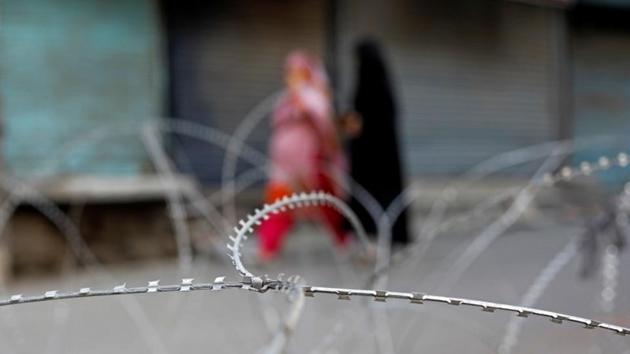
With landlines and mobile networks down since the government revoked Jammu and Kashmir’s special status on August 5, there are very few options for the people of the Valley to reach their friends and family outside. Local calls can be made from some police stations and intermittently working landlines in parts of Srinagar. But for international calls, there is so far just one stop.
{{/usCountry}}With landlines and mobile networks down since the government revoked Jammu and Kashmir’s special status on August 5, there are very few options for the people of the Valley to reach their friends and family outside. Local calls can be made from some police stations and intermittently working landlines in parts of Srinagar. But for international calls, there is so far just one stop.
{{/usCountry}}Mir, who lives in Nawakadal in downtown Srinagar, has come to the centre before but his turn never came. Waiting at the centre is not his only worry – getting there is a challenge too. “Movement is still restricted in our area. I had to take a much longer route to reach here,” he said. Most of the people were angry that the Centre hasn’t lifted curbs on communication and connectivity. They were expecting the landlines to function normally; schools, colleges and markets to open. “In 2016, when I joined college, our first semester examination was delayed by a year and a half. We are again staring at a delay because we have final examinations scheduled for the end of August,” said Mir, who is enrolled for a Bachelor of Commerce course in a local college.
Wahid Aslam, the official in charge of overseeing the facilities for domestic and international calls, said he and other staff members had been working from 9am to 11pm on most days since August 6. “Sometimes the people break down and start crying when they can’t get through to their relatives or they can’t speak to them long enough,” he said.
Many of the people making calls are parents trying to reach their children studying or working abroad or in other parts of India. While two phone lines are dedicated to international calls, three more are used for domestic calls, officials said.
The centre handled up to 2,000 calls a day immediately after communication links were snapped, but the number has declined to about 400 a day after the partial restoration of landlines.
Besides the problem of connectivity, most shops and commercial establishments across Srinagar remain closed.
Pharmacies and a few small grocery shops are the only outlets that are open but concerns remain among the city’s residents about a possible shortage of medicines in the days to come.
ABOUT THE AUTHOR
Follow the latest breaking news, major developments and agenda-setting stories from India and around the world with the newsdesk at Hindustan Times. Operating round the clock, the desk brings together experienced editors, reporters and correspondents to deliver fast, accurate and contextual reporting across subjects that influence public policy, governance, business, society and international affairs. The HT News Desk covers politics, elections, government policies, the economy, business and markets, science and technology, the environment, law and order, infrastructure, education, climate issues and geopolitics, while closely tracking developments across states, institutions and global capitals. The team also leads coverage of major breaking news events, policy announcements, court proceedings, natural disasters, public emergencies and significant international developments. Reports published by the newsdesk are based on information gathered from reporters on the ground, official statements, government agencies, court records, regulatory filings, recognised institutions and other authoritative sources. Stories undergo editorial scrutiny and verification processes to ensure accuracy, fairness and relevance, and are updated as events evolve and additional information becomes available. Whether covering a key political decision in New Delhi, an economic policy shift affecting millions, a landmark court ruling or a major global event, the HT News Desk aims to provide readers with reliable, fact-based journalism that delivers not only the latest developments but also the context and analysis needed to understand their wider implications.