India’s national capital and its surroundings were engulfed by a toxic haze and the acrid stench of smoke on Thursday night as a large number of revellers violated a ban on firecrackers and police looked the other way to inflict on their fellow citizens a public health crisis that would have turned far more toxic had it not been a providential strengthening of winds on Friday that helped blow the smoke away.
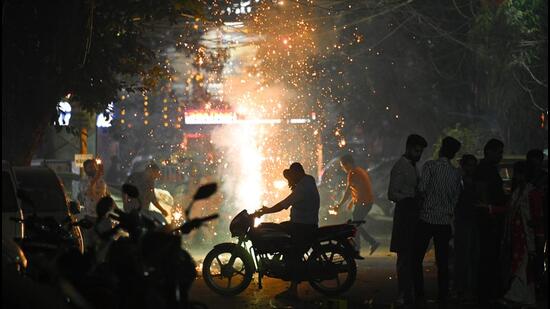
Across the national capital region (NCR), what began as a staccato of pops and bangs in the late evening turned into a crescendo of whistling rockets, thunderous aerial explosions and relentless smoke-spewing sparks of anars and charkhis that went on well past midnight. The air quality index (AQI) at 4pm before the celebrations began on Thursday was at 328, classified “very poor”, and held steady till about 9pm after which it began steadily worsening: 330 at 10pm, 338 at midnight, 347 at 3am on Friday and 362 at 9am.Post 9am, the AQI began improving and was 354 by noon, 339 by 4pm and 314 by 10pm.
But these figures were all 24-hour averages. In real time, PM2.5 levels in the city shot up by a staggering 15 times in some parts of the city, reaching as high as over 1,800 µg/m³ in certain residential areas. The World Health Organization sets the safe limit of PM2.5 exposure at 15µg/m³ India’s National Ambient Air Quality Standards sets it at 60µg/m³.
By Friday afternoon, the worst of the pollution appeared to have been swept away by strong winds and warm temperature, an unusual set of meteorological circumstances for this time of the year but one that meant the city of 20 million caught a lucky break.
{{/usCountry}}By Friday afternoon, the worst of the pollution appeared to have been swept away by strong winds and warm temperature, an unusual set of meteorological circumstances for this time of the year but one that meant the city of 20 million caught a lucky break.
{{/usCountry}}“We had steady winds throughout Diwali day and on Friday too. Wind speed was 12-16 km/hr till 6 pm on Thursday. It dipped marginally, but remained between 3 and 7 km/hr through the night and again picked up to around 10 km/hr when the sun came out on Friday,” said an India Meteorological Department official, who asked not to be named, while another climate expert described this improvement as nothing but “getting lucky with the weather”.
It was not merely the sights and sounds of Thursday night that illustrated the brazen flouting of the firecracker ban.
HT’s analysis of real-time pollution monitoring data shows in granular detail how concentrations of PM2.5, ultrafine particulates that mostly make up smoke, shot up in the evening: At the Nehru Nagar station, abutting Lajpat Nagar, hourly average PM2.5 concentration rose from 101 µg/m³ to a whopping 898 µg/m³ at 11pm, or a nearly nine-fold increase. At Anand Vihar, next to the residential settlements of Vivek Vihar, the peak 1am was 992 µg/m³, over seven times the 135 µg/m³ recorded at 6pm.
In instant readings, these numbers reached even more alarming figures: 1,853 µg/m³ at Vivek Vihar and 1,527 µg/m³ at Nehru Nagar.
That these spikes were due to firecrackers is clear when one takes into account readings at Narela and Najafgarh, both industrial zones that were empty as people went back home to celebrate Diwali. At Najafgarh, the peak was roughly 247 µg/m³ and in Narela, around 260 µg/m³ -- both these stations recorded 80-90 µg/m³ in the evening, which made the increase the most moderate seen across the city.
India classifies the safe limit for PM2.5 exposure to be no more than 60 µg/m³.
Other data too suggested there was widespread violation of the firecracker ban. The Delhi Pollution Control Committee (DPCC) said of its 31 ambient noise monitoring stations, 22 recorded higher decibel levels this Diwali compared to last year. The highest decibel levels this Diwali were recorded at central Delhi’s Karol Bagh – an average of 88.7 dB (A), around 5% higher than the average reading of 84.5 dB (A) recorded last Diwali.
The Delhi Fire Services too said it received the highest number of calls -- 280 -- for fire-related incidents since records were kept beginning 2012.
The defiance of the firecracker ban raised questions about the effectiveness of environmental regulations in a city consistently ranked among the world’s most polluted capitals. An environment department official when contacted, said enforcement of the ban lay with the Delhi Police. “We appealed to people to not burst crackers and to report instances on 112 and 1090. The Police was then responsible for taking suitable action,” the official added.
The Delhi Police did not comment on the mass violation of the firecrackers ban.
HT sent messages to several senior police officers, including the spokesperson of Delhi Police and deputy commissioners of police (DCPs) of all 15 police districts, seeking data and their response on action taken against violation of the firecrackers ban. They did not respond till the time of going to print.
What helped, then, was simply the weather. “We got lucky, in the sense that we have seen this in some previous years when wind speed has been low and the pollutants hang in the air for several days. If winds are strong, pollution disperses within a matter of hours and then you again have local sources adding to the pollution,” said Mahesh Palawat, vice president at Skymet meteorology, forecasting similar wind speed for Saturday, but a drop on Sunday.
Environmental experts pointed out that relying on favourable weather conditions is a dangerous gamble.
“October being a warmer month and Diwali day recording reasonably good wind speed, the pollution levels on Diwali night that build up to severe levels, did not last very long,” said Anumita Roychowdhury, executive director, research and advocacy at the Centre for Science and Environment (CSE), pointing out that peak pollution levels on Diwali night were in fact in the severe range.
“Bursting of crackers shows that command and control measures on firecrackers may have set the terms of compliance, but its success requires a high level of public awareness about the health risks from excessively high short duration exposure to such pollution,” she added.