Prime Minister Narendra Modi is known to have a busy calendar of engagements with global leaders, both at home and abroad.
Indeed, 2020 started out with PM Modi dialling a number of world leaders to extend new year greetings to them. He spoke to as many as 11 world leaders in the first two weeks of January 2020, including not only the leaders of neighbouring countries, but also those of Australia, the US, France and Russia.
The visits of Brazilian President Jair Bolsonaro as the Chief Guest on Republic Day, and US President Donald Trump in February showed that 2020 might shape up to be yet another year of hectic global engagements for PM Modi. Then the Covid-19 pandemic struck the world .
Also Watch | ‘India has a rich legacy in science & innovation’: PM Modi at IISF inauguration
Not only did the pandemic make it almost impossible for world leaders to travel, it also meant that most leaders shifted their focus to domestic efforts to contain the pandemic. Prime Minister Modi, however, had other ideas. Conscious of the important role India’s pharmaceutical industry could play during a global pandemic, PM Modi was keen to stay deeply engaged with the world. But how?
India commercially supplied 560 million tablets of Hydroxychloroquine and 53.13 metric tonnes of active pharmaceutical ingredient of HCQ to 82 countries. It also commercially supplied 154 million units of paracetamol and 1605 metric tonnes of API to 96 countries to counter the coronavirus.
Way back in 2016, PM Modi told his foreign policy team that he did not want Indian projects to be kept waiting for high profile inaugurations during VVIP visits. The solution PM Modi suggested was to use video conferences to engage with foreign leaders, without any foreign travel. Of course, this would help in keeping expenses down too. An initially sceptical South Block came around after some of these video inaugurations caught the public’s imagination and eased the pressure on leaders to travel. A number of such video conferencing events were done by PM Modi in the years that followed.
Even in 2020, before the pandemic hit, PM Modi participated in a virtual event with Prime Minister of Nepal K P Sharma Oli on 21 January. So, PM Modi was not only comfortable, but also very keen for Indian diplomacy to switch gears and go digital.
{{/usCountry}}Even in 2020, before the pandemic hit, PM Modi participated in a virtual event with Prime Minister of Nepal K P Sharma Oli on 21 January. So, PM Modi was not only comfortable, but also very keen for Indian diplomacy to switch gears and go digital.
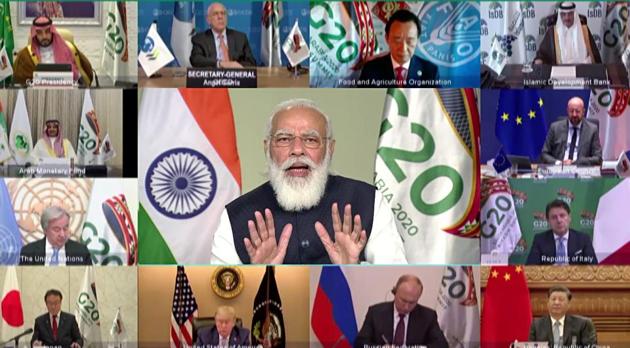
{{/usCountry}}The first such virtual summit in the pandemic era took place with SAARC leaders on 15 March. Some behind-the-scenes contacts with the Saudi leadership and suggestions in all the right capitals around the world ensured that a G-20 Virtual Summit soon followed on 26 March.
That opened the flood gates.
NAM, SCO, ASEAN, East Asia Summit, BRICS and G-20 were all held in virtual formats during the year.
PM Modi himself held a total of 17 such Virtual Summits, with leaders of Australia, European Union, Sri Lanka, Denmark, Italy, Luxembourg, Uzbekistan, Bangladesh, and most recently, Vietnam. These bilateral Virtual Summits were in addition to all the multilateral engagements of the Prime Minister.
PM Modi also made extensive use of phone calls to keep in touch with world leaders – expressing condolences to some, assuring medical supplies to many, and congratulating those who assumed office in the middle of the pandemic. He made and fielded more than 90 phone calls from world leaders.
A year that saw only five incoming visits of Heads of State and Government – all before the pandemic – is still ending as one in which India’s international engagement and international profile has been elevated multi-fold.
Whether the vaccines make the world safer or not in 2021, one thing is for sure – PM Modi is likely to stay deeply immersed and engaged in the world of geopolitics.