Vizag gas leak: All you need to know about Andhra Pradesh chemical plant
Eight people were killed and nearly 1,000 suffered breathing difficulty after Styrene gas leaked from a chemical plant near Andhra Pradesh’s Visakhapatnam.
A chemical gas leaked from an industrial plant in Andhra Pradesh early on Thursday, leaving people struggling to breathe and collapsing in the streets as they tried to flee.
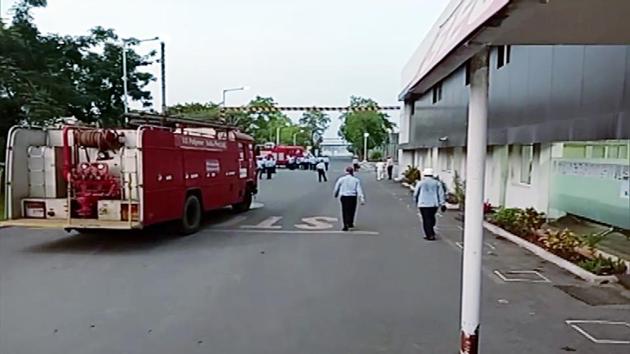
A firefighting vehicle stands outside the LG Polymers plant near Andhra Pradesh’s Visakhapatnam from where the deadly Styrene gas leaked on Thursday, leading to death of eight people. (ANI Photo)
At least nine people were killed and nearly 1,000 suffered breathing difficulties and other reactions.
About 80-100 people were hospitalised after the incident which occurred at about 2:30 am, NDRF Director General S N Pradhan said. Local revenue official BV Rani told news agency Reuters that she got a call at around 4 am from a panicking police sub-inspector near the facility.
Here is all you need to know about the plant from where the gas leaked:
• The plant is owned by South Korean company LG Chem. The company said in a statement that it is looking into what caused the leak of styrene monomer gas and is cooperating with authorities.
• Around 300 workers are employed at the Visakhapatnam plant, an LG Chem officials said.
{{^htLoading}} {{/htLoading}}
{{^usCountry}}
• The plant is located around 14 kilometers away from Visakhapatnam city. Areas within an approximately 3-kilometre radius of the plant are vulnerable, the municipal corporation said.
{{/usCountry}}
{{#usCountry}}
• The plant is located around 14 kilometers away from Visakhapatnam city. Areas within an approximately 3-kilometre radius of the plant are vulnerable, the municipal corporation said.
{{/usCountry}}
• The company was making arrangements for reopening the plant from Thursday after more than 40 days of closure when the incident occurred.
• LG Chem, South Korea’s top petrochemical maker by capacity, took over the facility previously owned by Hindustan Polymers and renamed it as LG Polymers India Private Limited (LGPI) in July, 1997, according to a company website.
• Originally set up in 1961, as Hindustan Polymers for manufacturing polystyrene and its co-polymers, the company was merged with McDowell & Co Ltd of UB Group in 1978. It ultimately became part of the South Korean group LG Chemical, in 1997.
{{^htLoading}} {{/htLoading}}
• The LG Polymers plant makes polystyrene products, according to a company website, which are used in manufacturing electric fan blades, cups and cutlery and containers for cosmetic products such as make up.
Follow the latest breaking news, major developments and agenda-setting stories from India and around the world with the newsdesk at Hindustan Times. Operating round the clock, the desk brings together experienced editors, reporters and correspondents to deliver fast, accurate and contextual reporting across subjects that influence public policy, governance, business, society and international affairs. The HT News Desk covers politics, elections, government policies, the economy, business and markets, science and technology, the environment, law and order, infrastructure, education, climate issues and geopolitics, while closely tracking developments across states, institutions and global capitals. The team also leads coverage of major breaking news events, policy announcements, court proceedings, natural disasters, public emergencies and significant international developments. Reports published by the newsdesk are based on information gathered from reporters on the ground, official statements, government agencies, court records, regulatory filings, recognised institutions and other authoritative sources. Stories undergo editorial scrutiny and verification processes to ensure accuracy, fairness and relevance, and are updated as events evolve and additional information becomes available. Whether covering a key political decision in New Delhi, an economic policy shift affecting millions, a landmark court ruling or a major global event, the HT News Desk aims to provide readers with reliable, fact-based journalism that delivers not only the latest developments but also the context and analysis needed to understand their wider implications.
Get Latest News, breaking headlines, and top India News, and today real-time updates from across the nation. Stay informed on politics, government policies, crime, Today Weather, and major developments on Hindustan Times
Get Latest News, breaking headlines, and top India News, and today real-time updates from across the nation. Stay informed on politics, government policies, crime, Today Weather, and major developments on Hindustan Times