India and the European Union (EU) are yet to reach a common position on the waiver of patent protections for Covid-19 vaccines, with external affairs minister S Jaishankar insisting on Wednesday that the time has come for such a move to dramatically boost vaccine production.
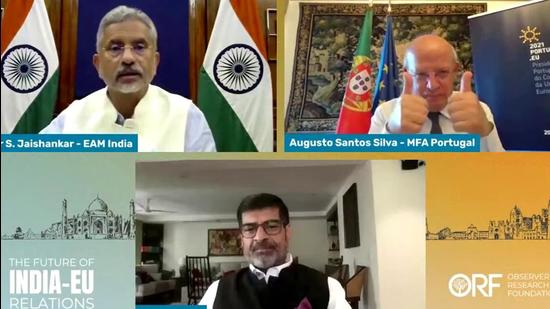
Jaishankar was responding to his Portuguese counterpart Augusto Santos Silva’s remarks defending the protection of intellectual property rights during an online conversation on the future of India-EU relations organised by the Observer Research Foundation.
Silva acknowledged there was a debate with the EU on the waiver of patents for vaccines but said: “We think it is very important to preserve (intellectual property rights) because by now it is already clear that new variants, new mutations, strains would rise from the pandemic.
“We have to prepare for the next pandemic and we need to keep the capacity of our ecosystem of science, innovation and industry related to the production of vaccines and the intellectual property rights are the key for this,” he said, adding a patent waiver should be the “last resort kind of a solution”.
Jaishankar, however, felt the Covid-19 pandemic is a calamity that meets the “last resort standard”, and it was because of this that India and South Africa had jointly submitted a proposal to the World Trade Organization (WTO) for temporarily waiving patent protections for Covid-related technologies and vaccines.
{{/usCountry}}Jaishankar, however, felt the Covid-19 pandemic is a calamity that meets the “last resort standard”, and it was because of this that India and South Africa had jointly submitted a proposal to the World Trade Organization (WTO) for temporarily waiving patent protections for Covid-related technologies and vaccines.
{{/usCountry}}“So I would say the global South, I hope will be joined by the enlightened North on this matter. And we can see some signs on it. There is an ongoing discussion at the EU. Not everybody in the EU has the same position,” Jaishankar added.
The world wouldn’t be able to deal with the pandemic without dramatically raising the production level of vaccines, he said. “Europe is absolutely key to solving this problem, not just due to intellectual property rights but also because a lot of supply chains go through Europe,” he said.
Silva backed measures aimed at removing bottlenecks in the production of vaccines and noted that the EU had decided to invest one billion euros in production facilities in Africa. He also said the EU is still waiting for a formal proposal from the US about backing a temporary waiver of patents. “But still, as far as I know, no concrete proposal was presented in the right framework, the WTO,” he added.
Though the EU has adopted a stance of both cooperating and competing with China, Silva said European states viewed India as their key partner in Asia because of convergences on issues such as the “political fundamentals” and human rights.
He said that while the EU can partner with China on matters such as climate change and selectively cooperate on technology and renewable energy, the grouping has “certain red lines”.
“I would refer to three red lines in our relationship with China – we cannot be silent when there are violations of human rights in Xinjiang province and we have to denounce it. Secondly we cannot accept the squeezing of the democratic space in Hong Kong, and third, we could not accept any change of the current status quo in the South China Sea and in relation to Taiwan,” Silva said.
Jaishankar described the rise of China as one of the “defining transformational trends” of the last 25 years but said New Delhi’s approach towards Beijing was different. “I’m a country which has a border with China, I have today a military which is...sort of right up there, closely deployed against the Chinese military. My situation is obviously very different from that of Europe and I would articulate it in a way in which it suits my interests,” he said.