Chief of Defence Staff Anil Chauhan said on Friday that war and geopolitics cannot be seen in isolation and that war “is a medium to achieve political ambitions”. He made the remarks while addressing a session on ‘National Security Challenges in front of India’ in Uttar Pradesh’s Gorakhpur.
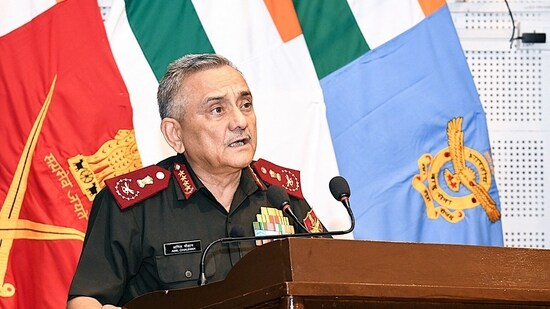
While talking about how the government and the military have to work hand-in-hand for securing a country’s national interest, Chauhan said that in a democracy “the military works under political leadership”.
"In Prussia, now Germany, a famous political scientist said that war is an extension of politics. War and geopolitics cannot be seen in isolation. War is a medium to achieve political ambitions,” he said.
"In a democracy, the military works under political leadership. When a government believes that force is needed to protect its political or national interests, a military officer like me has two duties: to provide more options to the government for using forces, and to build the government’s confidence in the military so it can take bigger decisions,” the CDS added.
{{/usCountry}}"In a democracy, the military works under political leadership. When a government believes that force is needed to protect its political or national interests, a military officer like me has two duties: to provide more options to the government for using forces, and to build the government’s confidence in the military so it can take bigger decisions,” the CDS added.
{{/usCountry}}Also read: ‘Boundary dispute with China India’s biggest challenge’: CDS Anil Chauhan in Gorakhpur
Chauhan said that after the army's clash with Chinese forces in Galwan and the Balakot airstrikes, the government allowed all three wings of the military to have emergency procurement.
How India prepared for Operation Sindoor
The CDS said that after Balakot airstrikes, which were done by India in response to the brutal Pulwama terror attack in 2019, both India and Pakistan "learned lessons”, leading to enhancement of military capabilities.
“India focused on long-range precision strikes, and Pakistan likely focused on air defence,” he said.
Talking about the tactics India has used over the years to target Pakistan’s military infrastructure, Chauhan said that for the surgical strike after the Uri terror attack in 2016, Indian forces “entered Pakistan by land and destroyed terrorist camps”, after the Pulwama attack, they opted for “airstrikes in Khyber Pakhtunkhwa”.
The CDS said that by the time the brutal terror attack happened in Pahalgam this year on April 22, in which 26 people were killed, most of whom were civilians, the Indian forces had “already enhanced our precision strike capabilities.”
“We tried to use lower airspace to maintain surprise and control escalation. But when we discussed with political leadership, we concluded that using drones and loitering munitions alone would not achieve our political objectives,” he said.
Chauhan added that to destroy Bahawalpur and Muridke, two of the nine terror sites in Pakistan and Pakistan occupied Kashmir that India targeted during Operation Sindoor, “airstrikes were necessary”.
He said that “political backing” and “discretion” were essential to carry out the operation.
“During Operation Sindoor, we had both, with a clear message: destroy the terrorist camps, but only retaliate if our forces were attacked.”