The India Meteorological Department (IMD) on October 16 announced the onset of the northeast monsoon, bringing increased rainfall to peninsular India, particularly along the east coast, as winds turned easterly to northeasterly over the region.
The India Meteorological Department (IMD) on October 16 announced the onset of the northeast monsoon, bringing increased rainfall to peninsular India. (Bhushan Koyande/HT Photo)
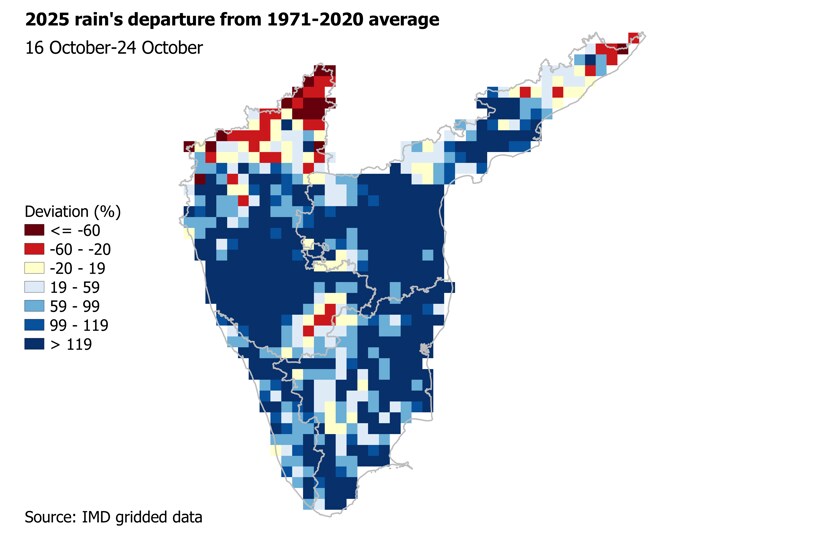
Since then, the region under its influence has received more than twice the rainfall it normally gets, an HT analysis of IMD’s gridded data shows. This has made this part of October one of the wettest in peninsular India in the past 125 years. However, the analysis also indicates that the large surplus has not necessarily translated into an overall excess for the month. In fact, IMD’s long-range forecasts suggest that this surplus may be partly offset in the coming weeks.
The northeast monsoon is often loosely defined as the October–December period, but just like the southwest monsoon, the season is experienced only once its weather conditions are established. This year, they set in on October 16 — earlier than the usual date of October 22, but well within the normal deviation of seven days.
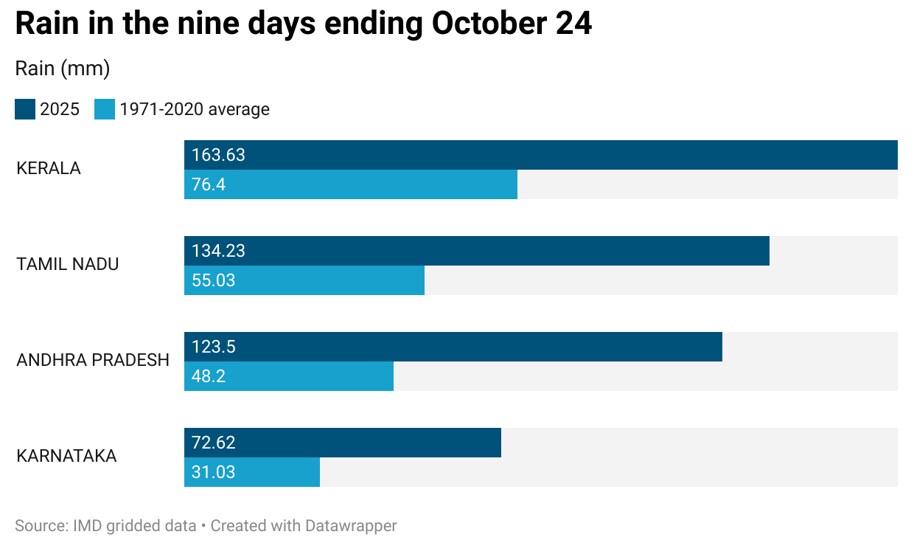
In the first nine days of the northeast monsoon, Tamil Nadu, Andhra Pradesh, Karnataka, and Kerala received 134 mm, 123 mm, 73 mm, and 164 mm of rain, respectively. While Karnataka may appear drier than the other states, this is because the northeast monsoon primarily affects south interior Karnataka, lowering the state’s overall average. Compared with the 1971–2020 average — which the IMD uses as the Long Period Average (LPA) to assess rainfall performance — all four states have recorded more than twice their usual rainfall for the nine days ending October 24. The largest deviation from the LPA is in Andhra Pradesh, which has received 2.6 times its normal rain, while the smallest is in Kerala, at 2.1 times the LPA.
Weather Bee: Northeast monsoon hits early and hard; surplus may be short-lived
Rainfall in Tamil Nadu and Kerala ranks relatively higher despite their smaller surpluses — eighth and ninth highest, respectively, since 1901, the first year for which the IMD has published gridded rainfall data. In contrast, rainfall in Karnataka and Andhra Pradesh ranks 13th and 14th highest since 1901.
Why has the start of the northeast monsoon been so rainy? Because a rain-enhancing weather system has been active almost every day since the season began. Cyclonic circulations — cyclone-like low-pressure areas with anti-clockwise winds but lower wind speeds — have persisted in the southeast Arabian Sea and near the Tamil Nadu coast on most days. A low-pressure area in the Bay of Bengal on October 24 is also likely to intensify into a cyclone by October 27, according to the IMD’s forecast on Friday.
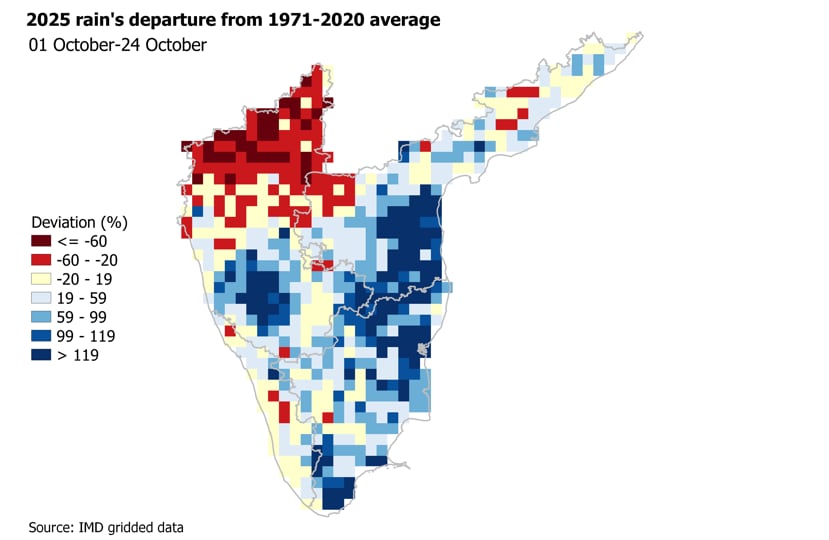
This surplus at the start of an important rainy season for peninsular India — which accounts for roughly 30% of the annual rainfall in the meteorological subdivisions of Tamil Nadu, Puducherry and Karaikal, Coastal Andhra Pradesh, Rayalaseema, Kerala and Mahe, and South Interior Karnataka — should not be taken as an indicator for the entire season. Despite the heavy rainfall over the past nine days, the western half of peninsular India has not seen a significant surplus in October overall. Moreover, the extended-range forecast issued by the IMD on October 23 shows that peninsular India is going to experience a weekly deficit starting October 30, with southern Tamil Nadu likely to see a deficit even in the week beginning October 23.
Weather Bee: Northeast monsoon hits early and hard; surplus may be short-livedWeather Bee: Northeast monsoon hits early and hard; surplus may be short-lived
However, the relatively dry forecast for the coming weeks only highlights the extreme start to the northeast monsoon season. The heavy rainfall occurred in a short span rather than being spread over several weeks. While this may quickly fill reservoirs, it poses risks to nearly every other aspect of human life.
Abhishek Jha is Assistant Editor-Data at Hindustan Times. He uses statistical programming to generate newsworthy insights from large datasets. He is part of the team that produces Number Theory, a daily data story feature of the paper’s print edition. Since March 2024, he has been writing Weather Bee, a weekly column for the Hindustan Times website. He is a chemical engineer by training, who specialises in stories related to weather, climate, and the environment.
Jha has been at HT since 2018, where he offers data-driven perspective and analysis on politics, environment, weather, climate, economy and society. His work includes data coverage of elections in India and abroad, including the 2019 and 2024 Lok Sabha elections; the disasters and extreme weather resulting from changing climate, such as floods, droughts, heat waves, cold waves, and dwindling snow cap in the Himalayas; the factors that drive poor air quality in northern India; the changing patterns of land use; the Covid-19 pandemic and its impact on labour market conditions; the changing pattern of consumer spending seen in the new consumer spending surveys; and social norms seen in the surveys such as the National Family Health Survey.Read More
Get the latest India News, breaking headlines and real-time updates from across the country. Stay informed about politics, government policies, crime, weather major national developments and Karnataka Bandh LIVE.
Home/India News/Weather Bee: Northeast Monsoon Hits Early, Hard; Dry Spell May Follow Next Month

 E-Paper