
 E-Paper



How Trump's 100% tariff on pharma imports could impact India. Explained
Donald Trump's pharma tariff threat could hit India’s $30 billion drug exports, unsettling the generics market that supplies 90% of US prescriptions.

 Prefer HTon Google


US President Donald Trump's decision to impose a 100 per cent tariff on branded and patented pharmaceutical imports from October 1 has put the spotlight on India’s pharmaceutical exports, a sector heavily reliant on the American market.
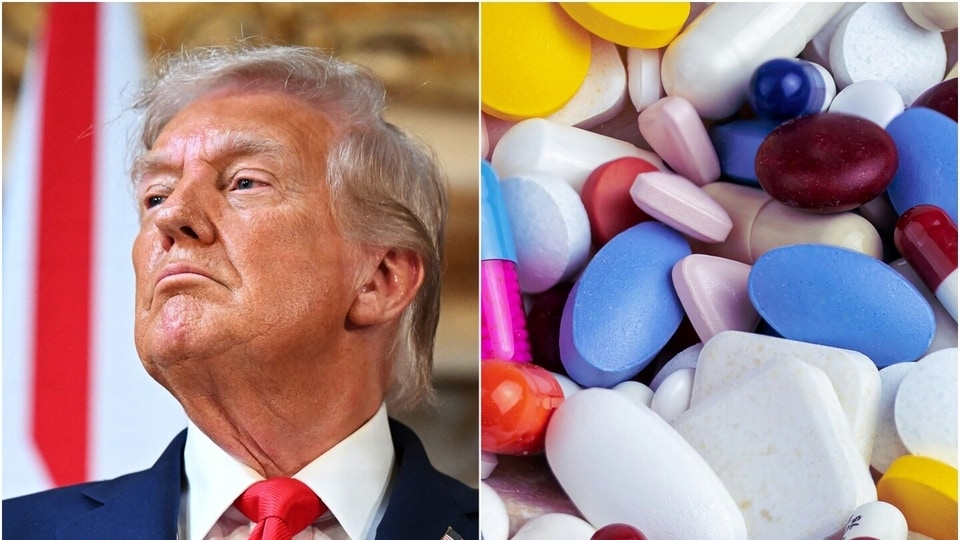
Trump declared that the new tariffs would apply unless companies are “building” pharmaceutical plants in the US -defined as “breaking ground” or being “under construction.”
In 2024, America imported nearly $233 billion in pharmaceutical and medicinal products, according to the Census Bureau. The prospect of prices doubling for some medicines could send shock waves to voters as health care expenses, as well as the costs of Medicare and Medicaid, potentially increase.
The pharmaceutical drug announcement was shocking as Trump has previously suggested that tariffs would be phased in over time so that companies had time to build factories and relocate production.
Why India may be hit
India is often dubbed the 'Pharmacy of the World'. It accounts for 20 per cent of global generic medicine supply, contributes 60 per cent of vaccines, and hosts the highest number of US FDA-approved plants outside America, according to industry body India Brand equity Foundation. Formulations and biologics make up nearly 79 per cent of India’s pharma exports.
In FY25 (April–December), India exported ₹1.87 lakh crore ($21.7 billion) worth of pharmaceutical products, with the US, UK, South Africa, the Netherlands, and France as top destinations.
India’s total global pharma exports stood at over $30 billion in 2024-25.
The US is India's single-biggest pharmaceutical market, accounting for 31 per cent of Indian pharma exports in 2024-25. India shipped $3.6 billion worth of drugs to the US in 2024 and another $3.7 billion in the first half of 2025 alone, according to the Pharmaceutical Export Promotion Council of India.
While Trump’s announcement explicitly targets patented drugs - a segment dominated by multinationals - concerns remain that complex generics and specialty medicines from India could also come under scrutiny.
Companies such as Dr Reddy’s, Sun Pharma, Lupin and Aurobindo built their fortunes on the US appetite for cost-effective generics - drugs that cover nine out of ten prescriptions but consume barely 1.2 per cent of the country’s healthcare budget.
With formulations and biologics making up 75 per cent of India’s pharma exports, any move to widen tariffs beyond patented drugs could place pressure not just on manufacturers but also on patients in the US who depend on low-cost Indian medicines.
Potential fallout
Indian drugmakers ahead of the announcement had warned that steep tariffs could disrupt supplies and worsen medicine shortages in the US, where Indian companies fill a crucial gap by supplying low-cost treatments for conditions like hypertension and pain management.
“If implemented, we will have no choice but to stop supplying drugs to the US. Patients there will suffer more than Indian manufacturers,” said a Himachal Pradesh-based pharma exporter told Hindustan Times in July.
An Andhra Pradesh manufacturer echoed the sentiment, saying, “Our drugs save the US system around $200 billion annually. If tariffs go through, they cannot replace our supply for at least 2–5 years. India will have to explore other markets.”
Industry representatives also warned that tariffs would drive the US to rely more heavily on China for life-saving medicines - a scenario some experts say could undermine Washington’s own national security objectives.
Some industry leaders, however, see opportunity in adversity. Rishad Dadachanji of the Dadachanji group told HT: “Tariffs would disrupt supply chains and hurt US consumers, but Indian pharma is resilient. Companies are already diversifying markets, investing in R&D, and exploring new partnerships. This could even accelerate India’s self-reliance in the sector.”


