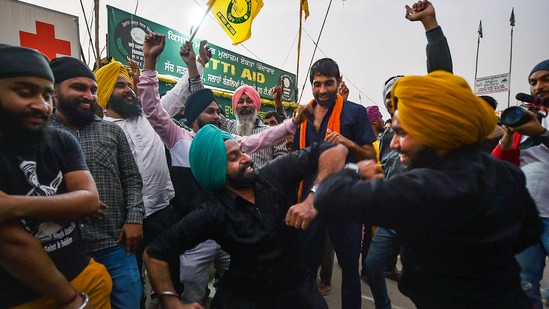
While announcing the repeal of the three farm laws on November 19, Prime Minister Narendra Modi said that while the laws were in the best interest of farmers, his government failed to convince a section of farmers about these benefits.
What explains this? Both the government and the Bharatiya Janata Party (BJP) spent significant political capital in advocating the benefits of these farm laws. Are farmers being irrational in refusing to see the benefits of these laws, or is there
Only if the “Bihar Model” of agricultural reforms had worked
The “Gujarat Model” of development was an important plank for the BJP in the 2014 general elections. Irrespective of its merits, Narendra Modi and his party were able to convince the electorate that the economic policies followed under Modi’s chief-ministership in Gujarat had the potential to boost India’s economic performance if adopted nationwide.
If the farm laws had to gain similar political traction, the government needed a similar model to sell. Bihar was a natural choice. One of the first things the Nitish Kumar-led National Democratic Alliance (NDA) government did in Bihar after assuming power in 2005 was to repeal the monopoly of Agricultural Produce Marketing Committees (APMCs) in the state, something which the farm laws did as well.
So, why did the government not sell the Bihar Model in support of the farm laws? The short answer is there are no discernible success stories to sell from the experience of agricultural reforms in Bihar.
“The aim of repealing the APMC Act in Bihar was to create new markets and attract private investment in agricultural markets and improve infrastructure. However, we find that private markets did not emerge... A priori, it is very hard to tell whether the repeal of APMC Act in Bihar is favourable for the farmer or not,” said an article published on the Ideas for India website by Avinash Kishore, a research fellow at the International Food Policy Research Institute and others.
While researchers have struggled to find evidence of the agricultural reforms in Bihar proving to be beneficial, farmers continue to remain unimpressed. This is borne out by data from the national sample surveys on satisfaction with prices received, where Bihar is one of the worst performers.
The pandemic’s shock might have revived economic stakes in farming
Counterfactuals are always difficult in politics. But there is a possibility that the decision to push for the farm laws during the pandemic actually worked against the government. Here’s why.
Agriculture has been losing its importance in the Indian economy, both in terms of output and employment. The share of agriculture and allied activities in gross value added was 35% in 1990-91. It fell continuously to reach 14.8% in 2019-20. But during the pandemic’s shock to the economy, agriculture was the only sector which showed positive growth in 2020-21, which increased this share to 16.4%. Data from the Periodic Labour Force Survey (PLFS) shows that the share of agricultural employment also increased during the lockdown. 2019-20 – the PLFS follows a July-June calendar so 2019-20 included the lockdown period – was an exception to this trend when agricultural employment actually increased from 42.5% in the 2018-19 PLFS to 45.6% in the 2019-20 PLFS.
The cushion which India’s largely informal migrant workforce received from agriculture during the lockdown might have made it realise the importance of pushing for a revival in farm earnings. The latest Situation Assessment of Agricultural Households and Land and Livestock Holdings of Households in Rural India (SAS) released by the National Statistical Office (NSO) shows that the share of income from crop production fell by 10 percentage points between 2012-13 and 2018-19 in India. The farmers’ protests were able to sell the belief that the farm laws would increase earnings for big business rather than farmers.
In recently published paper, Class, caste and agrarian change: the making of farmers’ protests, in the Journal of Peasant Studies, an international refereed journal, sociologist Satendra Kumar has linked the widespread support for the farmers’ protests among young Jat men in western Uttar Pradesh to the realisation that non-farm incomes have proved to be inadequate to supporting the lifestyle they aspire for in urban settings.
“The participation of young rural men like Jasvinder and Anil (field survey) also highlights a major shift in today’s farmers’ protests compared to the 1980s: instead of pointing to a classical rural urban divide (‘Bharat vs India’), attention and invective is now directed at the big corporates, who are perceived as threatening their land while failing to employ them in the city, and the BJP, which is seen as supporting corporate interests over farmers. By pushing corporate capital and big agribusiness, the farm laws passed in 2020 by the BJP government created fear among the farmers of losing land that remains essential to even diversified livelihoods,” the paper said.
It is this contradiction that suggests that the politics over the farm laws might be just the beginning of a widening conflict in India’s political economy landscape.