A recent exercise by the Indian government revealed a sharp increase in India’s length of coastline, which now stands at 11098.81 km, up from the earlier estimate of 7561.50 km. This rise is a result of a change of scale and in methodology since the last calculation of India’s coastline in 1970.
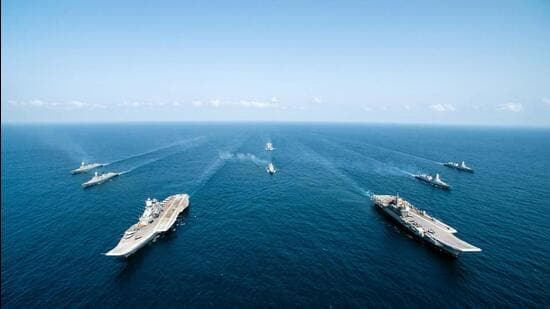
The sharp rise in the length of India’s coastline raises a vital question, emphasising the need for continued attention towards India’s maritime borders in context of framing national
A recent exercise by the Indian government revealed a sharp increase in India’s length of coastline, which now stands at 11098.81 km, up from the earlier estimate of 7561.50 km. This rise is a result of a change of scale and in methodology since the last calculation of India’s coastline in 1970.
The sharp rise in the length of India’s coastline raises a vital question, emphasising the need for continued attention towards India’s maritime borders in context of framing national security priorities.
While India’s national security thinking seems to be dominated by the threats stemming from its territorial borders, there is a need to prioritise its maritime boundaries. For this, it is essential to re-imagine India as a maritime nation. Towards this end, the revised length of India’s coastline serves as a critical reminder of how the multiple frontiers of India’s geography continue to remain interlinked.
A long history of territorial aggression from Pakistan and China has been greatly instrumental in shaping India’s security thinking. Apart from this, India’s security apparatus has had to grapple with the lingering problem of cross-border terrorism. The challenge of cross-border terrorism has again returned to the fore following the recent attacks in Pahalgam.
However, given the maritime character of India’s geography, a number of critical maritime security concerns ought to figure prominently in informing its national security thinking. Past experiences have demonstrated the criticality of the maritime frontiers in India’s national security preparedness. Arguably, the 2008 terrorist attacks in Mumbai have remained as a crucial reminder of how threats emerging from sea are deeply interlinked with territorial or homeland security.
Additionally, a number of non-traditional security challenges pose grave risks for overall national security thinking. These include risks induced from worsening climate change resulting in rising sea levels, natural calamities such as cyclones, Illegal, Unreported and Unregulated (IUU) fishing, transnational blue crimes such as piracy, maritime terrorism, human and drug trafficking, as well as smuggling of illegal weapons into the country.
Given these multifaceted challenges arising from the maritime frontiers, there is a critical need for India to strengthen its coastal security preparedness. A major fillip was accorded to India’s coastal security after 2008, when the coastal security service – the Indian Coast Guard – was co-opted into the Indian Navy, aimed at enhancing synchronisation and synergy among the various arms of India’s maritime services.
While this served to enhance broader operational synergy, it also signals a critical effort to look at the multiple frontiers of India’s geography in a continuum. Given that India’s maritime and territorial homeland security are directly interlinked, the two frontiers must not be seen as divorced from one another. As such, the two complement each other and require a serious, systematic, and a synergised strategy.
Arguably, the changing geopolitical order in the Indian Ocean has been a result of greater Chinese involvement in the region. China’s growing political influence among the Indian Ocean littoral states has mounted a nuanced challenge for India. However, increasingly China has sought to send its research vessels into the Indian Ocean region, prompting increasing insecurity in India of potential growth of Chinese naval presence in the region. Furthermore, the worsening maritime environment in the Indian Ocean serves to provide additional impetus for India to rethink the priority accorded to its maritime borders.
Interestingly, the revised length of India’s coastline has also thrown up a critical reality of the diminished difference of India’s territorial and maritime borders. According to estimates of home ministry, the length of India’s territorial borders stands at approximately, 15106.7 km. While earlier estimates of India’s maritime borders were almost half of its territorial borders, the revised length of 11098.81 km suggests that it is time to accord similar importance to its maritime frontier.
As India navigates an increasingly complex security environment, the evolving realities of the multifaceted nature of security challenges must inform India’s security thinking. Towards this end, India’s security thinking ought to remain immune from falling into the trap of ‘sea-blindness’ in formulating its national security strategy. The revision of the length of India’s coastline reveals the crucial reality of why maritime borders matter in its national security thinking.
Sayantan Haldar is a Research Assistant, Maritime Studies at Observer Research Foundation. (Twitter/X: @sayantan_h)
One Subscription.
Get 360° coverage—from daily headlines
to 100 year archives.
Archives
HT App & Website