The standing committee of the national board for wildlife will take a call on how to conserve disappearing grasslands in the country.
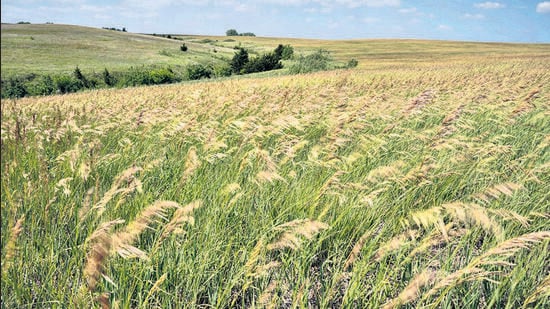
Not recorded or protected as forests, but supporting critical wildlife species, grasslands are on the brink, at least three standing committee members told the panel headed by Bhupender Yadav, union environment minister.
“The maximum number of threatened species such as Great Indian Bustard, Lesser Florican, Caracal etc. are found in grasslands. The grassland ecosystems are suffering most from habitat loss and degradation. It will be too late if there is no focus given to conservation of these ecosystems,” HS Singh, former principal chief conservator of forests (PCCF) and member of NBWL informed the panel on August 29, minutes of the meeting dated September 20 show.
Members said while there is an administrative framework for the conservation of habitats of larger faunal species like tigers, elephants, wetlands, corals, mangroves etc. both in the Ministry and also in the States, there is none for grasslands.
Member Secretary of NBWL, Bivash Pandav said that as per the Indian Grassland and Fodder Research Institute, Jhansi, a national institute under the control of Indian Council of Agricultural Research, over 100 million hectares of grasslands stand degraded.
“ Many natural grasslands have either degraded or lost due to agricultural expansions, overgrazing, large areas being converted to plantations / protected areas/ Industrial establishment,” he said.
{{/usCountry}}“ Many natural grasslands have either degraded or lost due to agricultural expansions, overgrazing, large areas being converted to plantations / protected areas/ Industrial establishment,” he said.
{{/usCountry}}The five ethnic grasslands which have existed in the country for centuries are Banni in Gujarat, Shola in the Western Ghats, the Thar desert in Rajasthan and Gujarat, the Terai, and Kangeyam in Tamil Nadu.
Indian Council of Forestry Research and Education (ICFRE), Dehradun has suggested a site-specific GIS plan depending upon the existing grasslands. Member Secretary, Pandav recommended that the Indian Forest Survey Report (IFSR) consider the inclusion of grasslands as a distinct and separate chapter in its biennial report.
“This would enable the generation of real-time data pertaining to these ecosystems, ensuring a more comprehensive and up-to-date assessment. To enhance our efforts in preserving and managing tropical grasslands, there is a proposal to establish a dedicated cell specifically tasked with the responsibility of overseeing and addressing matters related to these ecosystems,” he said.
Another member, Professor, R Sukumar from Indian Institute of Science said that grasslands have suffered significant damage due to extensive plantation activities apart from invasion by weeds, particularly in Western Ghats.
The standing committee decided that the environment ministry will organize a workshop on the conservation of grasslands and invite suggestions from experts. The report of the workshop shall then be placed before the standing committee.
The issue of conserving grasslands and other ecosystems is particularly significant because on August 4, the Centre notified the Forest Conservation Amendment Act 2023. One of the contentious provisions of the new law is that it exempts unrecorded deemed forests from the modified law on forest conservation.
Forest governance in India was majorly influenced by a Supreme Court judgement in 1996 in TN Godavarman vs Union of India, in which the court interpreted the meaning of forest as its dictionary definition, expanding the purview of the forest conservation law. The December 1996 judgement said forests will not only include forest as understood in the dictionary sense, but also any area recorded as forest in official records, irrespective of ownership. This brought hope to recognize ecologically rich land such as grasslands, so called wastelands, scrub forests etc that were not recorded as forests in government records but still needed to be protected because they were significant natural features.
But the FC Amendment Act states that it will recognise land that has been declared or notified as a forest in accordance with the provisions of the Indian Forest Act, 1927 or under any other law. It will also recognise land that is not recognised as forest under any law but has been recorded in Government records as forest, as on or after the October 25, 1980. The provisions of this clause shall not apply to land, which has been changed from forest use to use for non-forest purpose on or before December 12, 1996.
Grassland species are threatened by a range of issues including land use change and overhead powerlines. HT reported in March that a draft notification issued by the Central Electricity Authority on construction of electric lines in the habitat of the critically endangered Great Indian Bustard in Gujarat and Rajasthan has raised concerns because it could endanger the species, less than 100 of which remain.