The condescending statement issued by PLA's Western Theatre Command spokesperson after the unproductive 13th round of senior military commanders meeting on Sunday to de-escalate situation in East Ladakh is reflective of the overall Chinese belligerence towards its perceived adversaries with dragon breathing fire from Indo-Pacific to Ladakh.
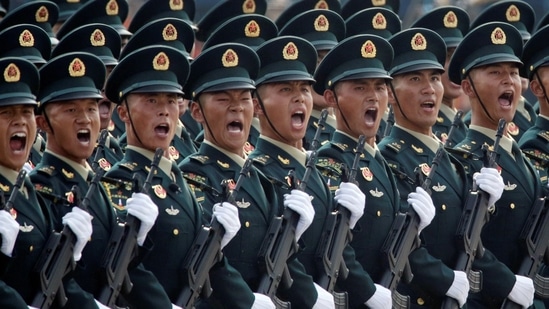
The PLA statement called Indian proposals for de-escalation as “unreasonable and unrealistic” and preached to Indian Army that they should be satisfied with what has been achieved till now without getting more militarily ambitious. Essentially, it means that the PLA is in no mood to normalise the situation along the 1597-km Ladakh LAC as it asks the Indian Army to honour the same bilateral border agreements that the Chinese army itself forgot by unilaterally executing the May 2020 transgressions in Galwan, Pangong Tso, Gogra and Hot Springs.
The PLA statement is in line with its Central Military Commission Chairman Xi Jinping’s aggressive statements to take over democratic Taiwan in the name of reunification. From Chinese national day on October 1 to Taiwan national day on October 10, the PLA air force tested Taipei’s beleaguered defence by flying more than 56 fighters and nuclear capable bombers on a single day to brow-beat the democratic tiny Island nation.
Although Chinese belligerence is often a combined function of its domestic and international situation, the unusual aggression from Beijing comes after AUKUS pact on September 15 which allows Australia to get nuclear submarines from US and UK, the Quad summit on September 24 and the high intensity naval exercises between Quad partners and between US-UK navies in the Indo-Pacific. Add to this the failing Chinese real estate giant and energy crisis, we get a very potent mixture. The PLA aggression on Ladakh in May 2020 also came after Beijing was hit globally for keeping the deadly coronavirus, which has origins in Wuhan, under wraps in cahoots with the WHO leadership. Two years after the pandemic broke in Wuhan, nearly five million have died and the world has lost trillions of dollars in economic disruption. This is without even counting the societal impact and mental trauma the world had to go through and is still going through without any accountability from China. Any country who so much as raises the accountability issue faces retaliation from Beijing.
{{/usCountry}}Although Chinese belligerence is often a combined function of its domestic and international situation, the unusual aggression from Beijing comes after AUKUS pact on September 15 which allows Australia to get nuclear submarines from US and UK, the Quad summit on September 24 and the high intensity naval exercises between Quad partners and between US-UK navies in the Indo-Pacific. Add to this the failing Chinese real estate giant and energy crisis, we get a very potent mixture. The PLA aggression on Ladakh in May 2020 also came after Beijing was hit globally for keeping the deadly coronavirus, which has origins in Wuhan, under wraps in cahoots with the WHO leadership. Two years after the pandemic broke in Wuhan, nearly five million have died and the world has lost trillions of dollars in economic disruption. This is without even counting the societal impact and mental trauma the world had to go through and is still going through without any accountability from China. Any country who so much as raises the accountability issue faces retaliation from Beijing.
{{/usCountry}}With US military power coming under question after Pakistani ISI backed Sunni terrorist force, the Taliban, militarily seized Kabul on August 15, the Chinese aggression now matches of an unbridled superpower who is not willing to yield an inch that it perceives its own. Beijing’s information warfare also matches its self-declared superpower status with political fires being lit in backyard of democracies opposing Chinese Communist Party’s belligerence through media and news aggregators. Combine this with the military psy-ops belted out routinely by Chinese propaganda media, the global perception of Beijing is several notches above than its actual capabilities.
Given that the Chinese cyber and automatic intelligence capabilities, even by recent admission of ex-Pentagon’s software specialist, exceed the US abilities, India must be prepared for more belligerence from Beijing as the latter will not let up in pressure. It is time that the Indian armed forces understood that the future wars will be won in cyberspace accompanied with stand-off weapons rather than intricate land maneuvers by tanks or infantry. The air wars will be fought with swam drones and armed unmanned platforms, which the PLA has in large numbers, rather than manned fighters which will be chased by Chinese acquired S-400 fired surface to air missiles. The sea will be ruled by nuclear submarines and unmanned sea drones mapping the oceans rather than goliath aircraft carriers which can be targeted by Chinese ballistic ship killer missiles. With US leading the way, India needs to garner its massive software talent to build up offensive and defensive cyber defence capabilities or the battle will be over even before it starts.
In fact, the Indian geographical situation is such that no country can avoid its relevance and salience when it comes to China or to Af-Pak terrorism. While it has deep strategic ties with US, India also has a very close relationship with Russia and France. It is a voice of credibility in Saudi Arabia and UAE, two of its closest allies in Middle East. It is India that can bridge the current gap between France and US over Australia preferring American nuclear submarines by cancelling the order of French built diesel attack platforms and cement over the division within democracies.
While Beijing prescribes an independent foreign policy (read anti-US) for India, it is the PLA which is pushing India towards a corner by its aggression and military infrastructure development along the 3488 km LAC. Even the so-called strategists talk about India staying away from US as the right path to pacify China. Quad, in fact, is the only counter to Chinese numero uno plans.