India has responded to Pakistan’s conditional offer to grant consular access to Kulbhushan Jadhav, underlining that it should be in an environment free of intimidation and reprisal. New Delhi’s response was conveyed to Islamabad Thursday.
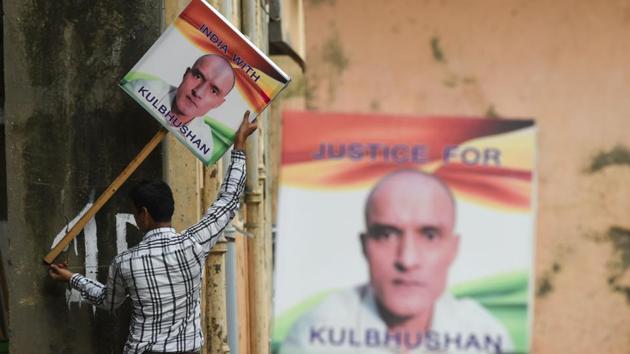
A response from the Pakistani side to the Indian response is awaited, sources said. The Pakistani side had proposed that consular access could be granted at 3 pm on Friday.
India had sought consular access to Jadhav after the International Court of Justice (ICJ) ruled on July 17 that Pakistan had violated his rights under the Vienna Convention on Consular Relations and sought a review of his death sentence.
The sources cited above said Pakistan’s offer of consular access with conditions attached was conveyed in a letter sent to India earlier this week. The offer had to be evaluated by officials of the external affairs ministry and legal experts in line with the ICJ’s judgment, which had said Jadhav should be granted consular access according to Article 36 of the Vienna Convention, they said.
“We have to make a considered decision after weighing all the pros and cons. We have to see whether this offer of consular access is acceptable with conditions attached,” said a person who declined to be identified.
{{/usCountry}}“We have to make a considered decision after weighing all the pros and cons. We have to see whether this offer of consular access is acceptable with conditions attached,” said a person who declined to be identified.
{{/usCountry}}Among the conditions reportedly being discussed by the two sides is whether Pakistani officials would be present when Jadhav is allowed to meet Indian officials, whether Jadhav would talk to the Indian officials from behind a glass partition, and the duration of the meeting.
Jadhav, a former Indian naval officer, was arrested by Pakistani authorities on March 3, 2016, in Balochistan on charges of espionage and involvement in subversive activities. India was informed about the arrest on March 25, 2016. Jadhav was sentenced to death in April 2017 after a secret trial by a military court.
Indian officials have described Jadhav’s trial as “farcical.”
Asked about the matter at a news briefing in New Delhi, external affairs ministry spokesperson Raveesh Kumar said: “I am not getting into the modalities of what is being discussed. I can only tell you that we have received a proposal from Pakistan, we are at this point of time evaluating the proposal in the light of the judgment of the ICJ. We will maintain communication with Pakistan in this matter through diplomatic channels.”
Article 36 of the Vienna Convention on Consular Relations lays down the rights of the sending state, in this case India, and the receiving state, which is Pakistan. It states consular officers “shall be free to communicate with nationals of the sending State and to have access to them” and also “have the right to visit a national of the sending State who is in prison, custody or detention, to converse and correspond with him and to arrange for his legal representation”.
However, the same article also states that these rights “shall be exercised in conformity with the laws and regulations of the receiving State”. After the ICJ gave its verdict on July 17, Pakistan had said it would proceed in the matter according to its own laws.