If springtime March felt like sizzling May, imagine what it would be like next month.
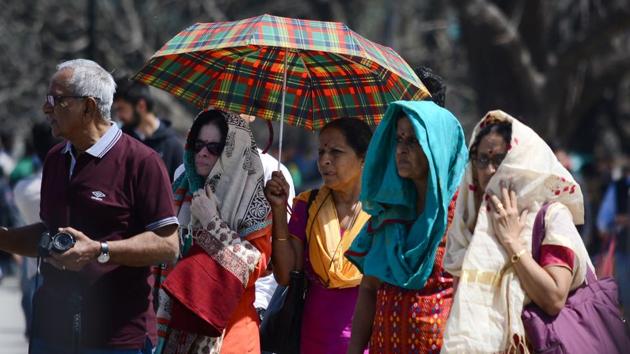
The India Meteorological Department’s (IMD) seasonal forecast shows the worst is yet to come, as vast swathes of the country are set to reel under scorching heat from April to June before the monsoon arrives.
The average and minimum temperatures in the Delhi-Haryana region could be at least 1.5-degree Celsius above normal in these three months. For the north-west and central India, the mercury is likely to hover over a degree Celsius above normal.
The weather outlook, done with an advanced model that gives a better resolution, says only the Himalayan regions of West Bengal and Sikkim might escape the summer scorcher.
The forecast is a reflection of the searing heat in most parts of India, including the national capital, since March. New Delhi endured its hottest March in seven years this season, and the mercury is refusing to relent.
The day temperature in New Delhi and Chennai rose to nearly 40 degrees Celsius, at least seven notches above the season’s average, on Monday.
Banda in Uttar Pradesh was the hottest, recording a maximum of 43.6 degree Celsius — followed by Madhya Pradesh’s Nowgong at 42.7, Bankura in West Bengal and Jaisalmer in Rajasthan at 42.6 and Jharkhand’s Daltonganj at 42.5.
{{/usCountry}}Banda in Uttar Pradesh was the hottest, recording a maximum of 43.6 degree Celsius — followed by Madhya Pradesh’s Nowgong at 42.7, Bankura in West Bengal and Jaisalmer in Rajasthan at 42.6 and Jharkhand’s Daltonganj at 42.5.
{{/usCountry}}There are fears that an emerging El Nino in the equatorial Pacific might interfere with the monsoon — the June-September rain that delivers 70% of India’s annual precipitation.
El Nino, a cyclical climate pattern, is linked to the warming of the Pacific water surface. A cooler Pacific means normal monsoon. Conversely, warmer oceans mean patchy rains. An El Nino-induced drought scorches crops and kills livestock.
The monsoon is critical for India’s farm-driven economy and its farmers, as nearly half of the country’s farmland lacks irrigation. The country received average monsoon rain last year, but the rainfall distribution was uneven, leaving parts of southern and western India parched. Back-to-back droughts have ravaged crops in Maharashtra.
The weather office is due to issue its monsoon forecast this month, but India could emerge unscathed from the El Nino weather pattern, said KJ Ramesh, the IMD director general.
But private forecaster Skymet last week predicted a poor monsoon this year.
(With agency inputs)