
 E-Paper



Xi secures record 3rd term in power, promotes allies
Xi Jinping was on Sunday appointed the general secretary of the ruling Communist Party of China (CPC) for a record-breaking third time, cementing his place as an unrivalled authority over the second largest economy of the world


Xi Jinping was on Sunday appointed the general secretary of the ruling Communist Party of China (CPC) for a record-breaking third time, cementing his place as an unrivalled authority over the second largest economy of the world.
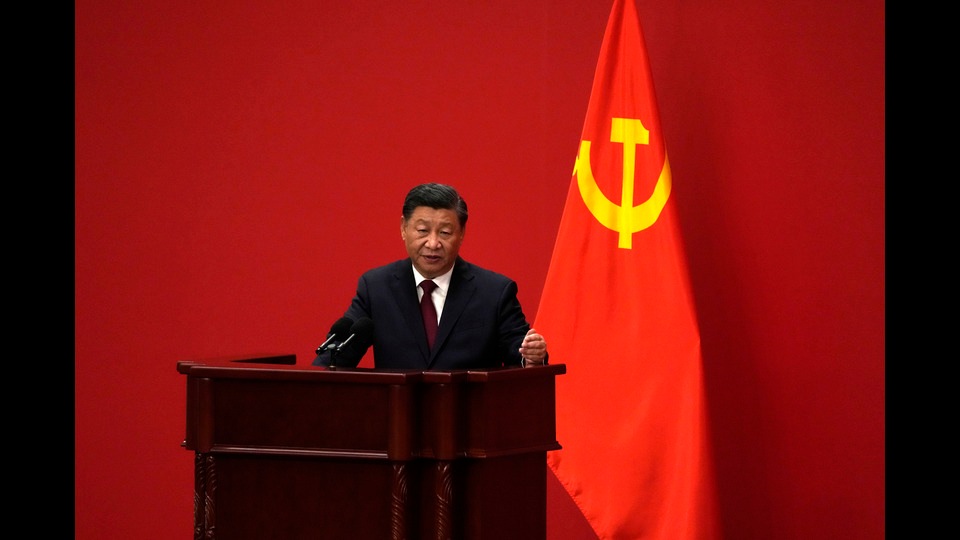
In his path to become China’s most powerful leader since Mao Zedong, the founder of modern China, Xi, 69, has brushed aside domestic headwinds headlined by a wobbling economy and growing frustration over the country’s “zero-Covid” policy, besides a global pushback against Beijing’s aggressive diplomacy under his decade-old rule.
Xi is now set for at least another five years’ term, with China watchers saying it’s possible for him to remain the country’s leader indefinitely, an observation bolstered by the fact that he did not anoint any successor like he didn’t during the 19th party national congress in 2017.
Xi packed his team of six new members of the CPC’s Politburo Standing Committee (SC), the highest decision-making body in China, with loyalists — Chinese politicians who are known to have close links with him.
Dressed in his customary black suit and red tie, the CPC general secretary presented his new team to domestic and foreign journalists at the grand Golden Hall of the Great Hall of the People at noon on Sunday.
The Shanghai CPC chief Li Qiang, 63, followed Xi onto the stage as the new Politburo SC was introduced, putting him in line to succeed Li Keqiang as premier when the latter retires in March 2023.
The other members of the seven-man SC are Zhao Leji and Wang Huning, who returned to the elite group from the previous committee; newcomers Beijing CPC chief Cai Qi and Ding Xuexiang, who is considered to be Xi’s close aide as the director of the President’s office; and Li Xi, the party secretary of the southern economic powerhouse province of Guangdong.
Ding, 60, is the youngest on the new panel.
The four new members of the SC have worked with Xi during his time in Chinese provinces, like Fujian or Zhejiang or, in the case of Ding, in his office, and the choice for the SC membership makes it clear that he is comfortable working with them.
Li Xi from Guangdong hasn’t directly worked with Xi, but is said to have close family ties and is also said to be close to him ideologically.
Though his name had been widely discussed, the inclusion of Shanghai party chief Li Qiang in the SC came as a surprise to many because of his handling of the Covid-19 outbreak in Shanghai, which recorded hundreds of thousands of cases and a bruising two-month lockdown earlier this year.
In the end, Li’s proximity to Xi appears to have clinched the powerful spot for him.
“It is hard for Xi to go further in terms of centralisation and power concentration. Security will continue to trump everything, including economic growth. So, this set of priorities clearly compels Xi to keep a high degree of control and centralisation,” said Jean-Pierre Cabestan, emeritus professor at the department of government and international studies, Hong Kong Baptist University.
According to Adam Ni, co-founder and publisher at China Neican, a Chinese current affairs website, for Xi, “control” is the operative word, and hence the centralisation of power.
“The economy is a major weakness, but under Xi economic growth is no longer the first priority, replaced by control,” Ni said.
Addressing journalists after unveiling the leadership, Xi emphasised the Party’s leadership in “a new journey to turn China into a modern socialist country”, a recurring theme in his speeches.
“We must make sure that our century-old Party, the biggest in the world, will become ever more vigorous through self-reform and continue to be the strong backbone that the Chinese people can lean on at all times,” Xi added.
Talking about challenges, Xi said: “The CPC will not be daunted by high winds, choppy waters or even dangerous storms, for the people will always have its back and give it confidence.”
The unveiling of the SC and the larger 24-member Politburo — reduced by one seat from the previous one — comes a day after the closing of the CPC’s 20th Congress during which amendments were added to the party charter, cementing the core status of Xi and the guiding role of his political thought within the party.
For the first time in 25 years, after five national congresses, not a single woman was named to the Politburo.
Given that the current member, Sun Chunlan, is retiring, the second-highest decision-making body in the country will not have a woman on it for the next five years.
Xi was also reappointed as the chairperson of the Central Military Commission (CMC) which oversees China’s vast military apparatus.
Expectations for the third term
On expectations of Xi’s third term, China watchers had one thing to say: expect more of the same. Xi’s next term will continue to see aggression in diplomacy abroad, and authoritarian decision-making at home.
“I think that Xi will be inclined to double-down on all his foreign policy decisions. The growing Cold War and decoupling with the US will contribute to intensifying these trends,” Cabestan said.
The clash of ideology and the fight for global influence between China and the US will intensify, agreed Neil Thomas, senior China analyst at the Eurasian Group, a geopolitical risk firm
“Xi is likely to keep leaning into his more assertive ‘Wolf Warrior’ diplomacy. He does not want war but he does want to deploy gray zone tactics to advance China’s interests in territorial disputes with neighbours such as India and Taiwan,” Thomas said.
Thomas added that Xi’s report to the party congress elevated the concept of Chinese-style modernisation, which suggests that he is determined to resist external pressure to steer the country on its own course.
“Xi indicated the need to uphold national honour and core interests while engaging in an international struggle for influence with the United States and its allies,” Thomas said.
“To be sure, he will need to deal with a slowing economy immediately after the Congress. For him the challenge is that slow economic growth is related to his zero Covid policy, which is a signature policy that is hard to abandon. He may continue it for a few more months until the growth impact becomes untenable,” said Victor Shih, associate professor at the school of global policy and strategy, UC San Diego, and an expert on Chinese elite politics.
“There are signs that Xi has an information deficit, especially in terms of Zero-Covid and the economy. Of the two, the latter is more worrying in the long term. The government’s hostility to market forces and free enterprise means the country has not had serious economic reforms in over a decade. It relies more and more on deficit spending to achieve growth. Without a fundamental change in economic policy, growth will continue to slow,” said senior fellow for China studies at the Council on Foreign Relations, Ian Johnson.
According to Cabestan, security of the regime will be at the top of Xi’s list of priorities in the next five years.
He will also have to “put back the economy on track and deliver a better growth rate, improve redistribution and welfare systems, especially the health insurance system,” Cabestan said.


