Climate activist Sonam Wangchuk will lead a symbolic 20-km march on September 23 to reiterate the demands for constitutional safeguards for Ladakh, a year after four people were killed in police firing during protests for the statehood and the region’s inclusion under the Constitution’s Sixth Schedule to preserve its tribal character.
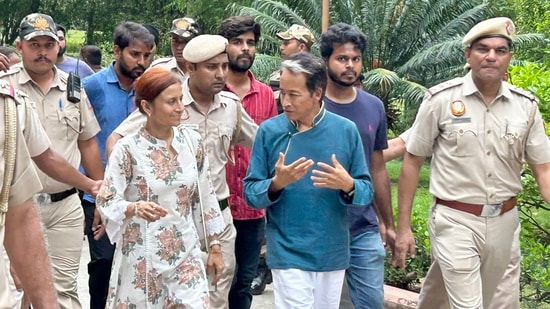
Activist Sonam Wangchuk, with his wife Gitanjali J Angmo, visits Rajghat to pay tributes to Mahatma Gandhi on July 27, 2026. (Raj K Raj/Hindustan Times)
{{^htLoading}} {{/htLoading}}
Wangchuk’s office said on Sunday that a “martyr’s day event” will follow the march the next day to mark the first anniversary of the civilian killings on September 24. Ladakh’s leaders have been demanding just compensation for the families of those killed and the withdrawal of related cases.
Wangchuk's fresh agitation threat
Last week, Wangchuk and other Ladakh leaders threatened a fresh agitation from September 19 to 24 after a meeting with Union home ministry officials in Delhi yielded no breakthrough. The agitation was called off citing weather conditions.
The Ladakh administration announced ₹15 lakh compensation each for the families of the four killed and ₹3 lakh for those injured. But Wangchuk said last week he was unhappy with the amount. “Looking at this compensation, I do not feel happy. Rather, my head is down with shame,” said Wangchuk, who spent six months in detention under the National Security Act (NSA) for allegedly inciting violence in Ladakh.
{{^htLoading}} {{/htLoading}}
{{^usCountry}}
Wangchuk, 59, was accused of misleading people by provocatively mentioning Arab Spring-style protests. The government revoked his detention in March with “immediate effect,” citing the need to facilitate “constructive and meaningful dialogue with all stakeholders.”
{{/usCountry}}
{{#usCountry}}
Wangchuk, 59, was accused of misleading people by provocatively mentioning Arab Spring-style protests. The government revoked his detention in March with “immediate effect,” citing the need to facilitate “constructive and meaningful dialogue with all stakeholders.”
{{/usCountry}}
His release came days before the Supreme Court was set to hear a habeas corpus petition over the activist’s incarceration under the 1980 law, which allows detention for up to 12 months without trial.
Wangchuk was detained on September 26, two days after the protests over demands for statehood for Ladakh turned violent. The Central Bureau of Investigation also launched a preliminary inquiry against an institute that Wangchuk founded.
Wangchuk's hunger strike
Wangchuk’s hunger strike and forcible removal from Delhi’s Jantar Mantar galvanised the Cockroach Janta Party (CJP) protest movement against paper leaks and exam irregularities, and forced the then Union education minister Dharmendra Pradhan to resign in July.
{{^htLoading}} {{/htLoading}}
Ladakh was carved out as a Union territory without a legislative assembly in August 2019, following the nullification of the Constitution’s Article 370, which ended Jammu and Kashmir’s semi-autonomous status. There have since been demands for statehood and constitutional safeguards. In 2023, the Union Home Ministry formed a committee under minister of state Nityanand Rai to protect the region’s culture, language, and strategic interests.
Separately, Ladakh lieutenant-governor VK Saxena approved a notification from the revenue department creating Ladakh Autonomous Hill Development Councils across all seven districts.
The Ladakh leaders, who have had four rounds of discussions with the Union home ministry, have expressed frustration over the government stalling the decisions. On September 10, they said in Delhi that the ministry is yet to present a draft proposal for constitutional safeguards and an elected governance model for Ladakh.
{{^htLoading}} {{/htLoading}}
The government has hinted that the draft should be ready by October.
Neeraj Chauhan is a senior journalist with Hindustan Times and an investigative reporter specialising in national security, terrorism, organised crime, narcotics, corruption, financial crime and complex investigations. With over 21 years of experience across Hindustan Times, The Times of India, The Indian Express and The Pioneer, he has built deep expertise in India’s internal security and law-enforcement landscape. Neeraj has extensively covered India’s principal investigative, intelligence and security agencies, including the NIA, CBI, ED, IB, R&AW, MHA and other central security forces. His work has included deeply reported investigations into terrorism, terror financing, cross-border crime, narcotics trafficking, cybercrime, financial fraud and political and corporate corruption. He has reported on some of the most significant terror attacks and security developments in India over the past two decades, including the Delhi serial blasts, the 26/11 Mumbai attacks, the 2019 Pulwama terror attack and the recent Pahalgam attack. His reporting has also chronicled the rise and decline of the Indian Mujahideen, the activities and subsequent crackdown on the Popular Front of India (PFI), Islamist extremist networks, the conflict in Jammu and Kashmir, insurgencies in the Northeast and Maoist violence. Some of Neeraj’s major breaking stories are in Aryan Khan drug case, Sushant Singh Rajput suicide, interception of a 3,000-kg Afghan heroin consignment worth about ₹21,000 crore at Mundra port, Sri Lanka easter bombings, Aarushi-Hemraj murders in Noida, 2G scam, coal block allocation scam, AgustWestland VVIP chopper deal and major bank frauds and extradition cases involving Mehul Choksi, Nirav Modi and Vijay Mallya. His reporting is marked by an ability to cultivate sources, analyse confidential and complex documents, and follow investigations over several years—from the initial breakthrough to chargesheets, trials and international legal proceedings. He specialises in making complicated security and investigative developments accessible while examining their wider implications for governance and public policy. A Chevening South Asia Journalism Programme Fellow at the University of Westminster, Neeraj also spent time at the Financial Times as part of the fellowship. He was also a Robert Bosch Media Ambassadors India-Germany Fellow, studying at the University of Tübingen and working with Der Tagesspiegel in Berlin. He has previously taught investigative journalism and crime reporting as a guest faculty member at the Times School of Journalism. Over more than two decades, Neeraj has established himself as an authoritative voice on India’s national security and investigative landscape, with his reporting closely followed by officials, investigators, lawyers, policymakers and readers seeking insight into some of the country’s most complex and consequential developments.
Get the latest India News, breaking headlines and real-time updates from across the country. Stay informed about politics, government policies, crime, weather major national developments and Karnataka Bandh LIVE.
Get the latest India News, breaking headlines and real-time updates from across the country. Stay informed about politics, government policies, crime, weather major national developments and Karnataka Bandh LIVE.
Home/India News/Year after violent statehood protests in Ladakh, Sonam Wangchuk to lead 20-km march on Sep 23
{{^htLoading}}
Advertisement
{{/htLoading}}
SHARE THIS ARTICLE ON
{{#usCountry}}{{/usCountry}}
Notifications
Get breaking alerts directly from the newsroom
Notifications are on!You'll be notified when news breaks